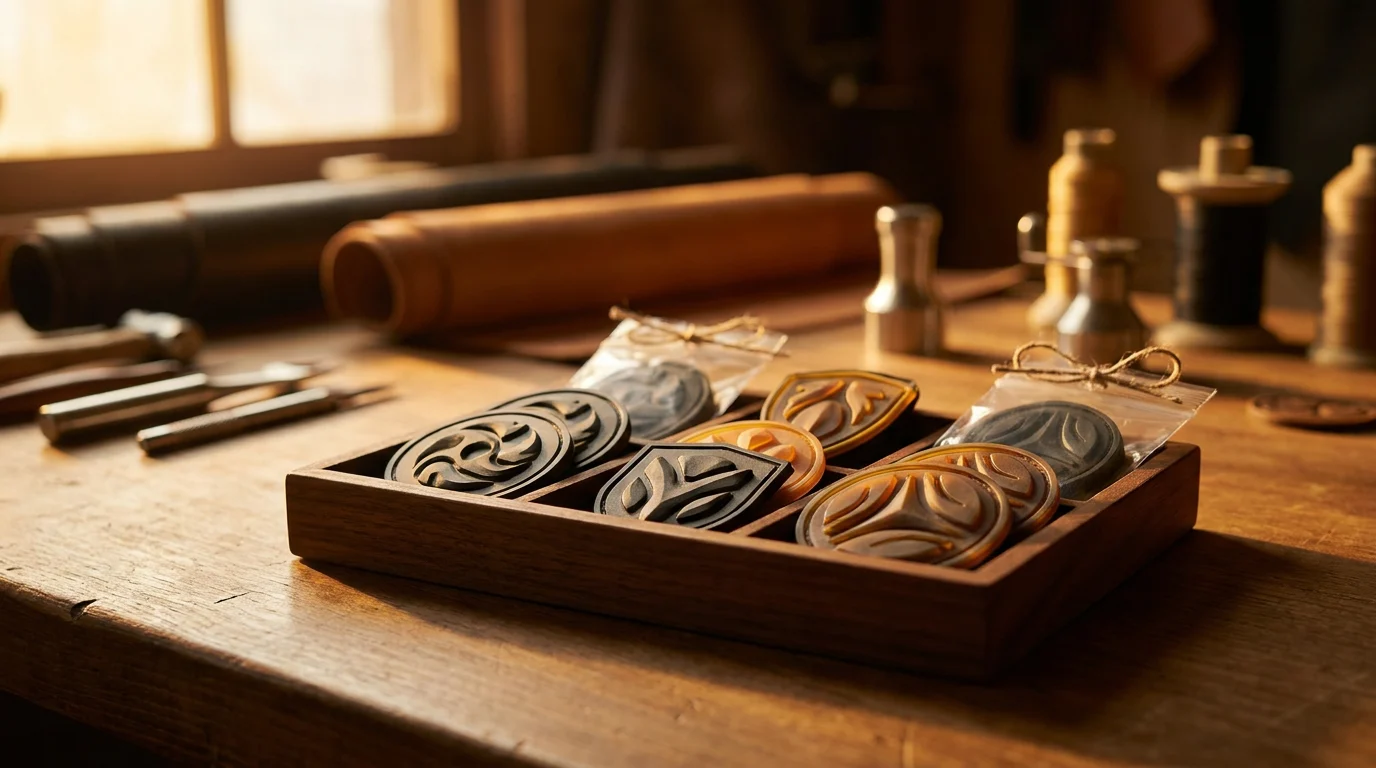
Sculpted relief · 3.5mm · Pantone matched
3D PVC Patches — Sculpted Rubber Patches Made to Your Artwork
3D PVC patches are moulded rubber badges poured against a sculpted metal die, so the design rises to different heights across the surface at a finished thickness of around 3.5mm. Customers supply artwork, approve a digital proof, and receive a bespoke 3D patch with velcro, sew-on or adhesive backing. A 3D PVC patch adds sculpted depth where a 2D patch would sit flat, which is why UK military units, airsoft teams, streetwear labels and sports clubs choose 3D relief for faces, animals and detailed crests.

Featured Client
Material: plasticised polyvinyl chloride (PVC) · Relief: sculpted, multi-height · Average thickness: 3.5mm · Minimum text height: 6mm · Colour: Pantone (PMS) matched, full-depth pigment · Backing: hook-and-loop, sew-on, 3M adhesive, plain (not iron-on) · Minimum order: none · Standard production: 10–14 working days from proof approval · Made in: United Kingdom
Definition
What Are 3D PVC Patches?
3D PVC patches are flexible rubber emblems moulded from liquid polyvinyl chloride inside a sculpted metal die. The die contours the surface so elements rise to several heights and taper at the edges, which builds depth into the design rather than layering it flat. A 3D PVC patch reproduces a logo, crest or character as raised, rounded relief that catches light from more than one angle.
Rubber patches carry several trade names across the UK market. Suppliers list the sculpted format as 3D PVC patches, 3D rubber patches, moulded morale patches or dimensional patches. The material stays the same in each case: soft, plasticised PVC with pigment sealed inside the polymer.

How 3D Relief Is Created
Mould depth creates 3D relief. A 2D patch uses a shallow cavity that finishes flat on top, while a 3D patch uses a deep, multi-level cavity that sculpts the surface into rounded contours. Engineers cut those height levels into the mould before any PVC is poured, so the relief is fixed at the tooling stage. Deeper cavities hold more material, which is the reason a 3D patch measures thicker than a 2D patch of the same footprint.
3D PVC Patch Specifications
| Attribute | Value |
|---|---|
| Material | Plasticised polyvinyl chloride (PVC) |
| Relief | 3D sculpted, multi-height |
| Average thickness | 3.5mm |
| Mould depth | Deep, multi-level |
| Minimum text height | 6mm |
| Size range | 25mm – 200mm |
| Shape | Round, square, shield, or custom die-cut |
| Colour system | Pantone (PMS) matched |
| Backing | Hook-and-loop, sew-on, 3M adhesive, or plain |
| Edge finish | Die-cut, non-fraying |
| Minimum order | No minimum |
Production · Four stages
How 3D PVC Patches Are Made
3D PVC patch production follows four stages. Every stage happens before the patch reaches the customer, and the sculpted mould is the stage that makes the patch three-dimensional.

1. Artwork and Digital Proof
Artwork arrives as a vector file, a photograph or a hand-drawn sketch. The design team converts the file into a production-ready layout and marks the Pantone reference for each colour. Customers receive a digital proof and approve it before any tooling begins. Approval locks the design, because the next stage cuts that design into metal.
2. Sculpted Multi-Level Mould Engraving
Engineers engrave the approved design into a metal mould at several depths. A 3D patch needs a deep, sculpted cavity that steps and rounds across multiple height levels, unlike the shallow single-plane cavity a 2D patch uses. One mould serves the whole production run and every reorder of the same design, so the sculpted relief stays identical from the first patch to the last.
3. Layered PVC Pouring and Curing
Operators pour liquid PVC into the mould one colour at a time. Each colour occupies its own recess, which produces clean separation without outlines or bleed. The filled mould then cures under heat until the polymer sets into solid rubber. Curing fixes the sculpted relief permanently, so raised areas hold their contour for the life of the patch.
4. Trimming, Backing and Inspection
Technicians release the cured patch, trim the die-cut edge and apply the chosen backing. Quality control checks every batch against the approved proof for colour accuracy, dimensions and surface finish. Patches that fail inspection are remoulded rather than shipped.

Side-by-side
3D PVC Patches vs 2D PVC Patches
3D PVC patches and 2D PVC patches differ in one property: mould depth. A 2D patch finishes flat on top, while a 3D patch sculpts the surface into rounded, multi-height relief. That single difference changes thickness, minimum text size, cost and the artwork each format suits.
| Attribute | 3D PVC Patch | 2D PVC Patch |
|---|---|---|
| Surface | Rounded, sculpted relief | Flat-topped layers |
| Average thickness | 3.5mm | 2.5mm |
| Mould depth | Deep, multi-level | Shallow |
| Minimum text height | 6mm | 5mm |
| Best for | Faces, animals, detailed crests, emblems | Text, flat logos, line art |
| Relative cost | Higher | Lower |
Choose 3D relief when the artwork benefits from dimensional modelling, such as a face, an animal or a layered crest. Choose 2D PVC patches when the design is text, a flat logo or line art, because a shallower mould reproduces those cleanly at a lower cost. Both formats share the same waterproof, colour-fast, non-fraying material — only the surface geometry changes.
Seven measurable attributes
Benefits of 3D PVC Patches
3D PVC patches combine sculpted depth with the durability of moulded rubber. The format outperforms flat construction on presence and matches PVC’s material strengths across seven measurable attributes:
- Dimensional detail — sculpted relief models faces, animals and layered emblems that flat layers cannot reproduce.
- Reads at distance — multi-height relief catches light from several angles, so the design stays legible across a room or on a jacket back.
- Waterproof — solid polyvinyl chloride absorbs no moisture, so rain and immersion leave no mark.
- Colour-fast — Pantone pigment runs through the full depth of the material, so the patch does not fade, peel or crack.
- Non-fraying — die-cut edges seal during moulding, so no border unravels.
- Machine washable — the patch withstands repeated laundering at 40°C.
- Premium tactile finish — a raised rubber face reads as high-value on caps, jackets and retail merchandise.
Sculpted depth turns a badge into a focal point. Where a printed transfer flattens under sunlight and a stitched thread frays with abrasion, a 3D PVC patch keeps its contour and colour for the working life of the garment it sits on.

UK sectors
Where 3D PVC Patches Are Used in the UK
3D PVC patches appear wherever a badge needs presence as well as durability. Application drives specification: size, relief height and backing change with the environment the patch works in.

Military, Cadet and Airsoft Morale Patches
British forces personnel, cadet detachments and airsoft teams mount 3D PVC morale patches on plate carriers, smocks and bergens. Hook-and-loop backing suits this sector because operational roles change between deployments, and sculpted relief gives an emblem physical presence on subdued kit. Subdued colourways and glow-in-the-dark variants are standard requests, and BFPO delivery is accepted for serving personnel. See military and cadet PVC patches and airsoft and morale patches for sector detail.
Streetwear, Caps and Headwear
Streetwear labels and headwear brands fit 3D PVC patches to trucker caps, beanies and hoodies. Raised rubber relief gives a tactile front panel that reads as premium at retail, and 3D construction holds fine detail at small sizes between 40mm and 70mm better than embroidery. Learn how these brands specify their badges on the streetwear PVC patches and hat and cap patches pages.
Clubs, Crests and Emblems
Sports clubs, motorcycle clubs and university societies order sculpted 3D crests for jackets, kit bags and vests. A custom die-cut outline follows the crest shape exactly, and moulded relief avoids the bulky stitched border of an embroidered patch. Explore club applications on the sports club patches page.
Artwork rules
Designing a 3D PVC Patch
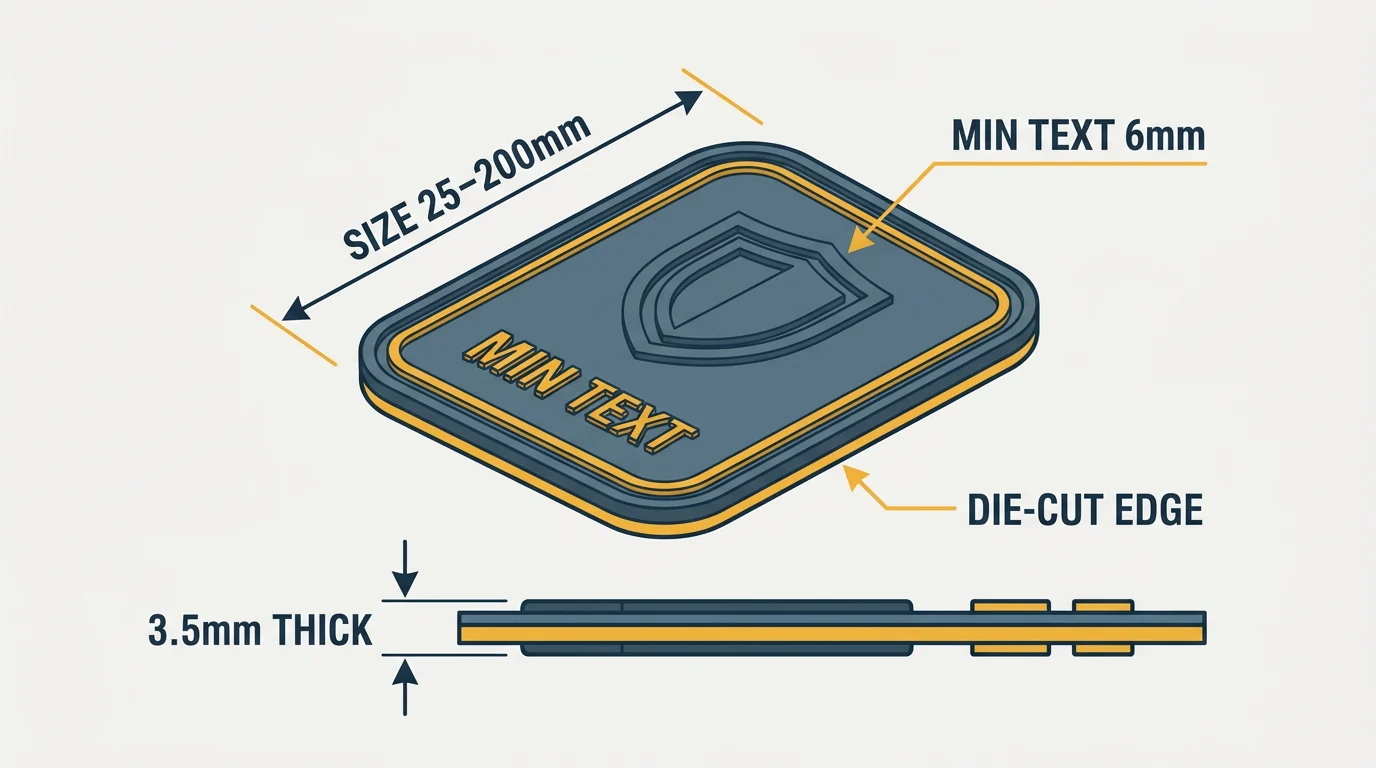
A 3D PVC patch design succeeds when the artwork gives the sculpted relief room to breathe. Three design factors set the outcome: text size, patch size and backing.
Minimum Text and Detail Size
Minimum text height on a 3D PVC patch is 6mm. Sculpted relief needs slightly more height than the 5mm minimum on a 2D patch, because rounded contours occupy space that flat layers do not. Fine detail below this threshold loses definition once the surface is modelled, so the design team flags any element at risk during proofing. See the minimum text size guide for full artwork thresholds.
Sizes and Custom Shapes
3D PVC patches are produced between 25mm and 200mm across the longest edge, and size is measured as the average of width and height. Standard shapes include round, square, shield and oval, while custom die-cut shapes follow the outline of your artwork at no additional tooling cost. Review the full range on the sizes and shapes page.
Backing Options
3D PVC patches accept four backing types: hook-and-loop, sew-on, 3M adhesive and plain. Hook-and-loop backing makes the patch removable for tactical kit, sew-on backing gives the strongest permanent bond for workwear, and 3M adhesive suits hard surfaces such as helmets and cases. PVC patches are not supplied iron-on, because polyvinyl chloride softens above 120°C and a domestic iron reaches 180°C, which deforms the moulded relief. Compare all options on the hook-and-loop backing page.
Enquiry to delivery
How to Order 3D PVC Patches
Ordering a 3D PVC patch follows five steps from enquiry to delivery.
- Send your artwork — upload a vector file, JPEG or sketch with your target size and quantity.
- Receive a quotation — pricing covers sculpted moulding, production, backing and UK delivery, quoted in pounds sterling with VAT stated.
- Approve the digital proof — check colours against Pantone references and confirm the relief and dimensions.
- Production begins — sculpted mould engraving, layered pouring, curing and backing application.
- Delivery — tracked despatch to a UK address, including BFPO.

There is no minimum order for 3D PVC patches, so you order exactly the quantity you need. Standard production takes 10 to 14 working days from proof approval, and express production takes 5 to 7 working days. UK mainland delivery adds 1 to 2 working days on top of production. A 3D mould is deeper than a 2D mould and uses more PVC, so a 3D patch costs slightly more than a 2D patch at the same size; reorders of an approved design cost less, because the sculpted mould is retained and needs no re-engraving. See current PVC patch pricing and turnaround and delivery for detail.
In their words
Stories About Us and Our Customers
PVC patches end up on kit that works for a living. These are the orders behind them, the brief, the mould, and what the patch had to survive.
Tactical · Hook-and-loop
“The patches arrived clean, sharp and ready to go straight onto our kit bags.”
The hook-and-loop backing made it easy for the team to swap patches between packs, jackets and plate carriers without losing the raised detail in the badge.
Sarah Mitchell · Manchester
Workwear · Sew-on
“The PVC badges made our workwear look much more professional than printed logos.”
The sew-on finish gave the uniforms a permanent patch that could handle daily wear, wet weather and repeated cleaning.
James Carter · Birmingham
Streetwear · 3D relief
“The 3D finish gave our caps the premium detail we wanted.”
The raised rubber face helped the logo stand out on the front panel while keeping the colours consistent across the run.
Amelia Thompson · London
Outdoor · Waterproof
“The patches held up well on wet kit and still looked fresh after a muddy weekend.”
Waterproof PVC was chosen for bags and jackets where stitched thread would have absorbed moisture and frayed at the edge.
Oliver Hughes · Bristol
Club · Custom shape
“Our badge shape was unusual, but the final patch followed it neatly.”
The custom die-cut outline kept the club crest recognisable while the moulded edge avoided the bulky border of an embroidered patch.
Priya Shah · Leeds
Security · Velcro
“Being able to remove and replace patches between shifts has been really useful.”
Hook-and-loop backing was selected for staff jackets so roles and identifiers could be changed quickly without replacing garments.
Daniel Evans · Cardiff
Merchandise · Colour match
“The colours matched our brand better than the woven sample we tried before.”
Pantone-matched PVC helped keep the logo consistent for merchandise, reorder stock and event giveaways.
Hannah Wilson · Nottingham
Motorcycle · Jacket patch
“The rubber patch gave the jacket a cleaner, tougher finish.”
The club needed a weather-resistant badge that could handle rain, road grime and regular outdoor use.
Mark Robinson · Newcastle
Sports · Team kit
“The patch worked well on kit bags and training jackets.”
A flexible PVC build kept the team crest visible without adding a heavy stitched border to lightweight gear.
Rebecca Green · Sheffield
Repeat order · Reorder
“Reordering was simple because the mould was already set up.”
The second run kept the same dimensions, relief and colour references as the original patch order.
Thomas Baker · Glasgow
Tactical · Hook-and-loop
“The patches arrived clean, sharp and ready to go straight onto our kit bags.”
The hook-and-loop backing made it easy for the team to swap patches between packs, jackets and plate carriers without losing the raised detail in the badge.
Sarah Mitchell · Manchester
Workwear · Sew-on
“The PVC badges made our workwear look much more professional than printed logos.”
The sew-on finish gave the uniforms a permanent patch that could handle daily wear, wet weather and repeated cleaning.
James Carter · Birmingham
Streetwear · 3D relief
“The 3D finish gave our caps the premium detail we wanted.”
The raised rubber face helped the logo stand out on the front panel while keeping the colours consistent across the run.
Amelia Thompson · London
Outdoor · Waterproof
“The patches held up well on wet kit and still looked fresh after a muddy weekend.”
Waterproof PVC was chosen for bags and jackets where stitched thread would have absorbed moisture and frayed at the edge.
Oliver Hughes · Bristol
Club · Custom shape
“Our badge shape was unusual, but the final patch followed it neatly.”
The custom die-cut outline kept the club crest recognisable while the moulded edge avoided the bulky border of an embroidered patch.
Priya Shah · Leeds
Security · Velcro
“Being able to remove and replace patches between shifts has been really useful.”
Hook-and-loop backing was selected for staff jackets so roles and identifiers could be changed quickly without replacing garments.
Daniel Evans · Cardiff
Merchandise · Colour match
“The colours matched our brand better than the woven sample we tried before.”
Pantone-matched PVC helped keep the logo consistent for merchandise, reorder stock and event giveaways.
Hannah Wilson · Nottingham
Motorcycle · Jacket patch
“The rubber patch gave the jacket a cleaner, tougher finish.”
The club needed a weather-resistant badge that could handle rain, road grime and regular outdoor use.
Mark Robinson · Newcastle
Sports · Team kit
“The patch worked well on kit bags and training jackets.”
A flexible PVC build kept the team crest visible without adding a heavy stitched border to lightweight gear.
Rebecca Green · Sheffield
Repeat order · Reorder
“Reordering was simple because the mould was already set up.”
The second run kept the same dimensions, relief and colour references as the original patch order.
Thomas Baker · Glasgow
Answers
3D PVC Patches — Frequently Asked Questions
Are 3D PVC patches thicker than 2D patches?
YES
Yes. 3D PVC patches average 3.5mm against 2.5mm for 2D patches, because the sculpted mould is deeper and holds more PVC.
Are 3D PVC patches more expensive than 2D patches?
YES
Yes. 3D moulds are deeper and use more material, so a 3D patch costs slightly more than a 2D patch of the same size.
Can 3D PVC patches be ironed on?
NO
No. PVC softens above 120°C and a domestic iron reaches 180°C, which deforms the sculpted relief; choose sew-on backing for a permanent bond on fabric.
What is the minimum text size on a 3D PVC patch?
6MM
6mm. Sculpted relief needs slightly more height than a 2D patch to keep text crisp once the surface is modelled.
Are 3D PVC patches waterproof?
YES
Yes. Solid polyvinyl chloride absorbs no water, and the die-cut edge carries no stitching to fray or wick moisture.
Is there a minimum order for 3D PVC patches?
NO
No. You order exactly the quantity you need, whether that is a small batch or a larger production run.
Sculpted relief · UK orders
Order 3D PVC Patches from a UK Manufacturer
Sculpted relief is what separates a 3D PVC patch from every flatter alternative. Modelling the surface into rounded, multi-height contours gives a face, an animal or a layered crest the depth that stitching and printing cannot hold, while the plasticised polyvinyl chloride underneath keeps the badge waterproof, colour-fast and non-fraying through sunlight, rain and repeated washing. Working with a UK manufacturer shortens the loop between artwork, digital proof and tracked delivery, keeps pricing in sterling with VAT stated plainly, and retains your sculpted mould for fast, identical reorders. Send your design for a quotation and receive a digital proof before anything is cut.