Headwear · 3D Rubber Cap Badges
Custom Hat PVC Patches — 3D Rubber Cap Badges Made in the UK
Custom hat PVC patches are moulded rubber badges produced at 40mm to 70mm for cap front panels. Headwear brands, clubs and businesses add PVC patches to caps because moulded rubber holds fine detail that stitched thread loses at small scale. Each patch reproduces a logo or crest in 2D or 3D relief, matches a Pantone reference through the full depth of the material, and attaches to headwear by sew-on or hook-and-loop backing.

Featured Client
Definition
What Are Custom Hat PVC Patches?
Custom hat PVC patches are flexible rubber emblems moulded from polyvinyl chloride and fitted to headwear. Each patch carries a brand logo, club crest or unit badge as raised relief rather than stitched thread. PVC hat patches attach to cap front panels, beanie cuffs and bucket-hat panels, and they replace embroidery wherever detail, weather resistance and a premium tactile finish matter more than traditional texture.
Rubber cap patches solve a problem that stitched badges cannot. Embroidered cap patches lose crisp edges once a design shrinks to the size of a cap front, because thread has a minimum practical width. A moulded PVC patch reproduces the same artwork in solid rubber, so fine lines, small type and gradients survive at 40mm. The pigment sits inside the material rather than on the surface, which is why a hat PVC patch stays colour-fast through rain, sunlight and repeated wear.
Headwear compatibility
Which Hats and Caps Suit PVC Patches?
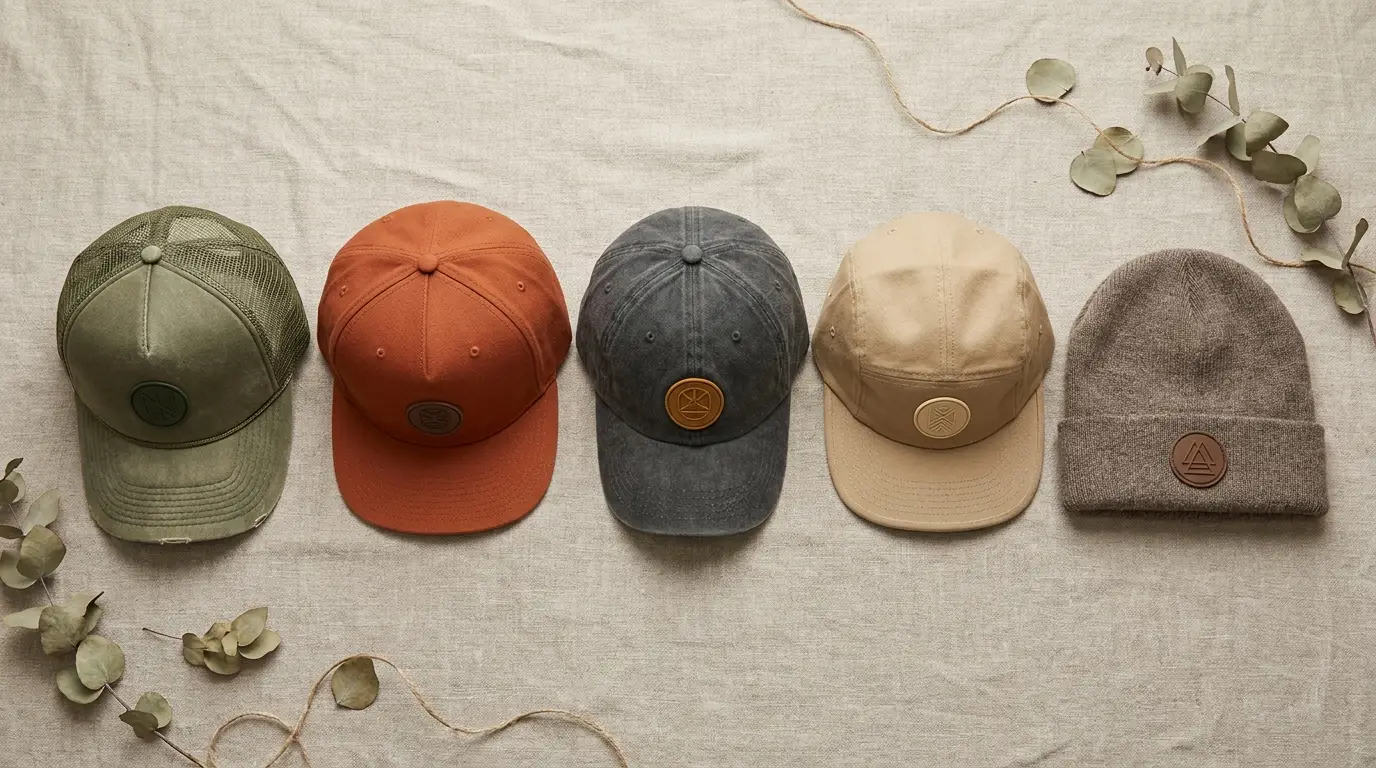
PVC patches suit most headwear styles, and the front panel geometry decides how large the patch can be. Flat, structured panels give the cleanest mounting surface, while curved or unstructured crowns call for a smaller footprint. The list below maps each style to its best patch placement.
- Structured front panels — trucker caps, snapbacks and 5-panel caps offer a flat, rigid area that holds a raised patch without distortion.
- Unstructured crowns — dad caps and baseball caps curve gently, so a compact patch follows the panel and stays flush.
- Knitted and soft headwear — beanies and bucket hats take a smaller patch on the cuff, front panel or side.
Trucker and Snapback Caps
Trucker caps and snapbacks carry PVC patches better than any other style. Both feature a stiff foam or buckram front panel that stays flat under a raised badge. The rigid surface prevents the panel from puckering around the patch edge, so the finished cap reads as a clean retail product. Streetwear labels and headwear brands choose trucker caps for exactly this reason.
Dad Caps and 5-Panel Caps
Dad caps and 5-panel caps present two different mounting surfaces. A 5-panel cap has a flat front seam that suits a centred rectangular or shield patch. A dad cap has a softer, slightly curved crown, so a smaller die-cut patch between 40mm and 55mm sits flush without lifting at the corners. Both styles keep the patch light, which protects the relaxed shape these caps are known for.
Beanies and Bucket Hats
Beanies and bucket hats extend PVC patches beyond peaked caps. A beanie takes a compact patch on the folded cuff, where the double layer of fabric supports a sewn edge. A bucket hat offers a larger front or side panel, so a die-cut PVC patch up to 80mm reproduces bigger artwork. Flexible plasticised PVC bends with the soft crown and returns to shape, so neither style cracks the badge in wear.

Relief choice
2D vs 3D PVC Patches for Caps
3D PVC patches are the default choice for headwear. A 3D patch is poured against a sculpted mould that contours the surface into rounded relief, so elements rise to different heights and catch light across the design. At the compact scale of a cap front, this dimensional modelling reads as premium and holds detail that flat construction cannot. A 3D hat patch finishes at 3.5mm thick with a 6mm minimum text height.
2D PVC patches remain the right choice for flat logos and clean typography. A 2D patch is built from flat-topped layers on a single plane, which suits wordmarks, geometric shapes and line artwork. A 2D hat patch finishes at 2.5mm thick with a 5mm minimum text height, and a shallower mould uses less material, so 2D construction costs less than 3D at the same size.
Attachment
Backing Options for Hat PVC Patches
Backing determines how a PVC patch attaches to a cap, and headwear uses two backings in practice. Sew-on backing fixes the patch permanently, and hook-and-loop backing makes the patch removable. Backing is applied after curing, so the choice never affects the moulded face of the badge.

Sew-On Backing
Sew-on backing is the permanent standard for caps. A sew-on PVC patch carries a stitch channel around the border, and a tailor attaches it to the cap front panel by machine or by hand. The resulting bond survives daily wear and repeated cleaning, which is why brands, sports clubs and workwear suppliers specify sew-on backing for headwear that stays in service. Sew-on backing produces the strongest attachment of any option.
Hook-and-Loop (Velcro) Backing for Tactical Caps
Hook-and-loop backing suits tactical and outdoor caps fitted with a loop panel. A velcro PVC patch fastens to the loop field and lifts off without tools, so wearers swap emblems between caps, jackets and packs. Cadet units, airsoft players and security teams choose hook-and-loop backing because operational roles change and one cap then carries several identifiers.
Why Hat PVC Patches Are Not Iron-On
PVC patches are not supplied iron-on. Polyvinyl chloride softens above 120°C, and a domestic iron reaches 180°C on a cotton setting, so ironing deforms the relief and destroys the design. Adhesive backing is designed for hard surfaces rather than fabric, so it is not used on caps. Customers who need a permanent bond on headwear select sew-on backing instead.
Dimensions & placement
Size and Placement for Cap PVC Patches
Cap PVC patches measure 40mm to 70mm across the longest edge on a standard front panel. Size is measured as the average of width and height, which is the convention UK suppliers quote against. This compact range keeps the patch proportional to the panel and preserves the shape of the cap. The full production range runs from 25mm to 200mm, so bucket hats and back panels take larger die-cut shapes when the design calls for them.
Placement follows the panel that suits each style. A centred front-panel patch works on trucker caps, snapbacks and 5-panel caps. A cuff patch works on beanies. A side or front panel works on bucket hats. Custom die-cut shapes follow the outline of your artwork at no additional tooling cost, because the mould is cut to your design regardless of profile.


Material comparison
Custom Hat PVC Patches vs Embroidered Cap Patches
PVC hat patches and embroidered cap patches differ in material, detail capacity and weather performance. PVC wins at small scale and in wet conditions, while embroidery keeps the traditional finish expected on club and uniform caps. The table compares both formats across the attributes that matter on headwear.
| Attribute | Hat PVC Patch | Embroidered Cap Patch |
|---|---|---|
| Material | Polyvinyl chloride (rubber) | Polyester thread on twill |
| Detail at 40–70mm | High — moulded relief | Low to medium |
| Thickness | 2.5–3.5mm | 1.5–2mm |
| Waterproof | Yes | No |
| Feel on cap | Smooth, raised, flexible | Textured, stitched |
| Edge finish | Die-cut, sealed | Merrow border |
| Colour matching | Pantone, full depth | Thread chart |
| Iron-on backing | Not available | Available |
| Best use | Outdoor, streetwear and tactical caps | Traditional club and uniform caps |
Embroidered patches remain the expected finish on blazer caps and formal club headwear, where thread texture carries tradition. PVC patches win wherever water, sunlight and abrasion shorten the life of thread, and wherever a design needs crisp detail on a small cap front. This distinction explains why outdoor, streetwear and tactical headwear brands moved to moulded rubber.
Artwork to delivery
How to Order Custom Hat PVC Patches
Ordering follows five steps from enquiry to delivery. There is no minimum order quantity, so a single sample cap and a full production run are both accepted.
- Send your artwork — upload a vector file, JPEG or sketch, and state your target size and cap type.
- Receive a quotation — pricing covers moulding, production, backing and UK delivery, quoted in pounds sterling and excluding VAT at 20%.
- Approve the digital proof — check the colours against Pantone references and confirm the dimensions before any tooling begins.
- Production begins — the mould is engraved, the PVC is poured and cured, and the chosen backing is applied.
- Delivery — orders despatch tracked to a UK address, and BFPO delivery is available for serving personnel.
Standard production takes 10 to 14 working days from proof approval, and express production takes 5 to 7 working days. UK mainland delivery adds 1 to 2 working days. Turnaround starts when the proof is approved, not when the enquiry arrives, because mould engraving cannot begin on an unapproved design.
In their words
Stories About Us and Our Customers
PVC patches end up on kit that works for a living. These are the orders behind them, the brief, the mould, and what the patch had to survive.
Tactical · Hook-and-loop
“The patches arrived clean, sharp and ready to go straight onto our kit bags.”
The hook-and-loop backing made it easy for the team to swap patches between packs, jackets and plate carriers without losing the raised detail in the badge.
Sarah Mitchell · Manchester
Workwear · Sew-on
“The PVC badges made our workwear look much more professional than printed logos.”
The sew-on finish gave the uniforms a permanent patch that could handle daily wear, wet weather and repeated cleaning.
James Carter · Birmingham
Streetwear · 3D relief
“The 3D finish gave our caps the premium detail we wanted.”
The raised rubber face helped the logo stand out on the front panel while keeping the colours consistent across the run.
Amelia Thompson · London
Outdoor · Waterproof
“The patches held up well on wet kit and still looked fresh after a muddy weekend.”
Waterproof PVC was chosen for bags and jackets where stitched thread would have absorbed moisture and frayed at the edge.
Oliver Hughes · Bristol
Club · Custom shape
“Our badge shape was unusual, but the final patch followed it neatly.”
The custom die-cut outline kept the club crest recognisable while the moulded edge avoided the bulky border of an embroidered patch.
Priya Shah · Leeds
Security · Velcro
“Being able to remove and replace patches between shifts has been really useful.”
Hook-and-loop backing was selected for staff jackets so roles and identifiers could be changed quickly without replacing garments.
Daniel Evans · Cardiff
Merchandise · Colour match
“The colours matched our brand better than the woven sample we tried before.”
Pantone-matched PVC helped keep the logo consistent for merchandise, reorder stock and event giveaways.
Hannah Wilson · Nottingham
Motorcycle · Jacket patch
“The rubber patch gave the jacket a cleaner, tougher finish.”
The club needed a weather-resistant badge that could handle rain, road grime and regular outdoor use.
Mark Robinson · Newcastle
Sports · Team kit
“The patch worked well on kit bags and training jackets.”
A flexible PVC build kept the team crest visible without adding a heavy stitched border to lightweight gear.
Rebecca Green · Sheffield
Repeat order · Reorder
“Reordering was simple because the mould was already set up.”
The second run kept the same dimensions, relief and colour references as the original patch order.
Thomas Baker · Glasgow
Tactical · Hook-and-loop
“The patches arrived clean, sharp and ready to go straight onto our kit bags.”
The hook-and-loop backing made it easy for the team to swap patches between packs, jackets and plate carriers without losing the raised detail in the badge.
Sarah Mitchell · Manchester
Workwear · Sew-on
“The PVC badges made our workwear look much more professional than printed logos.”
The sew-on finish gave the uniforms a permanent patch that could handle daily wear, wet weather and repeated cleaning.
James Carter · Birmingham
Streetwear · 3D relief
“The 3D finish gave our caps the premium detail we wanted.”
The raised rubber face helped the logo stand out on the front panel while keeping the colours consistent across the run.
Amelia Thompson · London
Outdoor · Waterproof
“The patches held up well on wet kit and still looked fresh after a muddy weekend.”
Waterproof PVC was chosen for bags and jackets where stitched thread would have absorbed moisture and frayed at the edge.
Oliver Hughes · Bristol
Club · Custom shape
“Our badge shape was unusual, but the final patch followed it neatly.”
The custom die-cut outline kept the club crest recognisable while the moulded edge avoided the bulky border of an embroidered patch.
Priya Shah · Leeds
Security · Velcro
“Being able to remove and replace patches between shifts has been really useful.”
Hook-and-loop backing was selected for staff jackets so roles and identifiers could be changed quickly without replacing garments.
Daniel Evans · Cardiff
Merchandise · Colour match
“The colours matched our brand better than the woven sample we tried before.”
Pantone-matched PVC helped keep the logo consistent for merchandise, reorder stock and event giveaways.
Hannah Wilson · Nottingham
Motorcycle · Jacket patch
“The rubber patch gave the jacket a cleaner, tougher finish.”
The club needed a weather-resistant badge that could handle rain, road grime and regular outdoor use.
Mark Robinson · Newcastle
Sports · Team kit
“The patch worked well on kit bags and training jackets.”
A flexible PVC build kept the team crest visible without adding a heavy stitched border to lightweight gear.
Rebecca Green · Sheffield
Repeat order · Reorder
“Reordering was simple because the mould was already set up.”
The second run kept the same dimensions, relief and colour references as the original patch order.
Thomas Baker · Glasgow
Answers
Custom Hat PVC Patches — Frequently Asked Questions
Can PVC patches be put on hats and caps?YES
Yes. PVC patches attach to cap front panels by sew-on stitching, and to loop-panel caps by hook-and-loop backing.
Can a PVC patch be ironed onto a cap?NO
No. Polyvinyl chloride softens above 120°C and a domestic iron reaches 180°C, which deforms the relief, so sew-on backing is the permanent option for headwear.
Do 3D PVC patches hold detail better than embroidery on a cap?YES
Yes. Moulded 3D relief reproduces fine detail at 40mm to 70mm that stitched thread loses at cap-front scale.
Is there a minimum order for custom hat PVC patches?NO
No. There is no minimum order quantity, so single caps and larger production runs are both accepted.
Do PVC cap patches survive rain?YES
Yes. Solid PVC absorbs no moisture, so caps worn outdoors keep a colour-fast, non-fraying badge.
Raised detail · Weatherproof finish
Why Choose PVC Patches for Your Caps
Custom hat PVC patches give headwear a raised, weatherproof badge that keeps its detail where embroidery fades. Moulded rubber reproduces small artwork cleanly on a cap front, seals its Pantone colour through the full depth of the material, and shrugs off the rain and sunlight that degrade stitched thread. Sew-on backing fixes the patch permanently, hook-and-loop backing keeps it swappable, and a UK production loop keeps pricing in sterling with a named contact behind every mould. Send your design for a quotation and receive a digital proof before anything is cut.