Flat relief · 2.5mm · Pantone matched
2D PVC Patches — Flat-Topped Custom Rubber Patches Made in the UK
2D PVC patches are moulded rubber badges built from flat-topped layers on a single plane, produced from polyvinyl chloride at a finished thickness of 2.5mm. The flat relief reproduces text, flat logos and line artwork with crisp edges, and it costs less than 3D relief at the same size. Customers across the UK order bespoke 2D patches with Pantone-matched colour and a choice of velcro, sew-on or adhesive backing.

Featured Client
Definition
What Are 2D PVC Patches?
A 2D PVC patch is a flexible rubber emblem moulded from liquid polyvinyl chloride inside an engraved metal die. The term “2D” describes the relief geometry of the patch, not the number of colours or the level of detail. Every raised area on a 2D patch finishes flat on top, so the whole design sits at one consistent height.
2D PVC patches carry several trade names across the UK market. Suppliers list them as flat PVC patches, flat rubber patches and 2D morale patches. The material stays the same in each case: soft, plasticised polyvinyl chloride with pigment sealed through the full depth of the rubber.

Construction geometry
What Makes a Patch “2D” — Flat-Topped Layer Construction
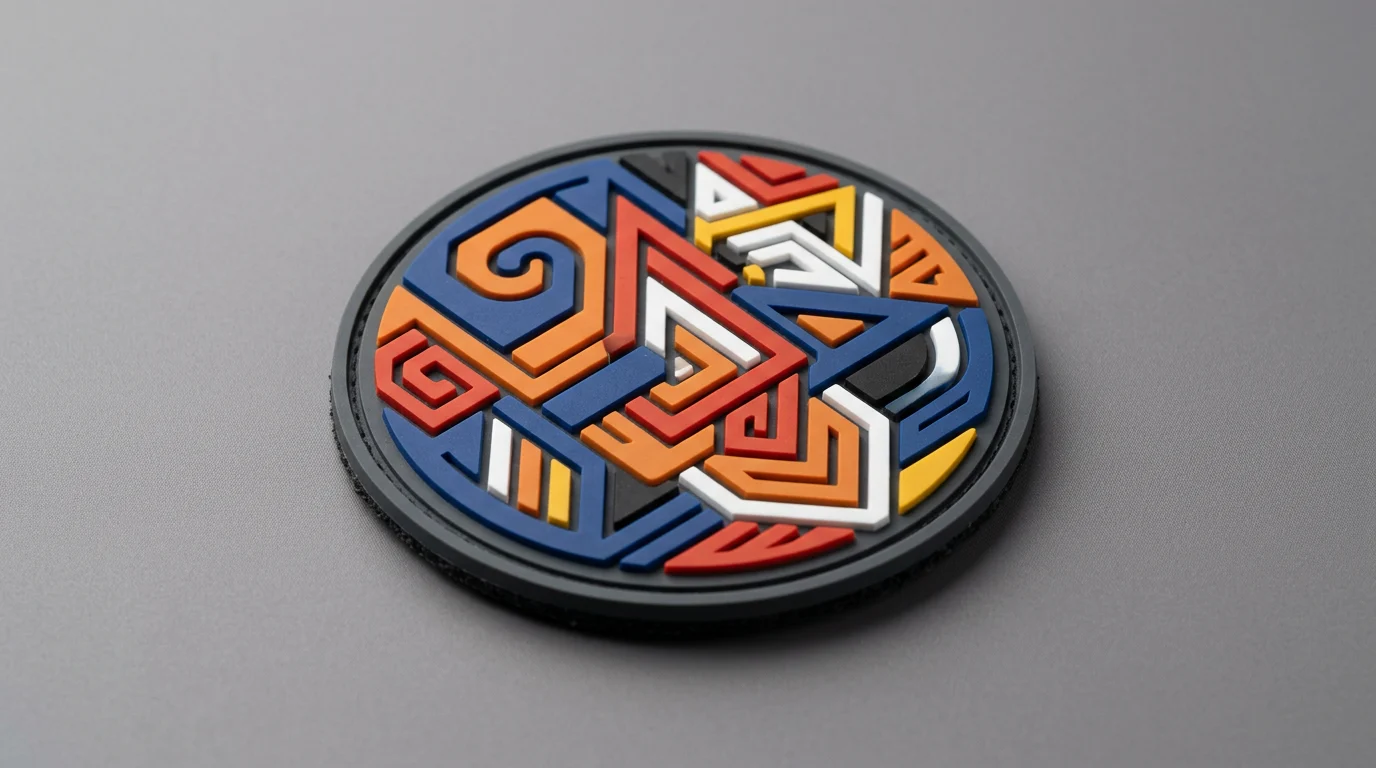
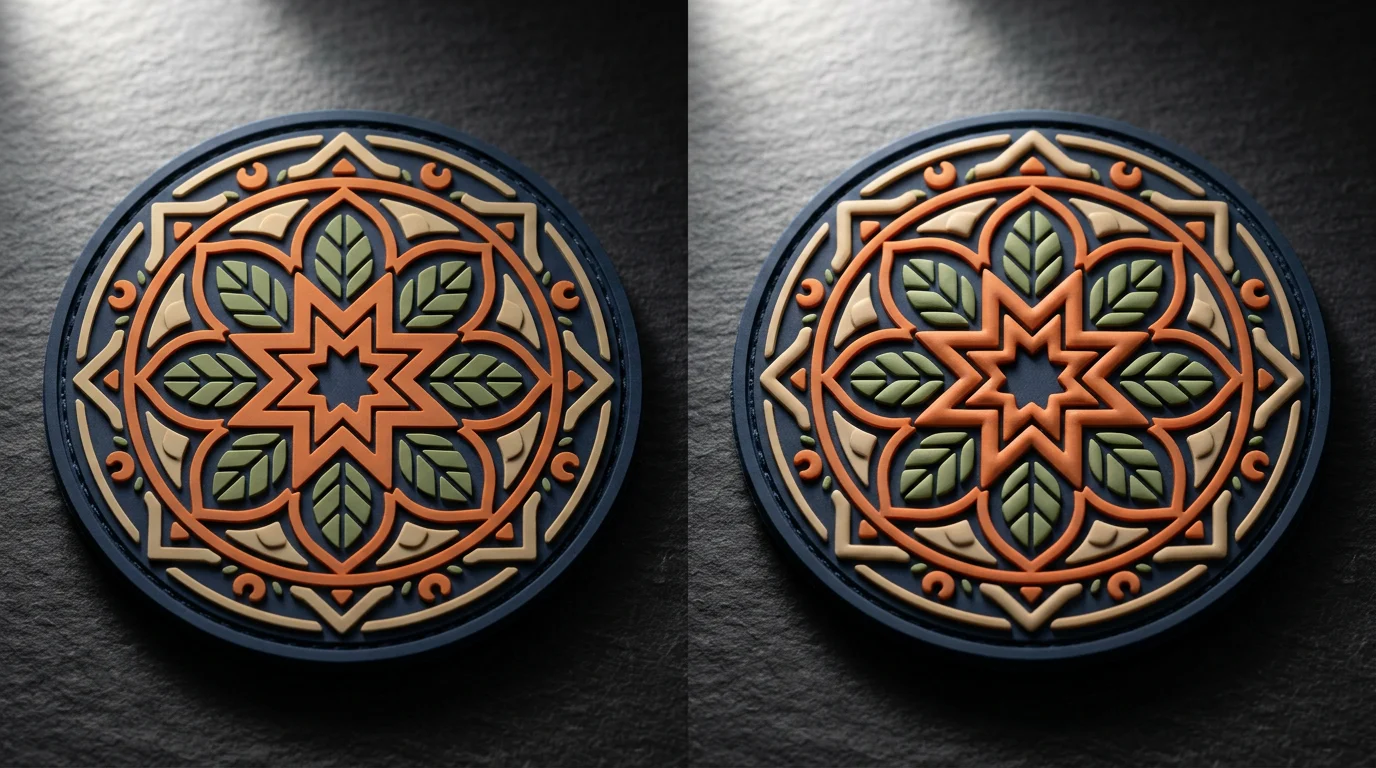
2D construction stacks flat layers on a single plane. Raised and recessed areas exist across the design, but every raised surface meets the same top height. Unlike a 3D PVC patch, which contours its surface across multiple height levels, a 2D patch keeps one flat working plane throughout.
Layers on a Single Plane
The mould separates each colour into its own recess. Operators pour one colour per recess, which produces clean colour separation without printed outlines or ink bleed. The result reads as a layered, flat-topped badge where colour blocks butt cleanly against each other.
Mould Depth and 2.5mm Thickness
A 2D patch requires a shallow mould cavity. The shallow cavity uses less PVC than a deep 3D cavity, and it finishes at an average thickness of 2.5mm. Lower material use and simpler tooling are the two reasons a 2D patch costs less than a 3D patch of the same size.
Minimum Text and Line Height
2D relief holds fine detail cleanly. Text reproduces down to a 5mm minimum height, and thin line artwork keeps its edges without merging. Flat tops carry small type better than rounded 3D relief, which is why wordmarks and technical line logos are specified as 2D. Check the full guidance on minimum text height before you finalise artwork.
Four-stage production
How 2D PVC Patches Are Made
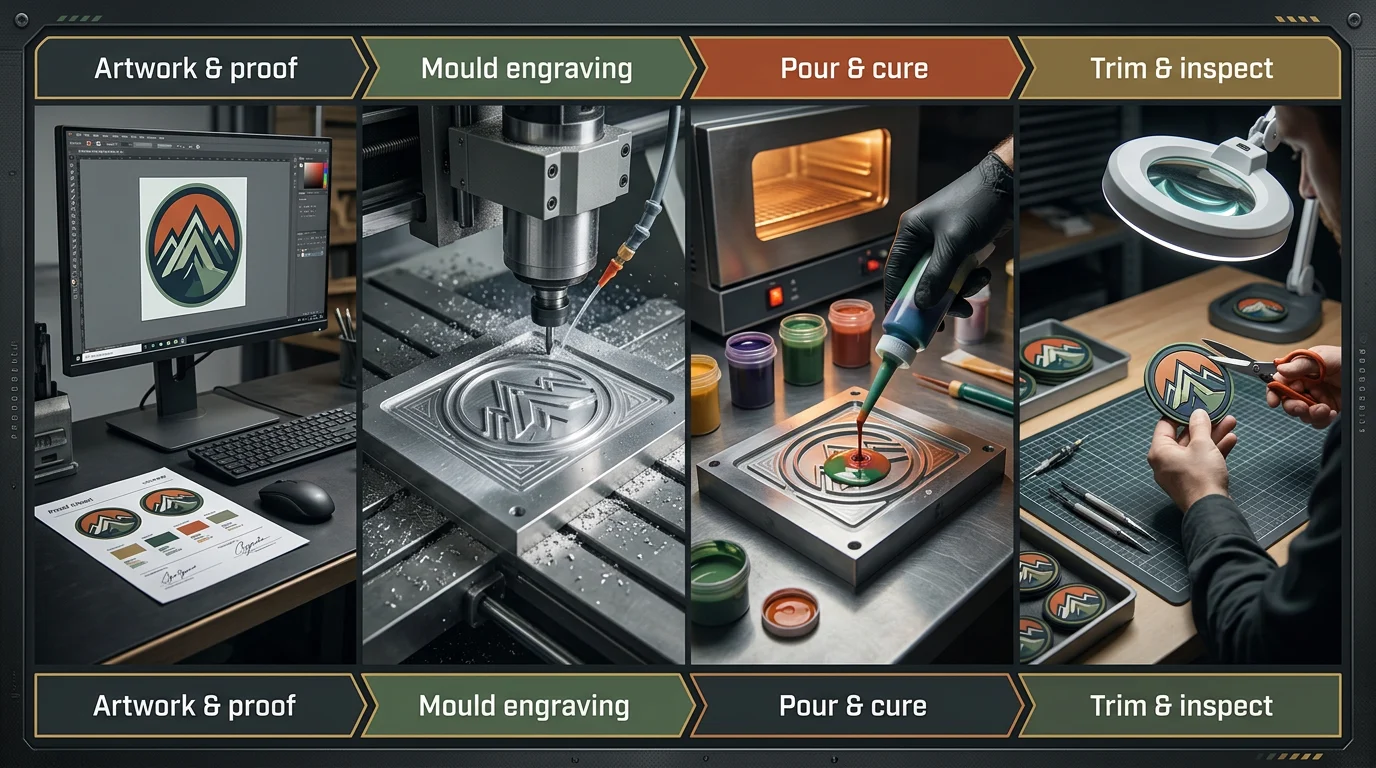
2D PVC patch production follows four stages. Artwork is prepared as a production layout and a Pantone reference is marked for each colour, then the customer approves a digital proof. Engineers engrave the approved design into a shallow metal mould. Operators pour liquid PVC one colour at a time and cure the filled mould under heat until the polymer sets into solid rubber. Technicians then trim the die-cut edge, apply the chosen backing and inspect every batch against the approved proof.
The moulding method is shared across all PVC patches; the mould depth is what separates 2D from 3D. For the full four-stage breakdown, see how PVC patches are made.
Seven measurable attributes
Benefits of 2D PVC Patches
2D PVC patches carry the full durability profile of moulded rubber, plus a cost advantage over 3D. The material outperforms stitched and printed alternatives across seven measurable attributes:
- Waterproof — solid polyvinyl chloride absorbs no moisture, so rain and immersion leave no mark
- UV-stable — heat stabilisers hold the colour under prolonged sunlight
- Colour-fast — pigment runs through the full depth of the rubber rather than sitting on the surface
- Flexible — plasticised PVC bends with the garment and returns to shape without cracking
- Non-fraying — the die-cut edge seals during moulding, so no border unravels
- Pantone-matched — brand colours reproduce to a PMS reference on every reorder
- Machine washable — patches withstand repeated laundering at 40°C
Flat construction adds a commercial benefit on top of durability. A 2D patch uses a shallower mould and less material, so it is the lower-cost PVC build at any given size. Buyers who need volume for uniforms or merchandise choose 2D for that reason.

Selection guide
When to Choose a 2D PVC Patch
Artwork decides the build. 2D suits any design that reads correctly on a flat plane, while 3D suits designs that need sculpted depth.
Text, Wordmarks and Line Art
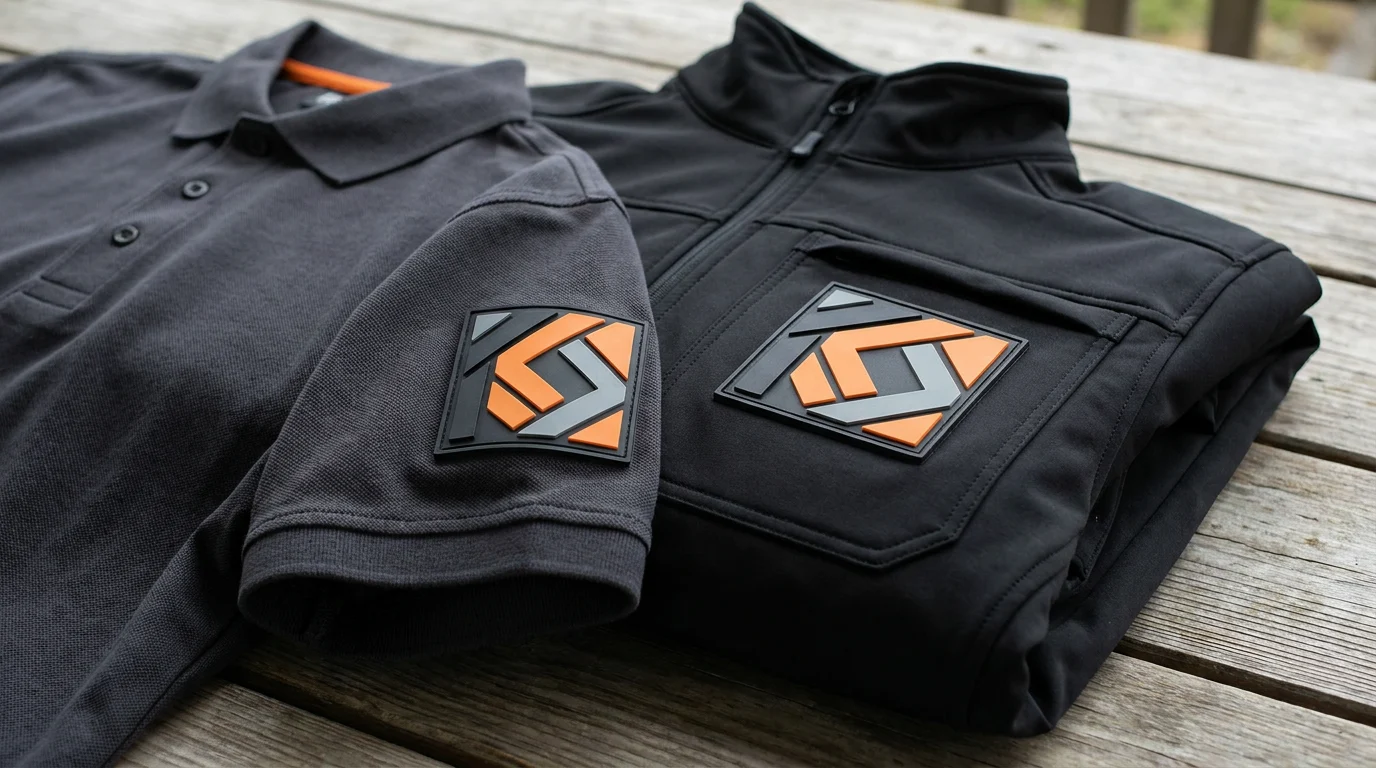
2D is the correct build for typography and thin strokes. Flat tops keep letterforms sharp and stop fine lines from rounding over, so wordmarks, mottos and technical line logos hold their shape at small sizes.
Flat Logos and Geometric Designs
Solid shapes and flat colour blocks read best in 2D. Geometric marks, badges with clean fills and simple icon logos reproduce cleanly because the design was drawn flat in the first place.
UK Sectors That Order 2D PVC Patches
2D PVC patches appear across several UK sectors. Facilities firms and contractors apply them to workwear and uniforms; security and door supervisor teams use flat identifiers on jackets; sports clubs and cadet units order flat name patches and crest badges. Where the artwork is dimensional — a face, an animal or a detailed crest — 3D PVC patches render the modelling that flat relief cannot.
Side-by-side
2D PVC Patches vs 3D PVC Patches
2D and 3D PVC patches share the same material and the same moulding process. They differ in surface geometry, thickness, mould depth and cost. The table sets the two builds side by side.
| Attribute | 2D PVC Patch | 3D PVC Patch |
|---|---|---|
| Surface | Flat-topped layers | Rounded, sculpted relief |
| Average thickness | 2.5mm | 3.5mm |
| Mould depth | Shallow | Deep, multi-level |
| Minimum text height | 5mm | 6mm |
| Best for | Text, flat logos, line art | Faces, animals, detailed crests |
| Relative cost | Lower | Higher |
The choice comes down to viewing distance and artwork. A 2D patch reads cleanly up close and suits flat, text-led designs. A 3D patch catches light at multiple angles and reads from a distance, which suits sculpted emblems.
Attachment options
Backing Options for 2D PVC Patches
A 2D patch takes the same four backings as any PVC patch, and backing is applied after curing, so it never affects the moulded face. Velcro backing makes the patch removable and repositionable, which suits tactical gear and uniforms. Sew-on backing produces the strongest, permanent attachment for workwear. 3M adhesive backing bonds to hard surfaces such as helmets and cases. Plain backing ships with no attachment layer for heat-pressing or loose supply.
2D PVC patches are not supplied iron-on. Polyvinyl chloride softens above 120°C and a domestic iron reaches 180°C, so heat deforms the relief. Choose sew-on backing for a permanent bond on fabric.

Enquiry to delivery
How to Order Custom 2D PVC Patches
Ordering follows five steps from enquiry to delivery.
- Send your artwork — upload a vector file, JPEG or sketch with your target size and quantity
- Receive a quotation — pricing covers moulding, production, backing and UK delivery
- Approve the digital proof — check colours against Pantone references and confirm dimensions
- Production begins — mould engraving, pouring, curing and backing application
- Delivery — tracked despatch to a UK address, including BFPO
There is no minimum order quantity, so you order exactly the number you need. Standard production takes 10 to 14 working days from proof approval, and express production takes 5 to 7 working days. UK mainland delivery adds 1 to 2 working days. All prices are quoted in pounds sterling and exclude VAT at 20%. See current PVC patch pricing and the detail on Pantone colour matching before you order.
In their words
Stories About Us and Our Customers
PVC patches end up on kit that works for a living. These are the orders behind them, the brief, the mould, and what the patch had to survive.
Tactical · Hook-and-loop
“The patches arrived clean, sharp and ready to go straight onto our kit bags.”
The hook-and-loop backing made it easy for the team to swap patches between packs, jackets and plate carriers without losing the raised detail in the badge.
Sarah Mitchell · Manchester
Workwear · Sew-on
“The PVC badges made our workwear look much more professional than printed logos.”
The sew-on finish gave the uniforms a permanent patch that could handle daily wear, wet weather and repeated cleaning.
James Carter · Birmingham
Streetwear · 3D relief
“The 3D finish gave our caps the premium detail we wanted.”
The raised rubber face helped the logo stand out on the front panel while keeping the colours consistent across the run.
Amelia Thompson · London
Outdoor · Waterproof
“The patches held up well on wet kit and still looked fresh after a muddy weekend.”
Waterproof PVC was chosen for bags and jackets where stitched thread would have absorbed moisture and frayed at the edge.
Oliver Hughes · Bristol
Club · Custom shape
“Our badge shape was unusual, but the final patch followed it neatly.”
The custom die-cut outline kept the club crest recognisable while the moulded edge avoided the bulky border of an embroidered patch.
Priya Shah · Leeds
Security · Velcro
“Being able to remove and replace patches between shifts has been really useful.”
Hook-and-loop backing was selected for staff jackets so roles and identifiers could be changed quickly without replacing garments.
Daniel Evans · Cardiff
Merchandise · Colour match
“The colours matched our brand better than the woven sample we tried before.”
Pantone-matched PVC helped keep the logo consistent for merchandise, reorder stock and event giveaways.
Hannah Wilson · Nottingham
Motorcycle · Jacket patch
“The rubber patch gave the jacket a cleaner, tougher finish.”
The club needed a weather-resistant badge that could handle rain, road grime and regular outdoor use.
Mark Robinson · Newcastle
Sports · Team kit
“The patch worked well on kit bags and training jackets.”
A flexible PVC build kept the team crest visible without adding a heavy stitched border to lightweight gear.
Rebecca Green · Sheffield
Repeat order · Reorder
“Reordering was simple because the mould was already set up.”
The second run kept the same dimensions, relief and colour references as the original patch order.
Thomas Baker · Glasgow
Tactical · Hook-and-loop
“The patches arrived clean, sharp and ready to go straight onto our kit bags.”
The hook-and-loop backing made it easy for the team to swap patches between packs, jackets and plate carriers without losing the raised detail in the badge.
Sarah Mitchell · Manchester
Workwear · Sew-on
“The PVC badges made our workwear look much more professional than printed logos.”
The sew-on finish gave the uniforms a permanent patch that could handle daily wear, wet weather and repeated cleaning.
James Carter · Birmingham
Streetwear · 3D relief
“The 3D finish gave our caps the premium detail we wanted.”
The raised rubber face helped the logo stand out on the front panel while keeping the colours consistent across the run.
Amelia Thompson · London
Outdoor · Waterproof
“The patches held up well on wet kit and still looked fresh after a muddy weekend.”
Waterproof PVC was chosen for bags and jackets where stitched thread would have absorbed moisture and frayed at the edge.
Oliver Hughes · Bristol
Club · Custom shape
“Our badge shape was unusual, but the final patch followed it neatly.”
The custom die-cut outline kept the club crest recognisable while the moulded edge avoided the bulky border of an embroidered patch.
Priya Shah · Leeds
Security · Velcro
“Being able to remove and replace patches between shifts has been really useful.”
Hook-and-loop backing was selected for staff jackets so roles and identifiers could be changed quickly without replacing garments.
Daniel Evans · Cardiff
Merchandise · Colour match
“The colours matched our brand better than the woven sample we tried before.”
Pantone-matched PVC helped keep the logo consistent for merchandise, reorder stock and event giveaways.
Hannah Wilson · Nottingham
Motorcycle · Jacket patch
“The rubber patch gave the jacket a cleaner, tougher finish.”
The club needed a weather-resistant badge that could handle rain, road grime and regular outdoor use.
Mark Robinson · Newcastle
Sports · Team kit
“The patch worked well on kit bags and training jackets.”
A flexible PVC build kept the team crest visible without adding a heavy stitched border to lightweight gear.
Rebecca Green · Sheffield
Repeat order · Reorder
“Reordering was simple because the mould was already set up.”
The second run kept the same dimensions, relief and colour references as the original patch order.
Thomas Baker · Glasgow
Answers
2D PVC Patches — Frequently Asked Questions
Are 2D PVC patches cheaper than 3D PVC patches?YES
Yes. 2D patches use a shallower mould and less material, so they cost less than 3D patches at the same size.
Can 2D PVC patches hold small text?YES
Yes. 2D construction reproduces text down to a 5mm minimum height, and flat tops keep the letters crisp.
Are 2D PVC patches waterproof?YES
Yes. 2D PVC patches are moulded from solid polyvinyl chloride, which absorbs no water and carries no stitched edge to fray.
Can 2D PVC patches be ironed on?NO
No. Polyvinyl chloride softens above 120°C, so 2D patches are supplied with velcro, sew-on, adhesive or plain backing instead.
Is there a minimum order for 2D PVC patches?NO
No. There is no minimum order quantity, so you can order a small batch or a full production run.
Flat relief · UK orders
Order 2D PVC Patches from a UK Manufacturer
2D PVC patches give you a flat, hard-wearing rubber badge at the lowest PVC price point, and they hold text and flat logos better than any other build. Pigment sealed inside plasticised polyvinyl chloride resists the sunlight, rain and laundry cycles that fade thread and lift printed transfers. Working with a UK supplier keeps pricing in sterling with VAT stated plainly and puts a named contact behind every mould. Send your design for a quotation and receive a digital proof before anything is cut.