Emergency Services · Reflective · Waterproof
Emergency Services PVC Patches — Reflective, Waterproof, UK Made
Emergency services PVC patches are moulded rubber badges made from polyvinyl chloride, produced in 2D or 3D relief at 2.5mm to 3.5mm thickness and specified with reflective, waterproof and hook-and-loop features for front-line use. UK fire, ambulance, coastguard and rescue teams fit these custom patches as ID panels, role identifiers and morale badges that survive weather, laundering and night operations. Every emblem is Pantone-matched, die-cut to shape and produced with no minimum order.
Featured Client

Definition
What Are Emergency Services PVC Patches?
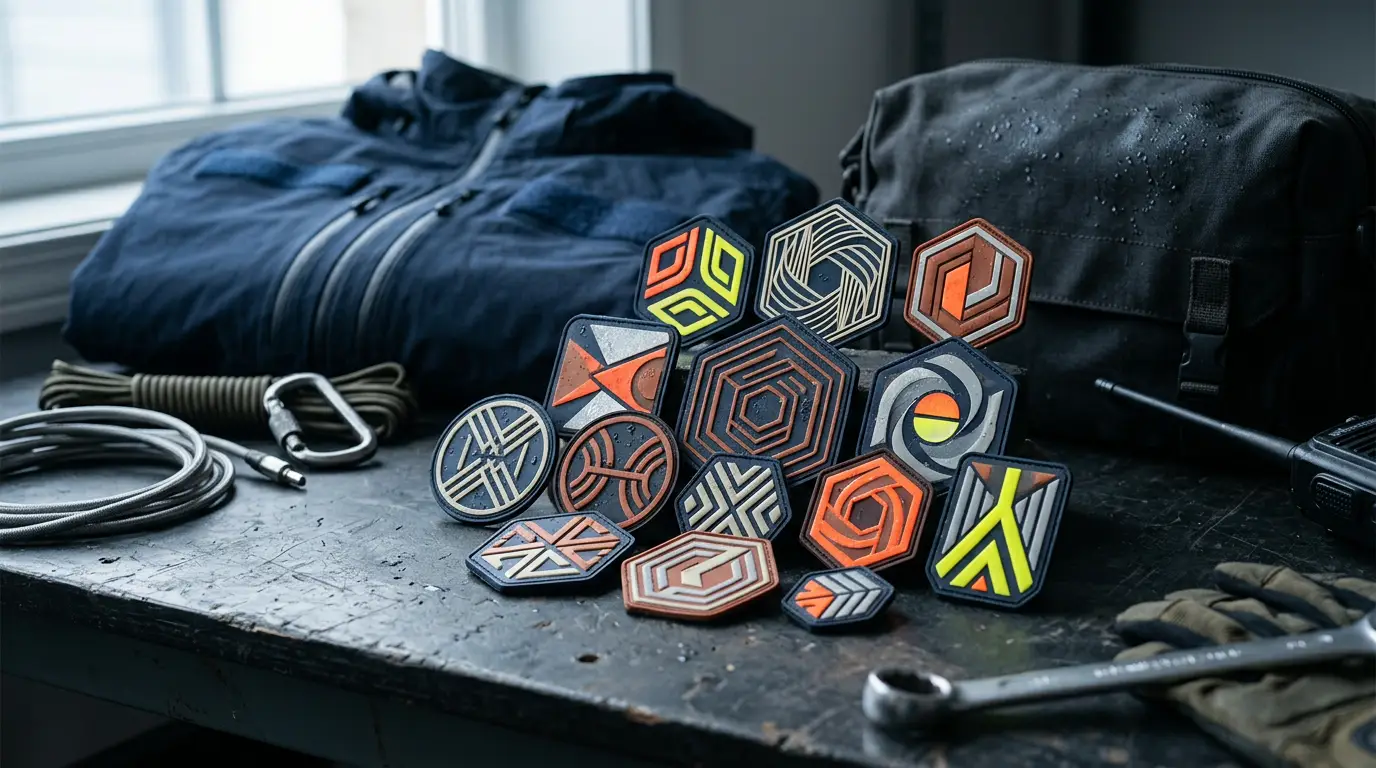
Emergency services PVC patches are flexible rubber emblems moulded from liquid polyvinyl chloride inside an engraved metal die. Each patch reproduces a badge, role marker or unit identifier as raised relief rather than stitched thread. PVC patches replace embroidery on front-line kit wherever water, abrasion and repeated laundering shorten the life of a stitched badge.
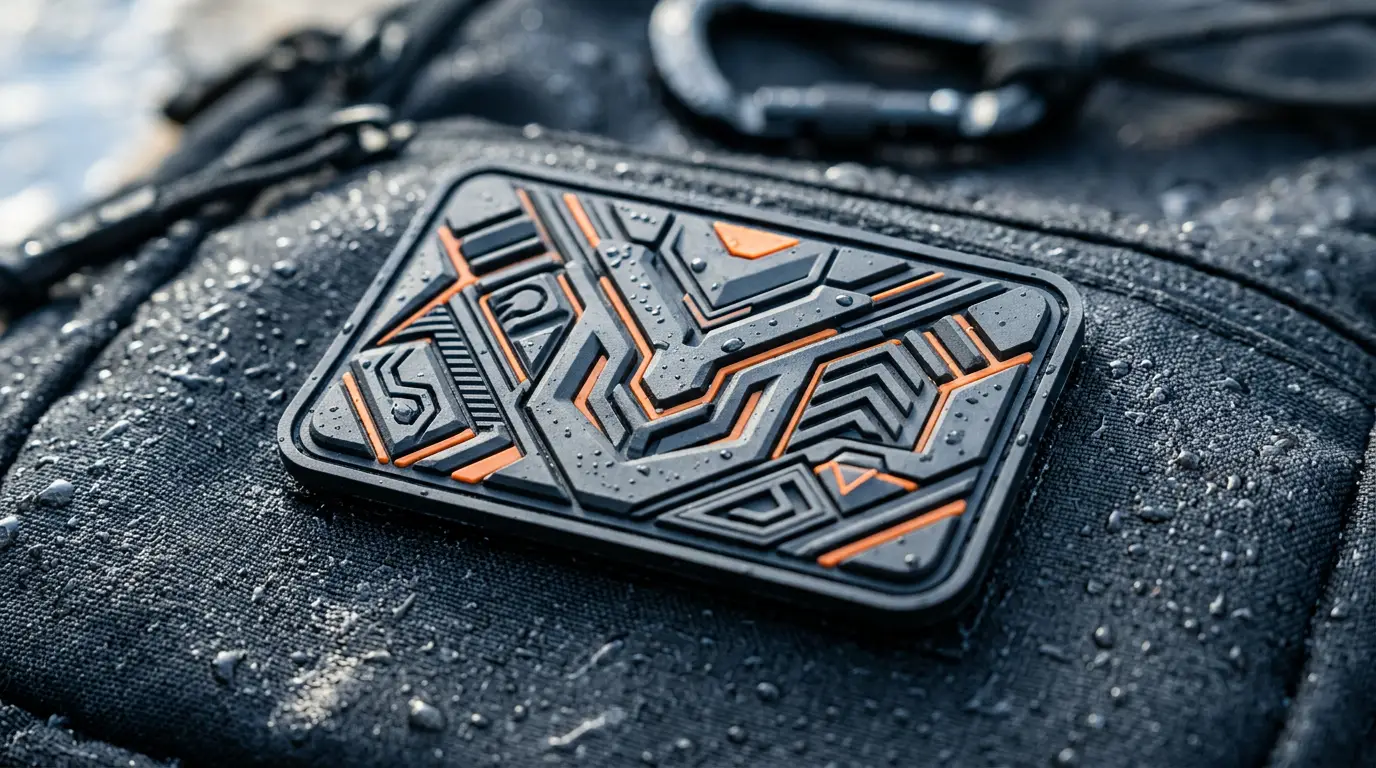
Moulded rubber earns its place on emergency service uniforms through material behaviour, not tradition. PVC patches resist water. PVC patches survive machine washing at 40°C. Pigment runs through the full depth of a PVC patch rather than sitting on the surface, so a colour-fast emblem holds its brand reference through years of wear. A die-cut edge seals during moulding, which means the border never frays on a hi-vis jacket that is washed weekly.
UK sectors
Which UK Emergency Services Use PVC Patches
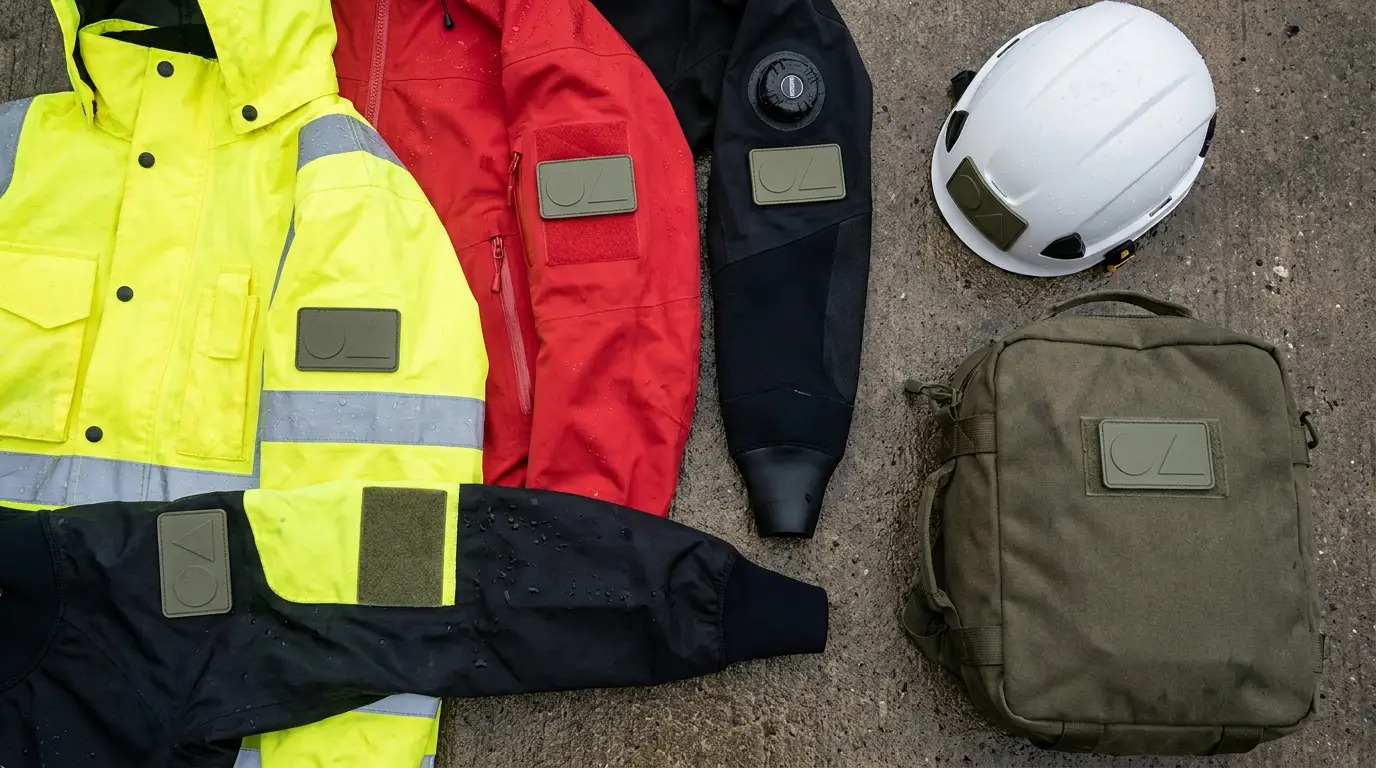
Emergency and first-response organisations across the UK fit PVC patches to uniforms, technical shells and equipment. Application drives specification, so size, relief and backing change with the environment the patch works in.
Fire and Rescue Services
reflective panels and helmet identifiers stand up to heat-area work and roadside incidents.
Ambulance Services and paramedics
colour-coded role and skill panels mark HART crews, technicians and community responders on hi-vis kit.
HM Coastguard and marine rescue
waterproof patches hold fast on drysuits, technical shells and dry bags in wet conditions.
Search and Rescue, Mountain Rescue and Lowland Rescue
night-visibility patches and team identifiers support long callouts after dark.
Community First Responders
chest identifiers on high-visibility outer layers make responders recognisable at a scene.
Event medical and first-aid providers
colour-coded role panels distinguish medics, doctors and welfare staff at festivals and events.
Workplace first aiders and site medics
durable ID patches survive industrial laundering on hi-vis workwear.
These sectors overlap with several other applications on this site. Marine crews often specify the same builds covered on our marine and sailing patches page, and site teams share requirements with workwear and uniform patches.
Four operational features
PVC Patch Features That Suit Emergency Service Use
PVC patches carry four features that matter most to emergency services. Feature selection depends on the operating environment: daylight roadside work, night search, wet conditions or repeated decontamination.

Reflective (Retroreflective) Panels
Reflective PVC patches combine moulded rubber with a retroreflective panel that returns light towards its source. A reflective panel activates under torchlight and vehicle headlights rather than glowing on its own. Roadside crews, traffic officers and highway response teams specify reflective PVC patches for high-visibility identification in a headlight beam.
Glow-in-the-Dark
Glow-in-the-dark PVC patches contain phosphorescent pigment that absorbs light and re-emits it in darkness. The pigment charges under any light source in roughly 15 minutes, then glows for several hours unaided. Search teams and cave rescue crews order glow-in-the-dark PVC patches so kit and personnel remain locatable when power fails or torches are stowed.
Waterproof and Colour-Fast
Solid polyvinyl chloride absorbs no moisture, so rain, spray and immersion leave a PVC patch unchanged. Heat stabilisers hold the colour under prolonged sunlight, and Pantone pigment sits through the full depth of the material. Coastguard and marine rescue teams rely on this waterproofing, which is explained further on our guide to whether PVC patches are waterproof.
Flexible and Non-Fraying
Plasticised PVC bends with the garment and returns to shape without cracking. A flexible patch conforms to a drysuit sleeve or a technical shell without lifting at the edge. The die-cut border seals during moulding, so no thread unravels after repeated washing.
Role, ID and visibility
Common Emergency Services Patch Types
Emergency services order PVC patches in several standard formats. Format follows function, so the same moulded rubber serves identification, role marking and team morale.
Role and skill identifier panels
descriptive markers such as MEDIC, DOCTOR or RESPONDER that identify a wearer's function at a scene.
Blood group patches
small, high-contrast panels worn where medical information must be read quickly.
Call sign and unit ID panels
unit and callsign markers for coordination across a team.
High-visibility chest and back panels
larger panels up to 200mm that read at distance on outer layers.
Shoulder and epaulette patches
compact identifiers for structured uniforms.
Team and morale patches
unofficial emblems that build identity within a crew or watch.
Attachment choices
Backing Options for Emergency Services Patches
Backing determines how an emergency services PVC patch attaches to a garment or piece of equipment. Three backing types suit front-line use, and each one matches a different attachment need.
Hook-and-Loop (Velcro) Backing
Velcro PVC patches carry a hook panel bonded to the reverse, which fastens to a loop field on the garment. Hook-and-loop backing makes the patch removable, so crews swap role, skill and call-sign panels between shifts and garments without tools. Emergency services choose hook-and-loop backing more often than any other option because operational roles change from one callout to the next.
Sew-On Backing
Sew-on PVC patches include a stitch channel around the border for a permanent attachment. A sew-on bond survives industrial laundering and decontamination cycles that a temporary fixing would not. Fixed service badges on tunics and uniforms use sew-on backing as the standard.
3M Adhesive Backing
Adhesive PVC patches use a peel-and-stick 3M film that bonds to smooth, rigid surfaces. The film holds on helmets, hard cases and dry-bag hard panels rather than fabric. Adhesive backing suits equipment marking where a sewn or hooked fixing has no purchase.
Emergency services PVC patches are not supplied iron-on. Polyvinyl chloride softens above 120°C, and a domestic iron reaches 180°C on a cotton setting, which deforms the moulded relief. Teams that need a permanent bond on fabric should select sew-on backing instead.
Night visibility comparison
Choosing Night-Visibility Patches: Reflective vs Glow-in-the-Dark
Reflective patches and glow-in-the-dark patches solve different night-visibility problems, and UK suppliers often confuse the two. A reflective patch needs an external light source; a glow patch produces its own light after charging. The table below sets the two side by side for emergency service conditions.
| Attribute | Reflective PVC Patch | Glow-in-the-Dark PVC Patch |
|---|---|---|
| How it works | Returns light towards its source | Absorbs light, then re-emits it |
| Light source needed | External (torch, headlights) | Charges under any light, glows unaided |
| Visible when | A beam hits it | In full darkness after charging |
| Duration | Continuous while lit | Several hours, fading gradually |
| Best emergency use | Roadside, traffic, headlight range | Power loss, dark interiors, kit location |
| Typical services | Fire, ambulance, highway response | SAR, cave rescue, night search |
Many teams specify both on the same garment. A reflective chest panel handles roadside visibility, while a glow identifier keeps a crew locatable once the headlights move away.
The second table matches a feature and a backing to each service environment, which shortens the specification decision.
| Service / environment | Recommended feature | Recommended backing |
|---|---|---|
| Fire and rescue (helmet) | Reflective | 3M adhesive |
| Ambulance / paramedic (hi-vis) | Colour-fast role panels | Hook-and-loop |
| HM Coastguard / marine | Waterproof + reflective | Hook-and-loop or sew-on |
| Mountain / cave rescue (night) | Glow-in-the-dark + reflective | Hook-and-loop |
| Event medical | Colour-coded role panels | Hook-and-loop |
| Site medic / first aider | Reflective ID | Sew-on |
Authorisation and use
Insignia and Compliance for Emergency Services Patches
Emergency services PVC patches are produced for authorised personnel, official suppliers and internal, training or morale use. Reproduction of an official service crest requires authorisation from the relevant service, which the customer confirms before production begins. This keeps a bespoke order aligned with the authority that owns the design.
UK law restricts official police insignia. Impersonating a police constable is an offence under the Police Act 1996, so we do not supply items intended to deceive the public as a serving emergency worker. Descriptive role markers, unit identifiers and morale designs remain straightforward to produce for genuine teams. This guidance is factual and does not replace advice from the relevant service or a solicitor.
Artwork to delivery
How to Order Emergency Services PVC Patches
Ordering emergency services PVC patches follows five steps from enquiry to delivery. Turnaround starts at proof approval, because mould engraving cannot begin on an unapproved design.
- Send your artwork — upload a vector file, JPEG or sketch with your target size (25mm to 200mm) and quantity. There is no minimum order.
- Receive a quotation — pricing covers moulding, production, backing and UK delivery, quoted in pounds sterling with VAT at 20% stated separately.
- Approve the digital proof — check colours against Pantone references and confirm dimensions before any tooling begins.
- Production begins — standard production takes 10 to 14 working days from proof approval, and express production takes 5 to 7 working days.
- Delivery — tracked despatch to UK mainland addresses adds 1 to 2 working days.
Full timings sit on our turnaround and delivery page, and the wider process is set out across the ordering hub.
UK production support
Why Order Emergency Services Patches from a UK Manufacturer
Front-line kit works in the rain, on the roadside and through the wash, and a moulded rubber badge is built for exactly those conditions. Pigment sealed inside plasticised polyvinyl chloride shrugs off the sunlight, water and laundering that fade thread and lift printed transfers, while reflective and glow variants add the visibility a night callout demands. Ordering from a UK manufacturer shortens the loop between artwork, proof and delivery, keeps pricing in sterling with VAT stated plainly, and puts a named contact behind every mould. Send your design for a quotation and receive a digital proof before anything is cut.
In their words
Stories About Us and Our Customers
PVC patches end up on kit that works for a living. These are the orders behind them, the brief, the mould, and what the patch had to survive.
Tactical · Hook-and-loop
“The patches arrived clean, sharp and ready to go straight onto our kit bags.”
The hook-and-loop backing made it easy for the team to swap patches between packs, jackets and plate carriers without losing the raised detail in the badge.
Sarah Mitchell · Manchester
Workwear · Sew-on
“The PVC badges made our workwear look much more professional than printed logos.”
The sew-on finish gave the uniforms a permanent patch that could handle daily wear, wet weather and repeated cleaning.
James Carter · Birmingham
Streetwear · 3D relief
“The 3D finish gave our caps the premium detail we wanted.”
The raised rubber face helped the logo stand out on the front panel while keeping the colours consistent across the run.
Amelia Thompson · London
Outdoor · Waterproof
“The patches held up well on wet kit and still looked fresh after a muddy weekend.”
Waterproof PVC was chosen for bags and jackets where stitched thread would have absorbed moisture and frayed at the edge.
Oliver Hughes · Bristol
Club · Custom shape
“Our badge shape was unusual, but the final patch followed it neatly.”
The custom die-cut outline kept the club crest recognisable while the moulded edge avoided the bulky border of an embroidered patch.
Priya Shah · Leeds
Security · Velcro
“Being able to remove and replace patches between shifts has been really useful.”
Hook-and-loop backing was selected for staff jackets so roles and identifiers could be changed quickly without replacing garments.
Daniel Evans · Cardiff
Merchandise · Colour match
“The colours matched our brand better than the woven sample we tried before.”
Pantone-matched PVC helped keep the logo consistent for merchandise, reorder stock and event giveaways.
Hannah Wilson · Nottingham
Motorcycle · Jacket patch
“The rubber patch gave the jacket a cleaner, tougher finish.”
The club needed a weather-resistant badge that could handle rain, road grime and regular outdoor use.
Mark Robinson · Newcastle
Sports · Team kit
“The patch worked well on kit bags and training jackets.”
A flexible PVC build kept the team crest visible without adding a heavy stitched border to lightweight gear.
Rebecca Green · Sheffield
Repeat order · Reorder
“Reordering was simple because the mould was already set up.”
The second run kept the same dimensions, relief and colour references as the original patch order.
Thomas Baker · Glasgow
Tactical · Hook-and-loop
“The patches arrived clean, sharp and ready to go straight onto our kit bags.”
The hook-and-loop backing made it easy for the team to swap patches between packs, jackets and plate carriers without losing the raised detail in the badge.
Sarah Mitchell · Manchester
Workwear · Sew-on
“The PVC badges made our workwear look much more professional than printed logos.”
The sew-on finish gave the uniforms a permanent patch that could handle daily wear, wet weather and repeated cleaning.
James Carter · Birmingham
Streetwear · 3D relief
“The 3D finish gave our caps the premium detail we wanted.”
The raised rubber face helped the logo stand out on the front panel while keeping the colours consistent across the run.
Amelia Thompson · London
Outdoor · Waterproof
“The patches held up well on wet kit and still looked fresh after a muddy weekend.”
Waterproof PVC was chosen for bags and jackets where stitched thread would have absorbed moisture and frayed at the edge.
Oliver Hughes · Bristol
Club · Custom shape
“Our badge shape was unusual, but the final patch followed it neatly.”
The custom die-cut outline kept the club crest recognisable while the moulded edge avoided the bulky border of an embroidered patch.
Priya Shah · Leeds
Security · Velcro
“Being able to remove and replace patches between shifts has been really useful.”
Hook-and-loop backing was selected for staff jackets so roles and identifiers could be changed quickly without replacing garments.
Daniel Evans · Cardiff
Merchandise · Colour match
“The colours matched our brand better than the woven sample we tried before.”
Pantone-matched PVC helped keep the logo consistent for merchandise, reorder stock and event giveaways.
Hannah Wilson · Nottingham
Motorcycle · Jacket patch
“The rubber patch gave the jacket a cleaner, tougher finish.”
The club needed a weather-resistant badge that could handle rain, road grime and regular outdoor use.
Mark Robinson · Newcastle
Sports · Team kit
“The patch worked well on kit bags and training jackets.”
A flexible PVC build kept the team crest visible without adding a heavy stitched border to lightweight gear.
Rebecca Green · Sheffield
Repeat order · Reorder
“Reordering was simple because the mould was already set up.”
The second run kept the same dimensions, relief and colour references as the original patch order.
Thomas Baker · Glasgow
Questions answered
Emergency Services PVC Patches — Frequently Asked Questions
Are PVC patches suitable for emergency services uniforms?
Yes. PVC patches are waterproof, colour-fast and machine-washable at 40°C, which suits the laundering and weather demands of front-line uniforms.
Can emergency services PVC patches be reflective?
Yes. Reflective PVC patches carry a retroreflective panel that returns torchlight and headlight beams for roadside and night operations.
Are PVC patches waterproof enough for coastguard and marine rescue?
Yes. Solid polyvinyl chloride absorbs no water, so PVC patches hold up on drysuits, technical shells and dry bags in wet conditions.
Can you make removable role or ID patches for emergency services?
Yes. Hook-and-loop backing lets teams swap role, skill and call-sign panels between shifts and garments without tools.
Can PVC patches be ironed onto emergency service uniforms?
No. PVC patches cannot be ironed on, because polyvinyl chloride softens above 120°C; choose sew-on backing for a permanent fabric bond.
Do you produce official police or emergency service insignia?
Official service crests are produced for authorised personnel and suppliers only, and reproduction requires authorisation from the relevant service.
Is there a minimum order for emergency services PVC patches?
No. There is no minimum order, so a single reflective panel or a full team run is produced to the same specification.