
PVC Patch Guide · Waterproofing
Are PVC Patches Waterproof?
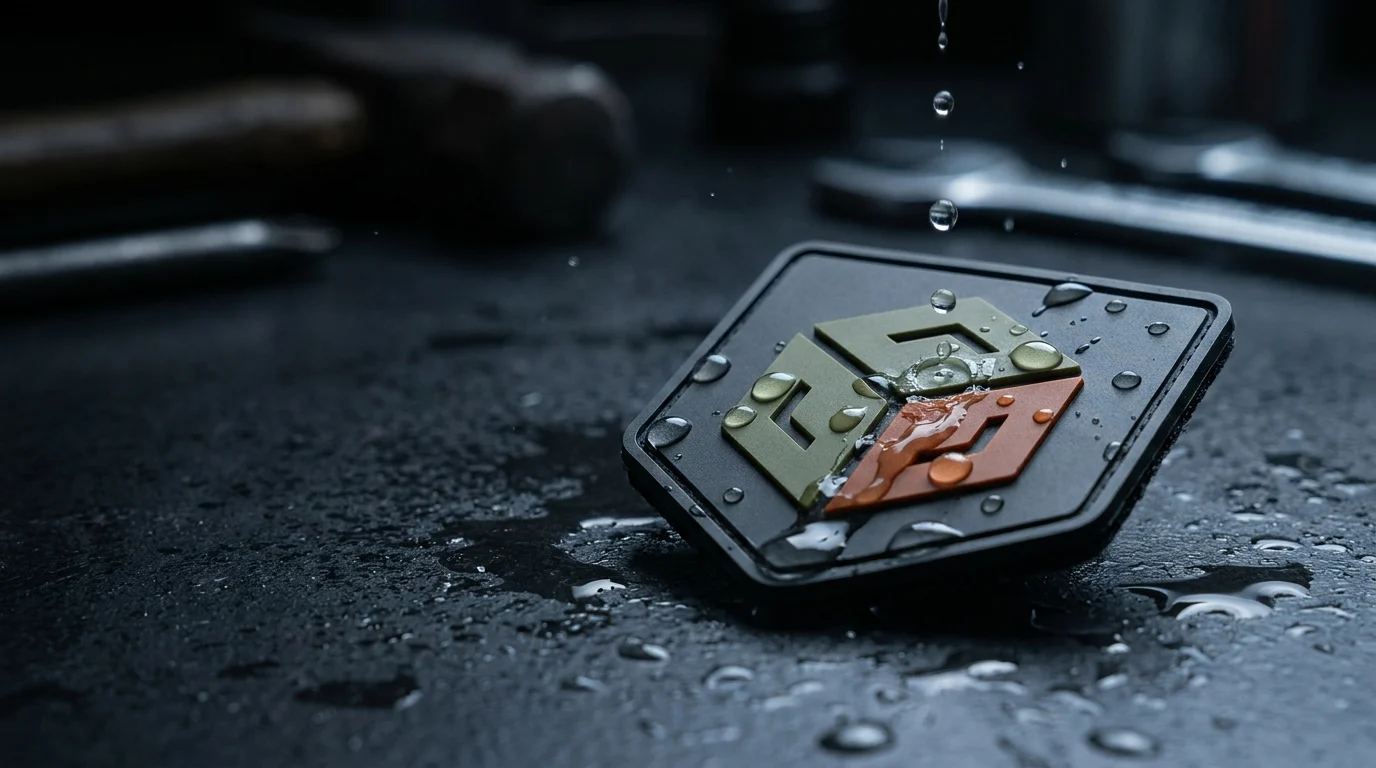
Yes. PVC patches are waterproof. A PVC patch is moulded from non-porous polyvinyl chloride, and non-porous polyvinyl chloride absorbs no water. The die-cut edge seals during moulding, and the moulded body carries no stitched thread to wick moisture. The patch itself is waterproof; the attachment method decides whether the garment stays waterproof, and this guide settles both points.
Featured Client

Short answer
Are PVC Patches Waterproof? The Short Answer
PVC patches are waterproof because the material is a solid, non-porous polymer with no route for water to enter. Rain runs off the moulded face. Immersion leaves the patch unchanged. Machine washing at 40°C does not fade, lift or crack it. A rubber patch behaves in water the way a wellington boot does — the water sits on the surface and drains away, and nothing soaks in.
Three structural reasons
Why PVC Patches Are Waterproof
PVC patches are waterproof for three structural reasons: the polymer, the edge, and the absence of thread. Each reason removes a path that water normally uses to get into a badge.
Non-Porous Polyvinyl Chloride
Polyvinyl chloride is a non-porous thermoplastic. Non-porous means the material contains no open pores, capillaries or fibres for water to travel through, so a moulded PVC patch has no internal route for moisture to enter. Pigment sits inside the polymer rather than printed on top, which is why colour runs through the full depth of the patch and water cannot lift it. The composition of the material — the PVC powder, plasticisers and stabilisers blended before moulding — is set out on the guide covering what PVC patch material is made from. The property that matters here is simpler: a solid non-porous body cannot absorb water.
The Sealed Die-Cut Edge
The die-cut edge seals during moulding. A PVC patch is cured inside an engraved metal mould, and the outline forms as part of that single moulded piece, so the border is sealed rubber rather than a cut or stitched seam. No edge frays, and no seam opens up in the wash. This matters because the edge is where most patches fail first in wet conditions — a raw or stitched border wicks water inward. The moulded, non-fraying edge produced during the PVC patch moulding process removes that weak point entirely.
No Stitched Thread to Absorb Water
A moulded PVC patch carries no stitched thread. Thread is absorbent by nature: embroidered patches are built from polyester or rayon stitching on a twill base, and both the thread and the twill hold water. A PVC patch replaces every stitch with moulded rubber, so there is nothing to soak, swell or fray. This is the core difference set out in full on the comparison of PVC patches versus embroidered patches: thread absorbs water, and rubber sheds it.
Terminology
Waterproof vs Water-Resistant — What PVC Patches Actually Are
PVC patches are waterproof, not merely water-resistant, and the distinction is real. A water-resistant material repels water for a limited time before it saturates. A waterproof material is unaffected by water indefinitely. PVC sits firmly in the second category, because a non-porous polymer never reaches saturation — there is nothing inside it to fill.
| Property | Water-resistant | Waterproof (PVC patch) |
|---|---|---|
| Behaviour | Repels water for a limited time | Unaffected by water indefinitely |
| Saturation point | Yes — eventually soaks through | None — nothing absorbs |
| Example | Treated fabric, coated thread | Moulded polyvinyl chloride |
Rain · Immersion · Washing
How PVC Patches Behave in Water
PVC patches perform identically across rain, immersion and laundering, because all three expose the same non-porous surface to water. The patch has no failure mode that water triggers.
In Rain
Rain beads on the moulded face and runs off. A PVC patch does not darken, swell or stain when wet, and the pigment stays true because it is sealed inside the material rather than sitting on top of it. Repeated soaking has no cumulative effect, which is why outdoor gear and technical shells carry rubber badges rather than stitched ones.
Under Immersion
Immersion leaves a PVC patch unchanged. Submerged in water, the patch does not absorb, swell or delaminate, and the moulded relief holds its shape. This resilience is why sailors, paddlers and open-water crews specify rubber over thread — the badge survives conditions that would waterlog an embroidered patch. The same waterproofing supports the patch across the rest of its service life, covered on the guide to how long PVC patches last.
In the Washing Machine
PVC patches withstand machine washing at 40°C without fading, lifting or cracking. The full laundering routine — cycle, drying and the handling of velcro versus sew-on patches — is covered on the guide to washing PVC patches. For the purposes of this page, the point is that a wash cycle is simply another water exposure the waterproof material shrugs off.
Patch vs garment
Does a Waterproof Patch Make the Garment Waterproof?
No. A waterproof patch does not make the garment waterproof, and this is where an honest answer matters more than a marketing one. The PVC patch is inert to water on its own, but the way it attaches to a shell decides whether the shell keeps its waterproofing. On an ordinary jacket this is irrelevant; on a technical waterproof membrane it is the whole question.
Sew-On and Needle Holes
Sew-on backing pierces the garment with a needle. Each stitch creates a small hole through the fabric, and on a standard cotton or polyester garment those holes are harmless. On a waterproof membrane shell, though, needle holes can breach the very layer that keeps rain out, so the patch stays dry while the jacket leaks around the stitching. The strengths and correct uses of sew-on backing are set out on its own page — the caveat here is narrow and specific to membrane fabrics.
Velcro and Adhesive on Technical Shells
Velcro and adhesive backings attach without piercing the fabric. Hook-and-loop backing fastens to a loop field with no penetration of the shell, which is why velcro backing is the standard choice for technical outdoor and tactical kit. Adhesive backing bonds to smooth, rigid surfaces rather than fabric, so 3M adhesive backing suits helmets and hard cases instead of jackets. One further honesty point: on a composite patch that combines PVC with embroidery or a reflective panel, only the moulded PVC section carries the full-depth waterproofing — the added thread or reflective element behaves like its own material.
UK use cases
Where Waterproofing Makes PVC the Right Choice
Waterproofing is the deciding attribute in three UK sectors. Marine crews fit rubber badges to dry bags, buoyancy aids and technical shells, covered under marine and sailing patches. Outdoor users choose them for rucksacks, tents and waterproof jackets, set out under bags and outdoor gear patches. Emergency services specify them for wet, high-wear duty conditions, detailed under emergency services patches. In each case, a stitched patch would absorb water and fray, and a printed patch would peel — the moulded rubber does neither.
In their words
Stories About Us and Our Customers
PVC patches end up on kit that works for a living. These are the orders behind them, the brief, the mould, and what the patch had to survive.
Tactical · Hook-and-loop
“The patches arrived clean, sharp and ready to go straight onto our kit bags.”
The hook-and-loop backing made it easy for the team to swap patches between packs, jackets and plate carriers without losing the raised detail in the badge.
Sarah Mitchell · Manchester
Workwear · Sew-on
“The PVC badges made our workwear look much more professional than printed logos.”
The sew-on finish gave the uniforms a permanent patch that could handle daily wear, wet weather and repeated cleaning.
James Carter · Birmingham
Streetwear · 3D relief
“The 3D finish gave our caps the premium detail we wanted.”
The raised rubber face helped the logo stand out on the front panel while keeping the colours consistent across the run.
Amelia Thompson · London
Outdoor · Waterproof
“The patches held up well on wet kit and still looked fresh after a muddy weekend.”
Waterproof PVC was chosen for bags and jackets where stitched thread would have absorbed moisture and frayed at the edge.
Oliver Hughes · Bristol
Club · Custom shape
“Our badge shape was unusual, but the final patch followed it neatly.”
The custom die-cut outline kept the club crest recognisable while the moulded edge avoided the bulky border of an embroidered patch.
Priya Shah · Leeds
Security · Velcro
“Being able to remove and replace patches between shifts has been really useful.”
Hook-and-loop backing was selected for staff jackets so roles and identifiers could be changed quickly without replacing garments.
Daniel Evans · Cardiff
Merchandise · Colour match
“The colours matched our brand better than the woven sample we tried before.”
Pantone-matched PVC helped keep the logo consistent for merchandise, reorder stock and event giveaways.
Hannah Wilson · Nottingham
Motorcycle · Jacket patch
“The rubber patch gave the jacket a cleaner, tougher finish.”
The club needed a weather-resistant badge that could handle rain, road grime and regular outdoor use.
Mark Robinson · Newcastle
Sports · Team kit
“The patch worked well on kit bags and training jackets.”
A flexible PVC build kept the team crest visible without adding a heavy stitched border to lightweight gear.
Rebecca Green · Sheffield
Repeat order · Reorder
“Reordering was simple because the mould was already set up.”
The second run kept the same dimensions, relief and colour references as the original patch order.
Thomas Baker · Glasgow
Answers
PVC Patches and Water — Frequently Asked Questions
Are PVC patches waterproof?Yes
Yes. PVC patches are moulded from non-porous polyvinyl chloride, which absorbs no water, so rain and immersion leave the patch unaffected.
Can PVC patches go in the washing machine?Yes
Yes. PVC patches withstand machine washing at 40°C without fading or lifting, and the full routine is on the guide to washing PVC patches.
Do PVC patches fade or peel when wet?No
No. Pigment runs through the full depth of the material rather than sitting on the surface, so water cannot lift or fade the colour.
Are PVC patches waterproof enough for sailing and marine use?Yes
Yes. The sealed rubber body suits wet marine kit where stitched thread would absorb moisture and fray.
Does sewing a PVC patch onto a waterproof jacket ruin the waterproofing?Attachment matters
The patch stays waterproof, but sew-on stitching pierces the fabric; on a technical membrane, velcro or adhesive backing avoids the needle holes.
Summary
Summary
A PVC patch resists water because it is built from a single non-porous polymer with a sealed moulded edge and not a stitch of absorbent thread anywhere in it. That construction is what keeps rain, submersion and a 40°C wash from marking it, and it is the reason marine, outdoor and emergency users reach for rubber over embroidery. The one caveat worth remembering is a matter of attachment, not material: pick a non-piercing backing on a waterproof shell, and both the badge and the jacket stay dry.