PVC Heat Safety · Attachment Guide
Why PVC Patches Cannot Be Ironed On
PVC patches cannot be ironed on, because polyvinyl chloride has a softening point above 120°C and a domestic iron reaches 180°C on its cotton setting. Ironing melts the moulded relief, scorches the surface and destroys the design. Sew-on backing gives the permanent fabric bond that customers expect from an iron-on patch, without the heat. This guide explains the material science behind the rule, shows what happens when heat meets a rubber patch, and sets out the backing options a UK manufacturer supplies instead.

Featured Client

Material science
Why PVC Patches Are Not Iron-On
PVC patches are not iron-on because heat reflows the material they are made from. A PVC patch is moulded from plasticised polyvinyl chloride, and that polymer changes state under heat rather than resisting it. An iron-on patch relies on a heat-seal adhesive that activates at high temperature; the same temperature that would melt that adhesive also melts a PVC patch. The problem is not the backing, therefore, but the body of the patch itself.
PVC Is a Thermoplastic Polymer
Polyvinyl chloride is a thermoplastic polymer, which means it softens with heat and hardens again as it cools. Thermoplastics reflow every time they are heated past their softening point, so the shape is never permanent under heat the way a stitched thread or a woven fibre is. Manufacturers exploit this property during production: liquid PVC is poured into an engraved metal mould, then cured under controlled heat until it sets into solid rubber. An iron applies uncontrolled heat to a finished patch and reverses that set, softening the relief that curing locked in place.
Pigment behaves differently in PVC than in a printed patch. Colour is mixed through the full depth of the material rather than printed on the surface, which is why PVC patches are colour-fast and do not fade. Heat, however, acts on the whole body of the patch, not a coating. When the material softens, the entire moulded structure distorts, and Pantone-matched colour distorts with it.

Iron Heat Exceeds the PVC Softening Point
Iron heat exceeds the PVC softening point at every fabric setting above synthetic. Polyvinyl chloride begins to deform above 120°C. A domestic iron runs from roughly 110°C on its lowest synthetic setting to around 200°C on cotton and linen. The overlap is unavoidable: the temperatures that press a cotton garment sit far above the temperature that warps a rubber patch. The table below sets the two scales side by side.
| Heat source | Typical temperature | Effect on a PVC patch |
|---|---|---|
| PVC softening point | Above 120°C | Moulded relief begins to deform |
| Iron — synthetic setting | ~110–150°C | Softening and gloss damage |
| Iron — wool setting | ~148–165°C | Relief deformation |
| Iron — cotton/linen setting | ~180–200°C | Melting and scorching |
| Commercial heat press | ~150–190°C | Melting and loss of detail |
A synthetic setting sits closest to the threshold, yet it still risks the surface, because the soleplate delivers direct contact heat that concentrates in the raised areas first. No iron setting stays reliably below 120°C long enough to bond a backing, so no iron setting is safe for a PVC patch.
Permanent damage
What Happens If You Ironed a PVC Patch
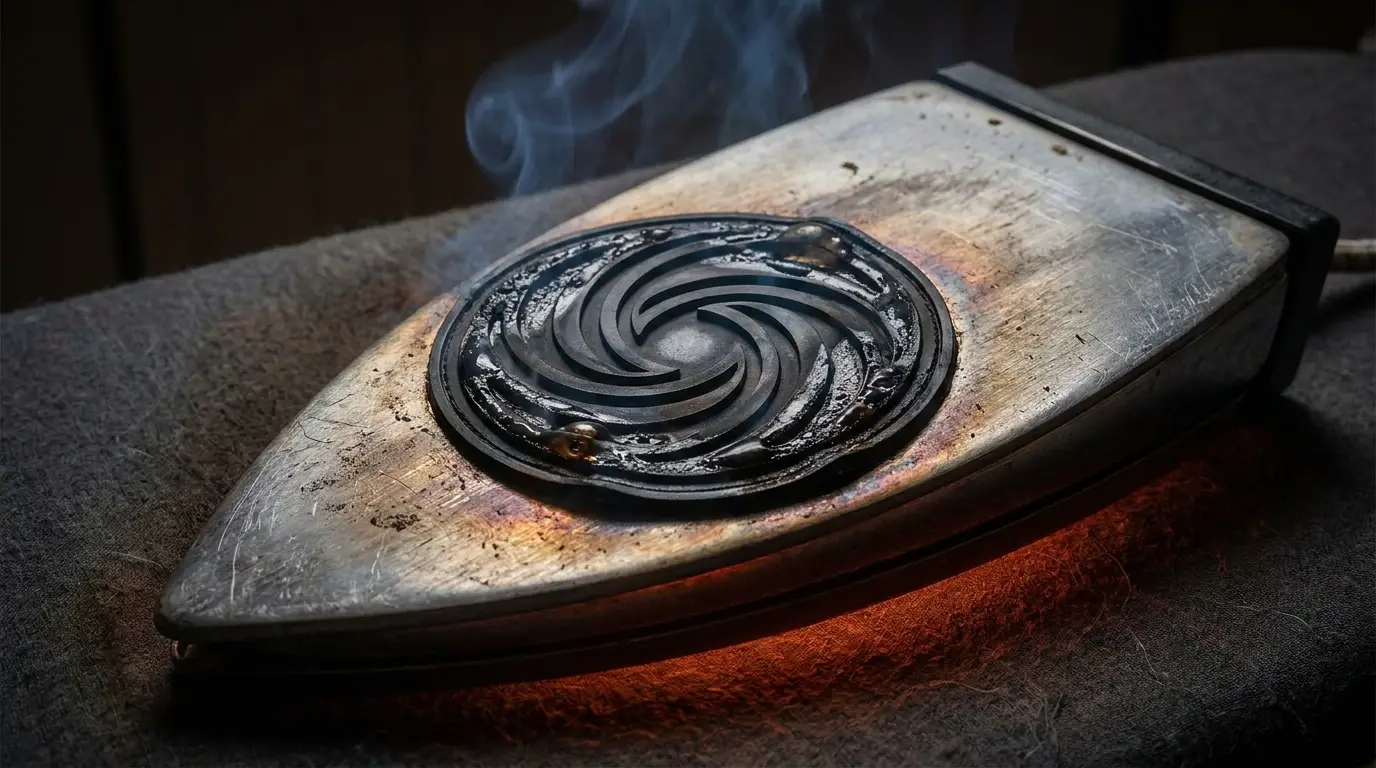
Ironing a PVC patch produces three failures in sequence: the relief melts, the surface scorches, and the softened material bonds to the iron and the garment. Each failure is permanent, and together they ruin both the patch and the item beneath it. The damage explains why care instructions for moulded rubber patches exclude heat of any kind.
The Moulded Relief Melts and Flattens
The moulded relief melts and flattens under the soleplate. A 2D PVC patch carries flat-topped layers at 2.5mm thickness, and a 3D PVC patch carries sculpted contours at 3.5mm thickness. Heat softens both. Raised edges slump first, fine detail rounds off, and the sharp separation between colours blurs as the material flows. The dimensional modelling that a metal mould created in production disappears within seconds under an iron.
The Surface Scorches and Discolours
The surface scorches and discolours as the polymer overheats. PVC releases fumes and yellows when it passes its safe temperature, and the glossy face dulls to a scorched, uneven finish. Colour shift is irreversible, because the pigment sits within a material that has now changed shape and chemistry. A scorched patch cannot be restored, unlike a creased embroidered patch that recovers after a gentle press.
The Patch Bonds to the Iron and the Garment
The softened patch bonds to the iron soleplate and to the garment fibres. Molten PVC is adhesive, so it transfers onto the metal plate and onto the fabric it is pressed against. Removing it lifts fibres from the garment and leaves residue baked onto the iron. One ironing attempt therefore risks three items at once: the patch, the clothing, and the appliance.
Heat-safe alternatives
Which Patches Can Be Ironed On Instead
Embroidered, woven and printed patches can be ironed on, because their materials tolerate iron heat that PVC cannot. These patch types are built on a twill base, and twill withstands the temperature a heat-seal backing needs to activate. A manufacturer bonds a heat-activated adhesive film to the reverse of a twill patch, and a household iron melts that film into the garment. PVC has no equivalent option, so heat tolerance is the one durability measure where embroidered patches lead.
The contrast is a useful way to choose a patch. Where a design needs home application with an iron, an embroidered or woven build suits the job. Where a design needs waterproofing, weather resistance and moulded relief, a PVC build suits the job — and it attaches without heat. The full trade-off between the two materials appears on the PVC vs embroidered patches comparison.

| Patch type | Iron-on available | Reason |
|---|---|---|
| PVC / rubber patches | No | Polyvinyl chloride softens above 120°C |
| Embroidered patches | Yes | Twill base tolerates iron heat |
| Woven patches | Yes | Fine woven thread tolerates iron heat |
| Printed patches | Yes | Twill or fabric base tolerates iron heat |
Three heat-free options
How to Attach a PVC Patch Without Heat
A PVC patch attaches to fabric and gear through three heat-free backings: sew-on, hook-and-loop and adhesive. Backing is applied after curing, so the choice never touches the moulded face. The right backing depends on whether the patch needs to be permanent, removable, or fixed to a hard surface. Every backing below replaces the function of iron-on without the risk of heat, and a step-by-step method for each sits on the how to attach a PVC patch guide.

Sew-On Backing — the Permanent Fabric Bond
Sew-on backing creates the strongest permanent bond of any option. A tailor stitches the patch through a border channel by machine or by hand, and the stitched attachment survives industrial laundering and repeated 40°C machine washing. Sew-on backing is the direct replacement for iron-on, because it delivers the permanence customers want on workwear, cadet uniforms and club colours without applying heat. Choose sew-on backing wherever a patch stays on one garment for its working life.
Hook-and-Loop (Velcro) Backing — Removable
Hook-and-loop backing makes a patch removable and repositionable. A hook panel bonds to the reverse of the patch and fastens to a loop field on the garment, so wearers swap emblems between jackets, plate carriers and packs without tools. Tactical units, airsoft players and security teams specify velcro backing more often than any other option, because operational roles change and the identifier changes with them.
3M Adhesive Backing — for Hard Surfaces
Adhesive backing bonds a patch to smooth, rigid surfaces. A peel-and-stick 3M film sits on the reverse and grips helmets, cases, laptop shells and vehicle panels. Adhesive backing suits hard surfaces rather than fabric, because textile fibres reduce the contact area and weaken the bond over time. Select adhesive backing for kit that is rigid rather than woven.

Professional equipment
Can a Heat Press Be Used on PVC Patches?
No. A heat press cannot be used on PVC patches, because a commercial press runs at 150°C to 190°C and that range sits above the 120°C softening point. A heat press applies the same failure as a domestic iron, with more force and more even heat, so the relief melts across the whole patch rather than in patches. Trade customers sometimes assume professional equipment solves the problem; the temperature makes it worse, not better. PVC patches reach the garment through stitching or a cold-applied backing, never through a press.
In their words
Stories About Us and Our Customers
PVC patches end up on kit that works for a living. These are the orders behind them, the brief, the mould, and what the patch had to survive.
Tactical · Hook-and-loop
“The patches arrived clean, sharp and ready to go straight onto our kit bags.”
The hook-and-loop backing made it easy for the team to swap patches between packs, jackets and plate carriers without losing the raised detail in the badge.
Sarah Mitchell · Manchester
Workwear · Sew-on
“The PVC badges made our workwear look much more professional than printed logos.”
The sew-on finish gave the uniforms a permanent patch that could handle daily wear, wet weather and repeated cleaning.
James Carter · Birmingham
Streetwear · 3D relief
“The 3D finish gave our caps the premium detail we wanted.”
The raised rubber face helped the logo stand out on the front panel while keeping the colours consistent across the run.
Amelia Thompson · London
Outdoor · Waterproof
“The patches held up well on wet kit and still looked fresh after a muddy weekend.”
Waterproof PVC was chosen for bags and jackets where stitched thread would have absorbed moisture and frayed at the edge.
Oliver Hughes · Bristol
Club · Custom shape
“Our badge shape was unusual, but the final patch followed it neatly.”
The custom die-cut outline kept the club crest recognisable while the moulded edge avoided the bulky border of an embroidered patch.
Priya Shah · Leeds
Security · Velcro
“Being able to remove and replace patches between shifts has been really useful.”
Hook-and-loop backing was selected for staff jackets so roles and identifiers could be changed quickly without replacing garments.
Daniel Evans · Cardiff
Tactical · Hook-and-loop
“The patches arrived clean, sharp and ready to go straight onto our kit bags.”
The hook-and-loop backing made it easy for the team to swap patches between packs, jackets and plate carriers without losing the raised detail in the badge.
Sarah Mitchell · Manchester
Workwear · Sew-on
“The PVC badges made our workwear look much more professional than printed logos.”
The sew-on finish gave the uniforms a permanent patch that could handle daily wear, wet weather and repeated cleaning.
James Carter · Birmingham
Streetwear · 3D relief
“The 3D finish gave our caps the premium detail we wanted.”
The raised rubber face helped the logo stand out on the front panel while keeping the colours consistent across the run.
Amelia Thompson · London
Outdoor · Waterproof
“The patches held up well on wet kit and still looked fresh after a muddy weekend.”
Waterproof PVC was chosen for bags and jackets where stitched thread would have absorbed moisture and frayed at the edge.
Oliver Hughes · Bristol
Club · Custom shape
“Our badge shape was unusual, but the final patch followed it neatly.”
The custom die-cut outline kept the club crest recognisable while the moulded edge avoided the bulky border of an embroidered patch.
Priya Shah · Leeds
Security · Velcro
“Being able to remove and replace patches between shifts has been really useful.”
Hook-and-loop backing was selected for staff jackets so roles and identifiers could be changed quickly without replacing garments.
Daniel Evans · Cardiff
Answers
Frequently Asked Questions
Can PVC patches be ironed on?NO
No. PVC patches cannot be ironed on, because polyvinyl chloride softens above 120°C and a domestic iron reaches 180°C on cotton. The heat melts the moulded relief and scorches the surface.
Do PVC patches come with iron-on backing?NO
No. PVC patches are supplied with sew-on, hook-and-loop, adhesive or plain backing, never heat-seal iron-on backing. Sew-on backing is the permanent fabric alternative.
At what temperature does a PVC patch melt?ABOVE 120°C
A PVC patch begins to deform above 120°C, which is well below the 180°C an iron reaches on its cotton setting. No iron setting stays safely below that threshold.
Can you use a heat press on a PVC patch?NO
No. A heat press runs at 150°C to 190°C and destroys the relief, exactly as a domestic iron does. Heat of any kind is unsuitable for moulded PVC.
Are embroidered patches iron-on?YES
Yes. Embroidered patches accept iron-on backing, because their twill base tolerates iron heat. This is the one durability measure where embroidered patches hold an advantage over PVC.
Key takeaways
Key Takeaways
Heat and moulded rubber do not mix. Polyvinyl chloride is a thermoplastic, so an iron or a heat press reflows the relief that curing set in the factory, and the damage cannot be undone. Customers who need a patch fixed to fabric for good reach for stitching rather than heat, and sew-on backing gives that permanence on every garment from workwear to cadet uniform. A UK manufacturer supplies PVC patches with sew-on, velcro, adhesive or plain backing, at no minimum order, with standard production of 10 to 14 working days from proof approval, express production of 5 to 7 working days, and 1 to 2 working days for UK mainland delivery. BFPO addresses are accepted for serving personnel.