Reflective PVC · Retroreflective visibility
Reflective PVC Patches UK — Retroreflective Rubber Badges Made to Your Artwork
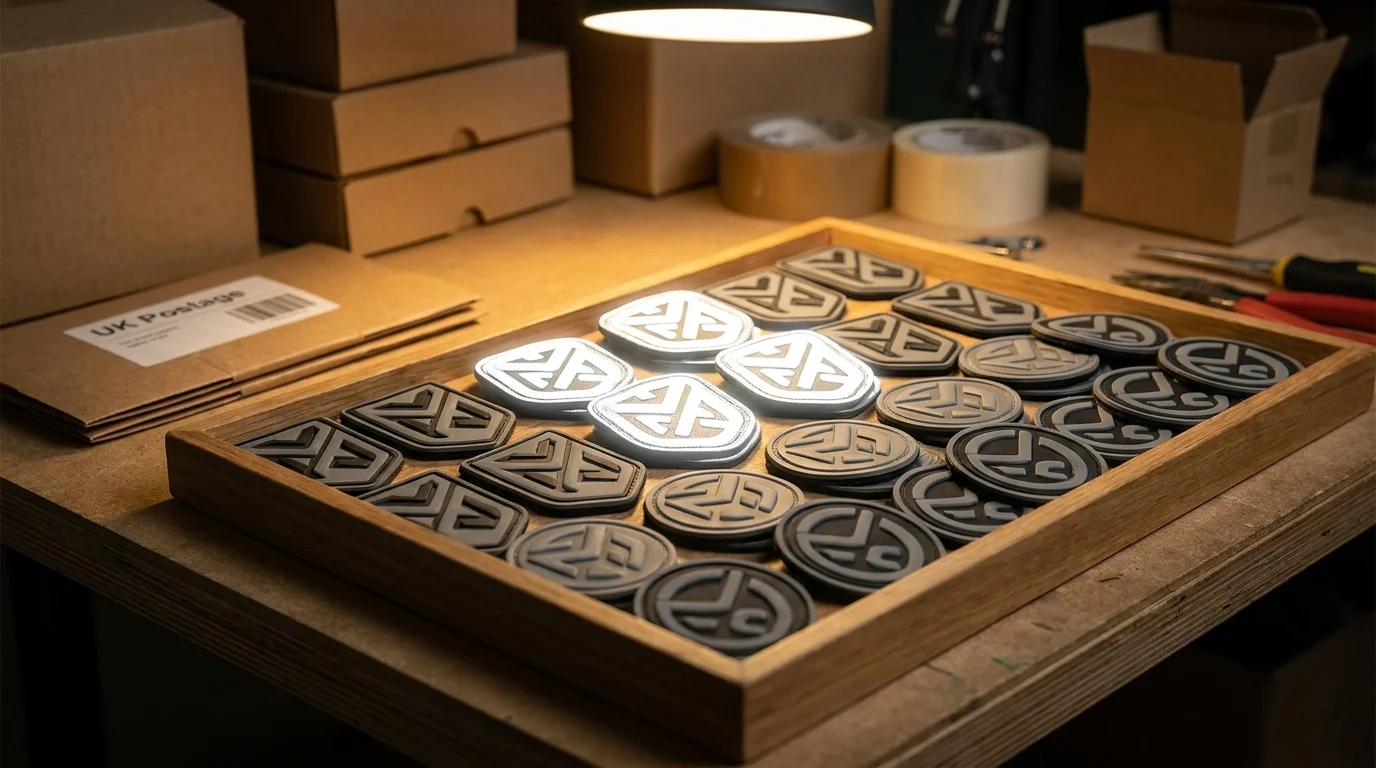
Reflective PVC patches are moulded polyvinyl chloride badges fitted with a retroreflective layer that returns torchlight and headlight beams towards their source. UK teams order reflective PVC patches for night-time visibility on tactical gear, workwear, cycling kit and emergency equipment. Customers supply artwork, approve a digital proof, and choose hook-and-loop, sew-on or adhesive backing, with Pantone colour matching on every moulded area of the patch.

Featured Client

Reflective PVC patches
What Are Reflective PVC Patches?
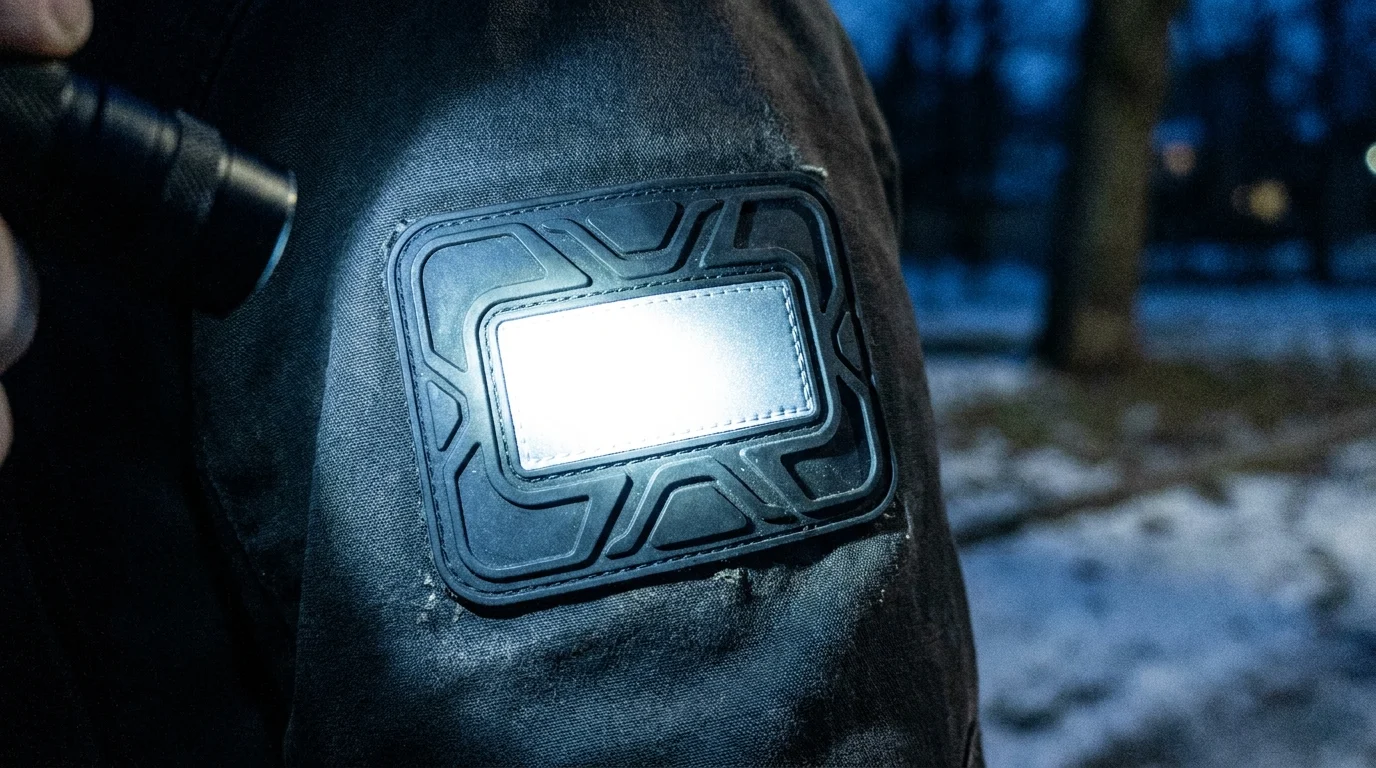
Reflective PVC patches combine a moulded rubber body with a retroreflective surface that activates under a directed light source. The rubber body reproduces a logo, badge or crest as raised relief, exactly as a standard PVC patch does. The retroreflective surface adds a second function: it sends light back along the path it arrived on, which makes the wearer visible to a driver, a torch or a head-torch at distance. A reflective PVC patch therefore works as both a branded emblem and a low-light safety marker.
Retroreflective material sits on the patch rather than inside the polymer. Manufacturers bond a reflective film or panel to the moulded PVC, then laminate and finish the edge so the patch stays waterproof and non-fraying. The moulded areas keep their Pantone-matched colour through the full depth of the material, while the reflective areas read as silver-grey or coloured in daylight and flare bright under a beam at night.
Reflective PVC Patch Specifications
| Attribute | Value |
|---|---|
| Material | Plasticised polyvinyl chloride (PVC) + retroreflective layer |
| Reflective type | Glass bead or microprismatic |
| Relief | 2D flat-topped or 3D sculpted |
| Thickness | 2.5mm (2D) / 3.5mm (3D) |
| Size range | 25mm – 200mm |
| Daytime appearance | Silver-grey or coloured reflective face |
| Night-time behaviour | Returns torchlight and headlight beams to source |
| Colour system | Pantone (PMS) matched on moulded areas |
| Backing | Hook-and-loop, sew-on, 3M adhesive, or plain |
| Wash tolerance | 40°C machine wash |
| Minimum order | No minimum |
What “Retroreflective” Actually Means
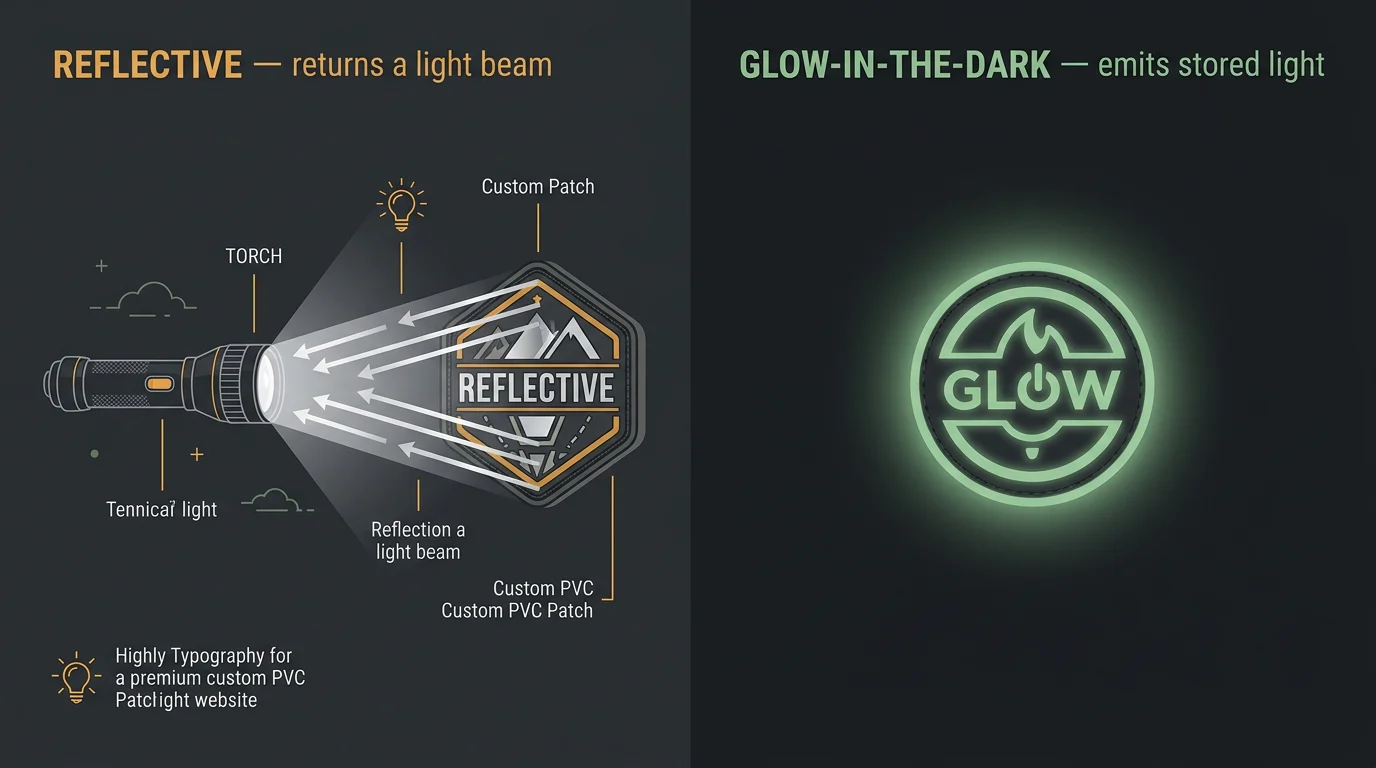
Retroreflection returns incoming light to the position it came from. A flat mirror bounces light away at an equal and opposite angle, so a driver sees nothing unless they sit directly in the reflected path. A retroreflective surface behaves differently: it returns the beam straight back to the source, so the driver behind the headlights sees the patch light up regardless of the exact angle. This property is what gives road signs, hi-vis clothing and reflective patches their night-time brightness.
Retroreflective patches depend on an external light source. The patch stays dark in full darkness and flares only when a torch, a head-torch or a vehicle headlight strikes it. Brightness rises as the beam gets stronger and as the viewer moves closer to the line of the light. Reflective PVC patches therefore perform best where moving light exists — roadsides, car parks, trails and night operations.
Reflective PVC Patches vs Glow-in-the-Dark PVC Patches
Reflective PVC patches and glow-in-the-dark PVC patches solve night visibility in opposite ways, and the two are often confused. A reflective patch returns light from an outside source and needs a beam to work. A glow-in-the-dark patch stores light and emits it on its own, so it shines in total darkness with no torch present. Reflective suits roadside and vehicle environments; glow suits pitch-dark identification where no light source exists. Choose reflective for a driver-facing marker, and choose glow for a self-lit badge — the distinction decides which patch fits the job.
Reflective PVC patches
Types of Reflective PVC Patches
Reflective PVC patches divide into three construction types plus two reflective materials. Construction decides how much of the patch reflects; material decides how brightly it reflects. Selection depends on how much night conspicuity the wearer needs and how prominent the branding has to stay in daylight.

Full Reflective-Base Patches
Full reflective-base patches carry a retroreflective surface across the entire face. The whole patch lights up under a beam, which produces the strongest return and the highest night conspicuity. Highway crews, roadside recovery operators and cyclists specify full reflective bases where maximum visibility outranks daytime colour.
Reflective Inset-Panel Patches
Reflective inset-panel patches set a retroreflective panel inside a moulded PVC frame. The frame holds the brand colour and relief, and the panel supplies the reflective flash. Name badges, ID markers and slot-in patches use this construction because it pairs a readable daytime layout with a reflective strip for low light.
Selective-Element Reflective Patches
Selective-element reflective patches make only chosen parts of the design reflect. An outline, a band of lettering or a single icon carries the reflective layer, while the surrounding rubber stays standard moulded PVC. This construction keeps a bold daytime brand and adds a reflective accent, so the patch reads as a logo by day and a marker by night.
Glass Bead vs Microprismatic Reflective Material
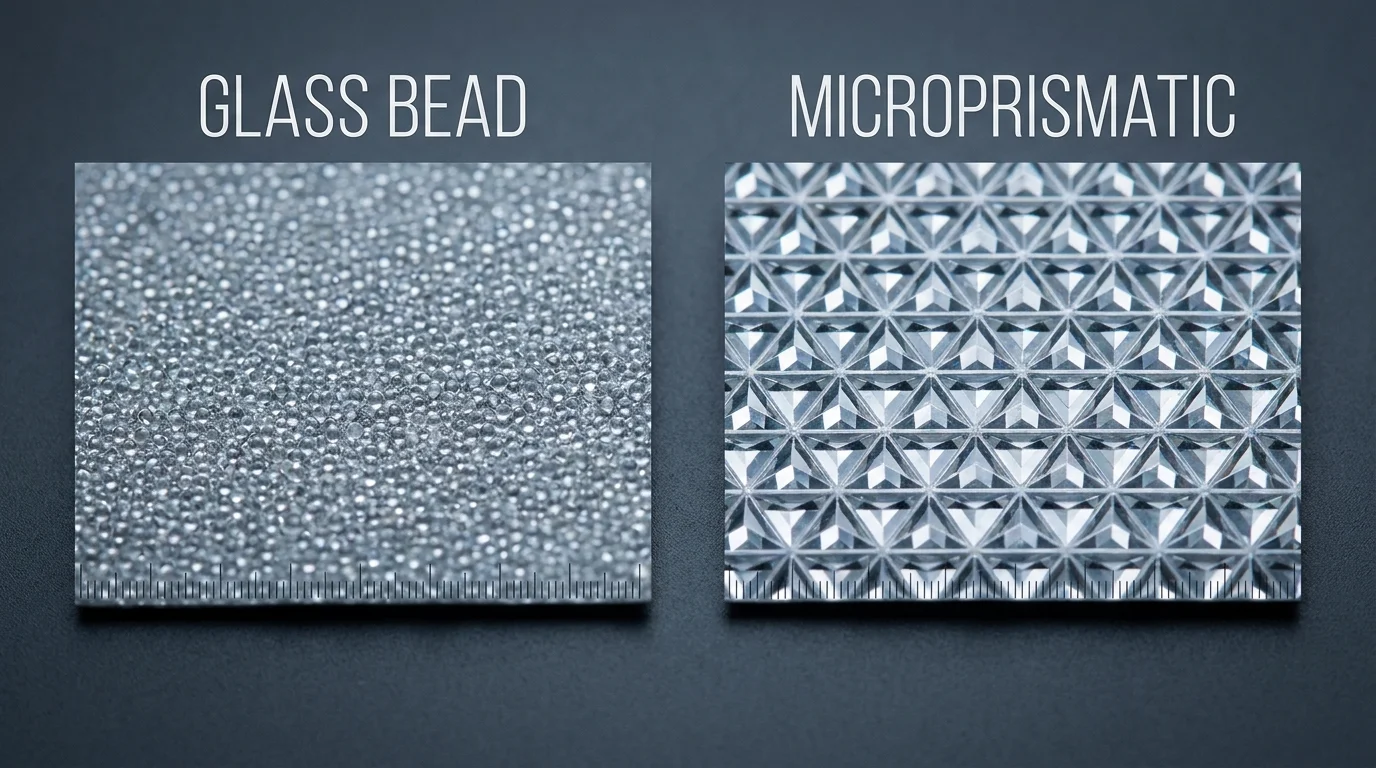
Glass bead material and microprismatic material return light by different methods. Glass bead film uses thousands of tiny glass spheres that bounce light back across a wide viewing angle. Microprismatic film uses a moulded grid of geometric prisms that returns more light in a tighter, brighter cone. Microprismatic reflects more light than glass bead at the same size, and costs more to produce. The table below sets the two side by side.
| Attribute | Glass Bead Reflective | Microprismatic Reflective |
|---|---|---|
| Reflective structure | Glass spheres | Moulded prism grid |
| Brightness | Good | Higher return |
| Viewing angle | Wide | Directional, very bright head-on |
| Surface | Smooth | Faceted / structured |
| Relative cost | Lower | Higher |
| Best for | General visibility markers | Maximum long-range conspicuity |
Reflective PVC patches
How Reflective PVC Patches Are Made
Reflective PVC patch production follows five stages. Each stage builds on the last, and the reflective layer joins the process after the rubber body is formed.
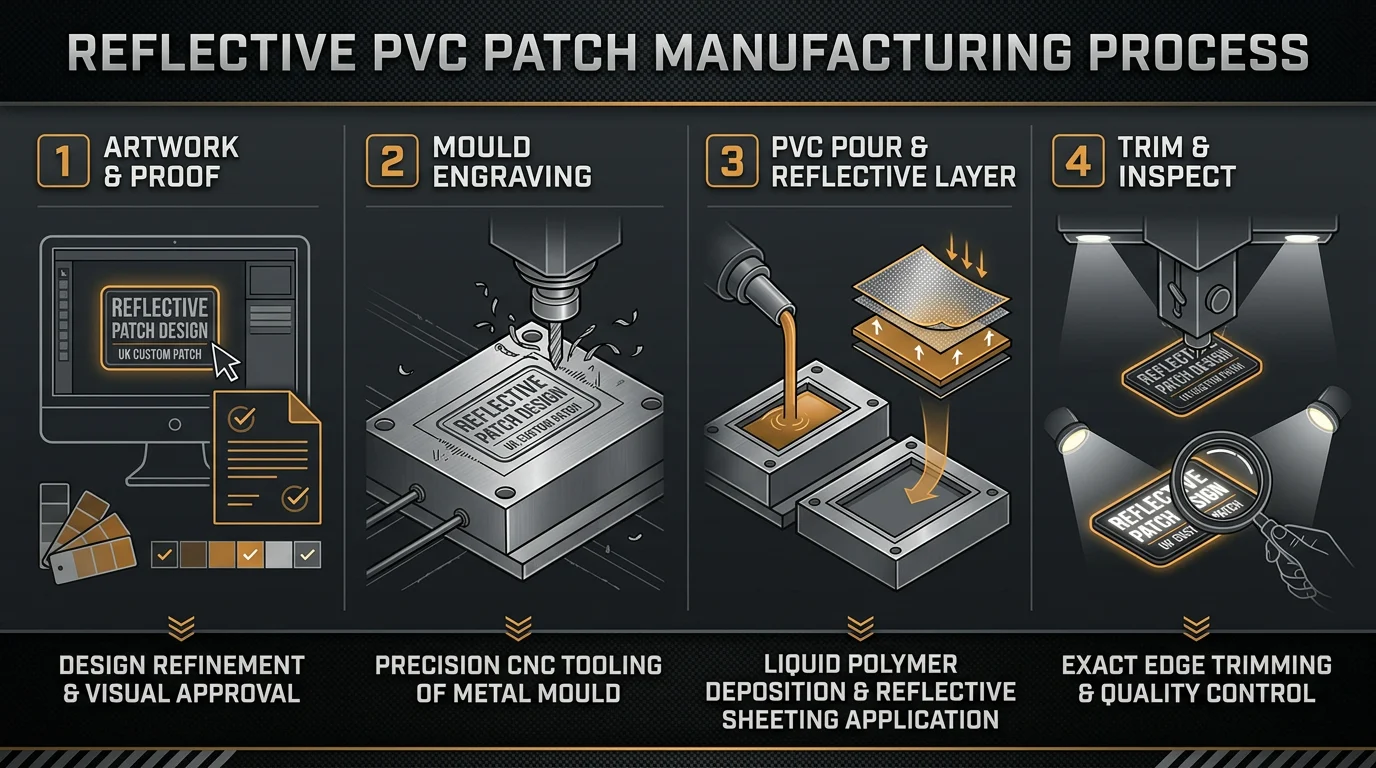
- Artwork submission and digital proof — Artwork arrives as a vector file, a photograph or a sketch. The design team marks the Pantone reference for each moulded colour and confirms which elements reflect. Customers approve the proof before any tooling begins.
- Metal mould engraving — Engineers engrave the approved design into a metal mould. A 2D layout uses a shallow cavity; a 3D layout uses a deeper, sculpted cavity. One mould serves the full run and every reorder.
- PVC pouring and curing — Operators pour liquid PVC into the mould one colour at a time, then cure it under heat until the polymer sets into solid rubber. Curing fixes the relief permanently.
- Retroreflective layer bonding — Technicians bond the reflective film or panel to the cured PVC and laminate the join. Lamination seals the reflective surface against water and abrasion.
- Trimming, backing and inspection — Technicians trim the die-cut edge, apply the chosen backing, and check every patch against the approved proof for colour, dimensions and reflective performance.
Reflective PVC patches
Benefits of Reflective PVC Patches
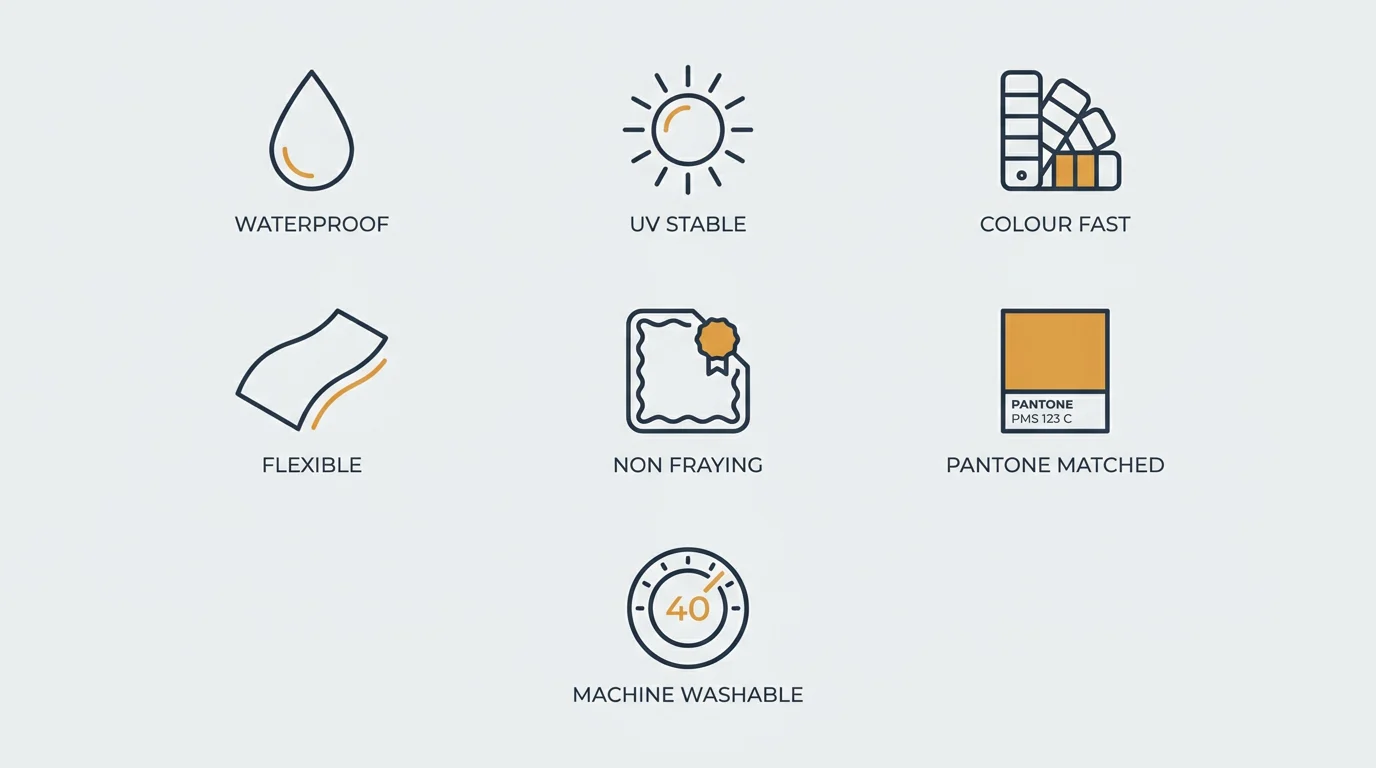
Reflective PVC patches outperform reflective thread and printed transfers across several measurable attributes:
- Light-returning — the retroreflective layer sends torchlight and headlights back to the viewer at distance
- Waterproof — the moulded PVC body absorbs no water and carries no stitched edge to fray
- UV-stable — heat stabilisers hold the moulded colour under prolonged sunlight
- Colour-fast — pigment runs through the full depth of the moulded areas rather than sitting on the surface
- Flexible — plasticised PVC bends with the garment and returns to shape without cracking
- Machine washable — the patch withstands repeated laundering at 40°C
- Pantone-matched — brand colour reproduces to a PMS reference on the moulded areas of every reorder
Durability translates into cost per wear. A moulded reflective patch survives rain, road grime and abrasion that shorten the life of reflective embroidery, which is why safety-critical and outdoor sectors adopt it first.
Reflective PVC patches
Where Reflective PVC Patches Are Used in the UK
Reflective PVC patches appear across five UK sectors. Application drives specification: size, reflective coverage and backing change with the environment the patch works in.

Emergency Services and Highway Maintenance
Emergency services crews and highway maintenance teams fit reflective PVC patches to jackets, tabards and plate carriers. Vehicle headlights strike the retroreflective surface and return a bright flash, which marks personnel on live carriageways and incident scenes. Waterproof rubber suits wet roadside conditions where reflective thread would soak and dull.
Cycling, Running and Outdoor Clubs
Cycling clubs, running groups and outdoor collectives mount reflective PVC patches on jerseys, packs and technical shells. Passing headlights and head-torches light the patch on unlit roads and trails. Adhesive and hook-and-loop backings attach the patch without piercing a waterproof membrane, so the shell stays sealed.
Security and Door Supervisors
Security teams and door supervisors specify reflective PVC patches on stab vests and softshells. Hook-and-loop backing lets staff swap role identifiers between shifts, and the reflective surface keeps personnel visible in dark car parks and doorways. A reflective ID patch reads clearly under a torch during night checks.
Military, Cadet and Airsoft Night Use
British forces personnel, cadet detachments and airsoft teams use reflective PVC patches for night identification. Reflective and infrared-compatible finishes support recognition after dark, and subdued daytime colourways keep the patch low-profile in daylight. BFPO addresses are accepted on delivery for serving personnel.
Assistance Dogs and Dog Walking
Assistance-dog handlers and dog walkers fit reflective PVC patches to harnesses, coats and leads. Passing headlights return from the patch and mark the animal on dark pavements and country lanes. Flexible rubber holds its shape on a moving harness where a stitched patch would abrade.
Reflective PVC patches
Reflective PVC Patches vs Reflective Embroidered and Printed Patches
Reflective PVC patches, reflective embroidered patches and reflective printed patches differ in their reflective source, waterproofing and outdoor life. Selection depends on where the patch works and how long it needs to last.
| Attribute | Reflective PVC Patch | Reflective Embroidered Patch | Reflective Printed Patch |
|---|---|---|---|
| Reflective source | Bonded retroreflective layer | Reflective thread | Reflective transfer film |
| Waterproof | Yes | No | Partial |
| Durability outdoors | High | Medium | Low |
| Edge finish | Die-cut, sealed | Merrow border | Cut edge |
| Iron-on backing | Not available | Available | Available |
| Best use | Outdoor, tactical, night safety | Uniforms, club colours | Short-run promotional |
Reflective embroidered patches carry reflective thread within a stitched design and suit club colours and uniforms where thread texture matters. Reflective printed patches apply a reflective transfer and suit short promotional runs. Reflective PVC patches lead wherever water, road grime and abrasion shorten the life of thread, which explains their adoption across emergency, marine and highway sectors. For a wider material comparison, see PVC vs embroidered patches.

Reflective PVC patches
Backing Options for Reflective PVC Patches
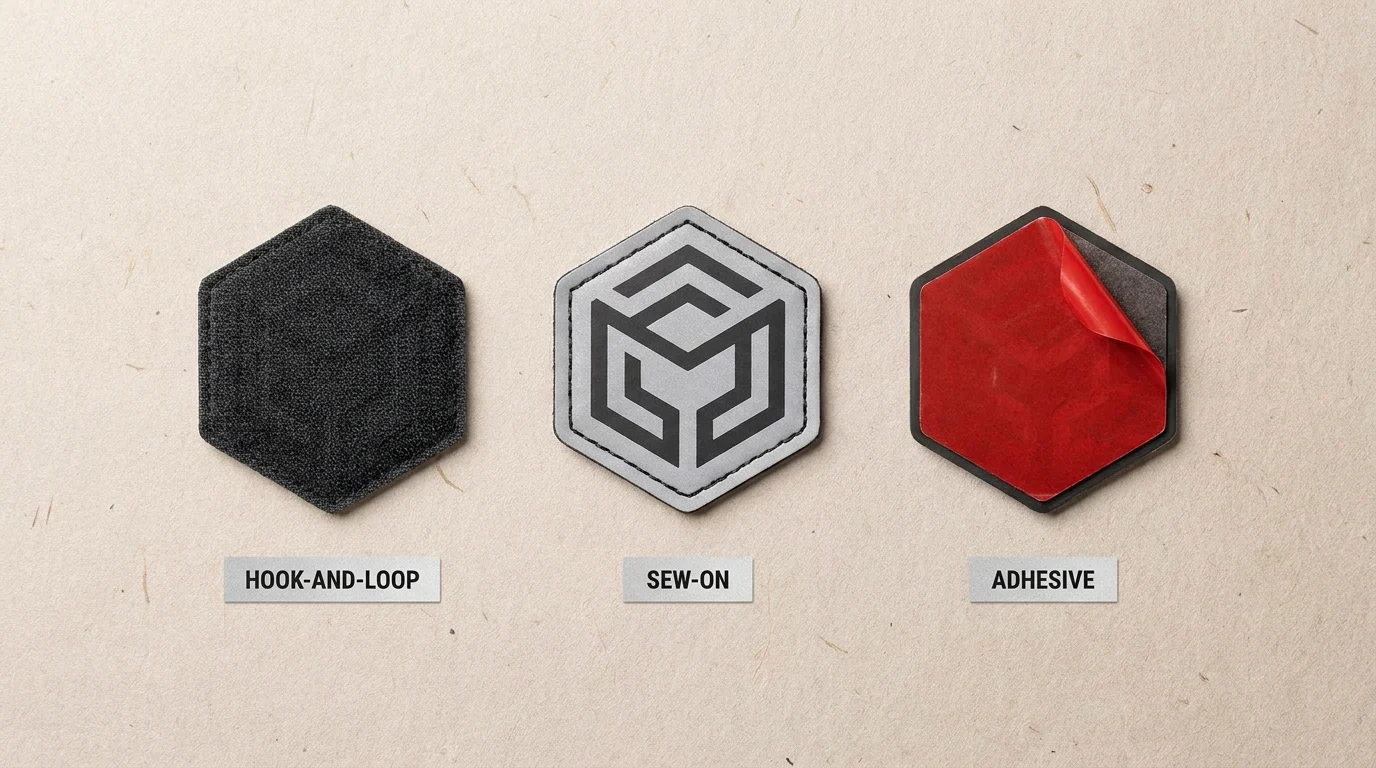
Backing determines how a reflective PVC patch attaches to a garment or piece of gear. Backing is applied after curing, so the choice does not affect the moulded face or the reflective surface.
- Hook-and-loop (velcro) — hook-and-loop backing makes the patch removable, so wearers swap it between jackets, plate carriers and packs. Tactical, security and airsoft users choose it most often.
- Sew-on — a stitch channel produces the strongest bond and survives industrial laundering. Workwear and uniforms use sew-on backing.
- 3M adhesive — a peel-and-stick film bonds to hard surfaces such as helmets and cases.
Reflective PVC patches are not supplied iron-on. Polyvinyl chloride softens above 120°C, and a domestic iron reaches 180°C on a cotton setting, so heat at that level deforms the moulded relief and can dull the reflective layer. Customers who need a permanent bond on fabric select sew-on backing instead.
Reflective PVC patches
Do Reflective PVC Patches Meet Hi-Vis Standards?
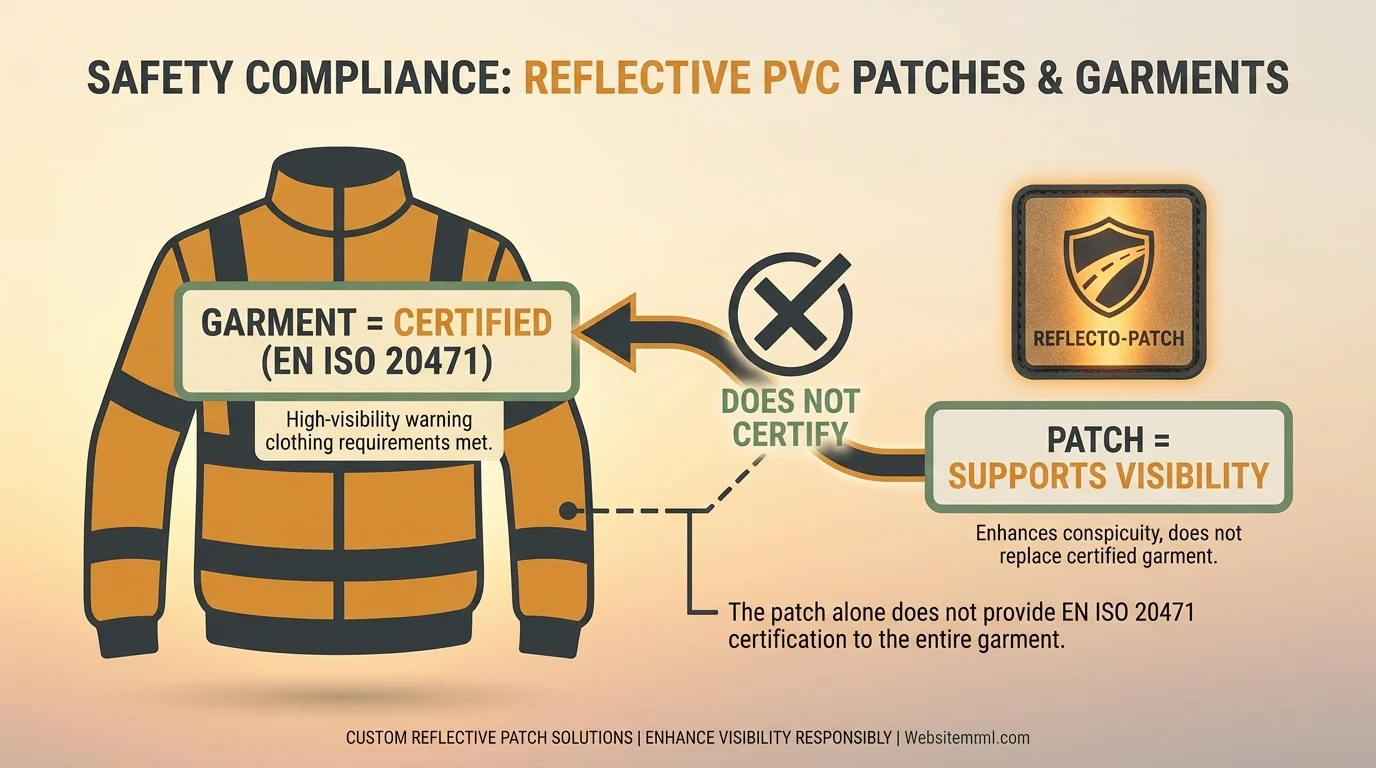
A reflective PVC patch supports visibility but does not certify a garment on its own. EN ISO 20471 is the British and European standard for high-visibility clothing, and it certifies complete garments as tested — the standard measures background fluorescent material and retroreflective material across the whole garment, not a single patch. A reflective patch adds a retroreflective marker and improves conspicuity, yet it does not turn a non-compliant jacket into a certified hi-vis garment.
Buyers who need certified high-visibility clothing should specify a garment that already carries an EN ISO 20471 rating, then add reflective PVC patches for branding and role identification. Reflective PVC patches work as a visibility aid and a bespoke badge; they do not replace certified PPE.
Reflective PVC patches
How to Order Reflective PVC Patches
Ordering follows five steps from enquiry to delivery.
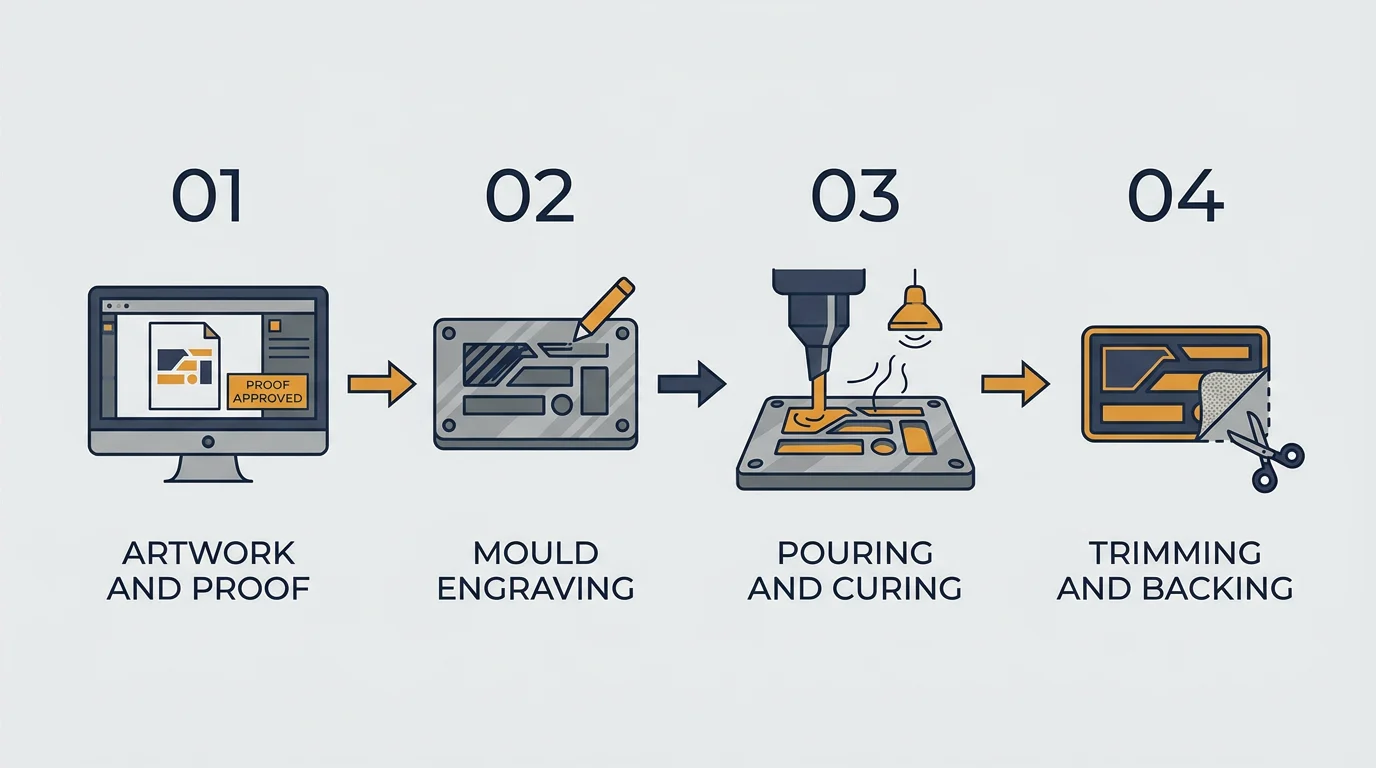
- Send your artwork — upload a vector file, JPEG or sketch with your target size, quantity and the elements you want to reflect.
- Receive a quotation — pricing covers moulding, the reflective layer, backing and UK delivery.
- Approve the digital proof — check moulded colours against Pantone references and confirm the reflective areas.
- Production begins — mould engraving, pouring, curing, reflective bonding and backing application.
- Delivery — tracked despatch to a UK address, including BFPO.
There is no minimum order quantity, so you order the exact number you need. Standard production takes 10 to 14 working days from proof approval, and express production takes 5 to 7 working days from proof approval. Delivery to UK mainland addresses adds 1 to 2 working days. Reorders of an approved design cost less than the first run, because the mould already exists. All prices are quoted in pounds sterling and exclude VAT at 20%. See UK turnaround and delivery for full despatch detail.
In their words
Stories About Us and Our Customers
PVC patches end up on kit that works for a living. These are the orders behind them, the brief, the mould, and what the patch had to survive.
Tactical · Hook-and-loop
“The patches arrived clean, sharp and ready to go straight onto our kit bags.”
The hook-and-loop backing made it easy for the team to swap patches between packs, jackets and plate carriers without losing the raised detail in the badge.
Sarah Mitchell · Manchester
Workwear · Sew-on
“The PVC badges made our workwear look much more professional than printed logos.”
The sew-on finish gave the uniforms a permanent patch that could handle daily wear, wet weather and repeated cleaning.
James Carter · Birmingham
Streetwear · 3D relief
“The 3D finish gave our caps the premium detail we wanted.”
The raised rubber face helped the logo stand out on the front panel while keeping the colours consistent across the run.
Amelia Thompson · London
Outdoor · Waterproof
“The patches held up well on wet kit and still looked fresh after a muddy weekend.”
Waterproof PVC was chosen for bags and jackets where stitched thread would have absorbed moisture and frayed at the edge.
Oliver Hughes · Bristol
Club · Custom shape
“Our badge shape was unusual, but the final patch followed it neatly.”
The custom die-cut outline kept the club crest recognisable while the moulded edge avoided the bulky border of an embroidered patch.
Priya Shah · Leeds
Security · Velcro
“Being able to remove and replace patches between shifts has been really useful.”
Hook-and-loop backing was selected for staff jackets so roles and identifiers could be changed quickly without replacing garments.
Daniel Evans · Cardiff
Merchandise · Colour match
“The colours matched our brand better than the woven sample we tried before.”
Pantone-matched PVC helped keep the logo consistent for merchandise, reorder stock and event giveaways.
Hannah Wilson · Nottingham
Motorcycle · Jacket patch
“The rubber patch gave the jacket a cleaner, tougher finish.”
The club needed a weather-resistant badge that could handle rain, road grime and regular outdoor use.
Mark Robinson · Newcastle
Sports · Team kit
“The patch worked well on kit bags and training jackets.”
A flexible PVC build kept the team crest visible without adding a heavy stitched border to lightweight gear.
Rebecca Green · Sheffield
Repeat order · Reorder
“Reordering was simple because the mould was already set up.”
The second run kept the same dimensions, relief and colour references as the original patch order.
Thomas Baker · Glasgow
Tactical · Hook-and-loop
“The patches arrived clean, sharp and ready to go straight onto our kit bags.”
The hook-and-loop backing made it easy for the team to swap patches between packs, jackets and plate carriers without losing the raised detail in the badge.
Sarah Mitchell · Manchester
Workwear · Sew-on
“The PVC badges made our workwear look much more professional than printed logos.”
The sew-on finish gave the uniforms a permanent patch that could handle daily wear, wet weather and repeated cleaning.
James Carter · Birmingham
Streetwear · 3D relief
“The 3D finish gave our caps the premium detail we wanted.”
The raised rubber face helped the logo stand out on the front panel while keeping the colours consistent across the run.
Amelia Thompson · London
Outdoor · Waterproof
“The patches held up well on wet kit and still looked fresh after a muddy weekend.”
Waterproof PVC was chosen for bags and jackets where stitched thread would have absorbed moisture and frayed at the edge.
Oliver Hughes · Bristol
Club · Custom shape
“Our badge shape was unusual, but the final patch followed it neatly.”
The custom die-cut outline kept the club crest recognisable while the moulded edge avoided the bulky border of an embroidered patch.
Priya Shah · Leeds
Security · Velcro
“Being able to remove and replace patches between shifts has been really useful.”
Hook-and-loop backing was selected for staff jackets so roles and identifiers could be changed quickly without replacing garments.
Daniel Evans · Cardiff
Merchandise · Colour match
“The colours matched our brand better than the woven sample we tried before.”
Pantone-matched PVC helped keep the logo consistent for merchandise, reorder stock and event giveaways.
Hannah Wilson · Nottingham
Motorcycle · Jacket patch
“The rubber patch gave the jacket a cleaner, tougher finish.”
The club needed a weather-resistant badge that could handle rain, road grime and regular outdoor use.
Mark Robinson · Newcastle
Sports · Team kit
“The patch worked well on kit bags and training jackets.”
A flexible PVC build kept the team crest visible without adding a heavy stitched border to lightweight gear.
Rebecca Green · Sheffield
Repeat order · Reorder
“Reordering was simple because the mould was already set up.”
The second run kept the same dimensions, relief and colour references as the original patch order.
Thomas Baker · Glasgow
Answers
Reflective PVC Patches — Frequently Asked Questions
Do reflective PVC patches glow in the dark?NO
No. Reflective PVC patches return an external light beam towards its source and stay dark without a torch or headlights, whereas glow-in-the-dark PVC patches emit stored light on their own.
Are reflective PVC patches waterproof?YES
Yes. The moulded PVC body absorbs no water and carries no stitched edge to unravel, so rain, immersion and machine washing leave the patch unchanged.
Can reflective PVC patches be ironed on?NO
No. PVC softens above 120°C and a domestic iron reaches 180°C, so choose sew-on backing for a permanent bond on fabric.
Are reflective PVC patches machine washable?YES
Yes. Reflective PVC patches withstand machine washing at 40°C; wash sew-on patches attached to the garment, and remove velcro patches before laundering.
Do reflective PVC patches make a garment hi-vis compliant?NO
No. EN ISO 20471 certifies complete high-visibility garments as tested, not individual patches, so a reflective patch supports visibility without certifying the garment.
Is there a minimum order for reflective PVC patches?NO
No. There is no minimum order quantity, so you order exactly the quantity you need, from a small batch to a larger production run.
Can reflective PVC patches have velcro backing?YES
Yes. Hook-and-loop backing is available and is the most common choice for tactical and security kit that changes between shifts. —
Reflective PVC patches
Why Order Reflective PVC Patches from a UK Manufacturer
Reflective PVC patches earn their place through material science rather than tradition. A retroreflective layer bonded to waterproof moulded rubber returns headlights and torchlight at distance, and it survives the rain, road grime and laundry cycles that fade reflective thread. Emergency crews, cyclists, security teams and cadet units across Britain choose moulded reflective badges for exactly that reason. A UK manufacturer shortens the loop between artwork, proof and delivery, quotes in sterling with VAT stated plainly, and accepts BFPO addresses for serving personnel. Send your design for a quotation and receive a digital proof before anything is cut.