Design hub · Artwork setup · UK
PVC Patch Design & Artwork Guide
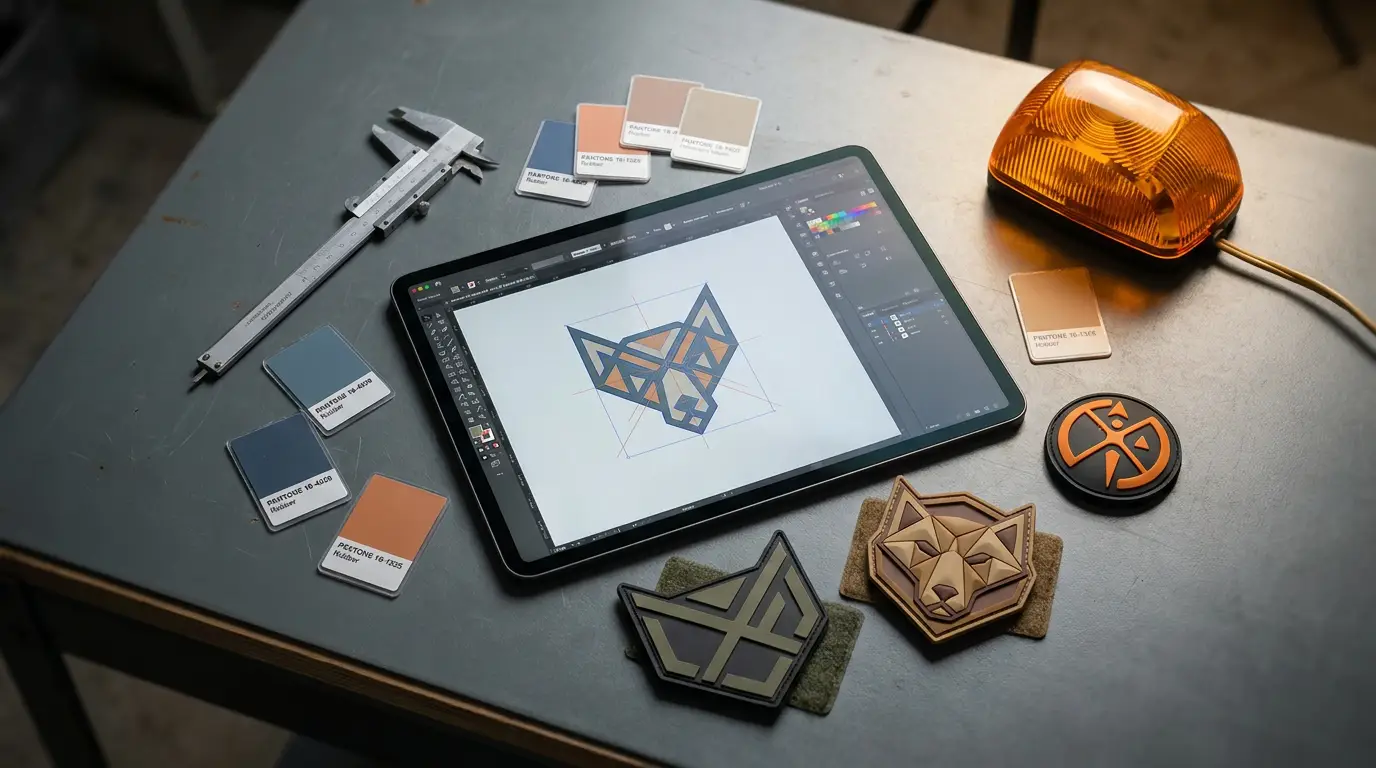
PVC patch artwork is the vector design file that a manufacturer engraves into a metal mould to produce a moulded rubber patch. This guide explains how to design a custom PVC patch and prepare print-ready artwork for the UK market, covering file formats, Pantone colours, minimum text size, sizes, die-cut shapes and the digital proof. Good preparation controls the outcome, because the mould reproduces exactly what the approved artwork contains.
Featured Client
Design specification
What Makes a Good PVC Patch Design?
A good PVC patch design uses bold shapes, clean colour separation and generous spacing. PVC reproduces a logo as raised relief inside a mould, not as printed ink or stitched thread, so the design rules differ from print and embroidery. The mould holds solid forms accurately, while it struggles with hairline detail and photographic gradients.
Four principles produce a reliable moulded emblem:
- Bold shapes read best — chunky forms translate cleanly into relief.
- Flat spot colours reproduce accurately — each colour occupies its own recess in the mould.
- Negative space keeps a design legible — crowded artwork closes up during moulding.
- Detail respects tolerance — text and lines below the minimum lose definition.
Design discipline at this stage prevents rework later, which is why file preparation matters next.

Design specification
Artwork File Requirements for PVC Patches
PVC patch artwork works best as a scalable vector file. A vector file stores the design as mathematical outlines, so it scales to any patch size without loss of quality. Our design team cuts the mould from these clean outlines, which is why vector artwork produces the sharpest relief.
Raster files are accepted as a fallback. A raster file stores the design as pixels, so it must be supplied at high resolution to hold detail at the final patch size.
| Attribute | Value |
|---|---|
| Preferred file type | Vector (AI, EPS, PDF, SVG) |
| Accepted fallback | High-resolution raster (PNG, JPEG) |
| Minimum raster resolution | 300 DPI at final patch size |
| Colour mode | Pantone (PMS) solid coated |
| Quote-stage input | Hand-drawn sketch or reference photo |
A sketch or photograph is enough to start a quotation, because our team redraws it as production-ready vector artwork before the proof. See the full PVC patch artwork requirements for file-by-file specifications. Once the file is correct, the relief type shapes the next design decision.

Design specification
Designing for 2D vs 3D Relief
Relief choice changes how a design translates into rubber. A 2D PVC patch has flat-topped layers on a single plane, and it suits text, flat logos and line art. A 3D PVC patch has sculpted, rounded relief, and it suits faces, animals and detailed crests. The two constructions carry different thicknesses and read differently at distance.
| Attribute | 2D PVC Patch | 3D PVC Patch |
|---|---|---|
| Surface | Flat-topped layers | Rounded, sculpted relief |
| Finished thickness | 2.5mm | 3.5mm |
| Mould depth | Shallow | Deep, multi-level |
| Minimum text height | 5mm | 6mm |
| Best for | Text, flat logos, line art | Faces, animals, detailed crests |
| Relative cost | Lower | Higher |
A 3D patch reads clearly from a distance, because sculpted relief catches light at multiple angles. Choose the relief before you finalise colours, since depth affects how each colour zone sits. Compare the constructions in detail on the 2D PVC patches and 3D PVC patches pages.

Design specification
Colour and Pantone Matching in Your Design
PVC patches carry colour through the full depth of the material. Manufacturers blend pigment into the plasticised polyvinyl chloride before moulding, so the colour does not fade, peel or crack the way printed ink does. This material-stage colouring is why a PVC patch holds its brand colours for the life of the garment.
Specify colours as Pantone (PMS) solid coated references. Each colour occupies a separate recess in the mould, which produces clean separation with no outlines and no bleed. Flat spot colours reproduce best, and gradients are limited because the process pours discrete colours rather than blending them.
Three rules keep colour accurate on a custom PVC patch:
- State a Pantone reference for every colour — the reference matches on every reorder.
- Keep the colour count deliberate — each colour adds a recess to the mould.
- Separate colours with clean edges — hard boundaries mould cleanly.
Accurate colour specification protects brand consistency across a fleet or a merchandise run. Full detail sits on the Pantone colour matching page. Colour settled, the next constraint is scale — how small the text and lines can go.

Design specification
Minimum Text and Line Size
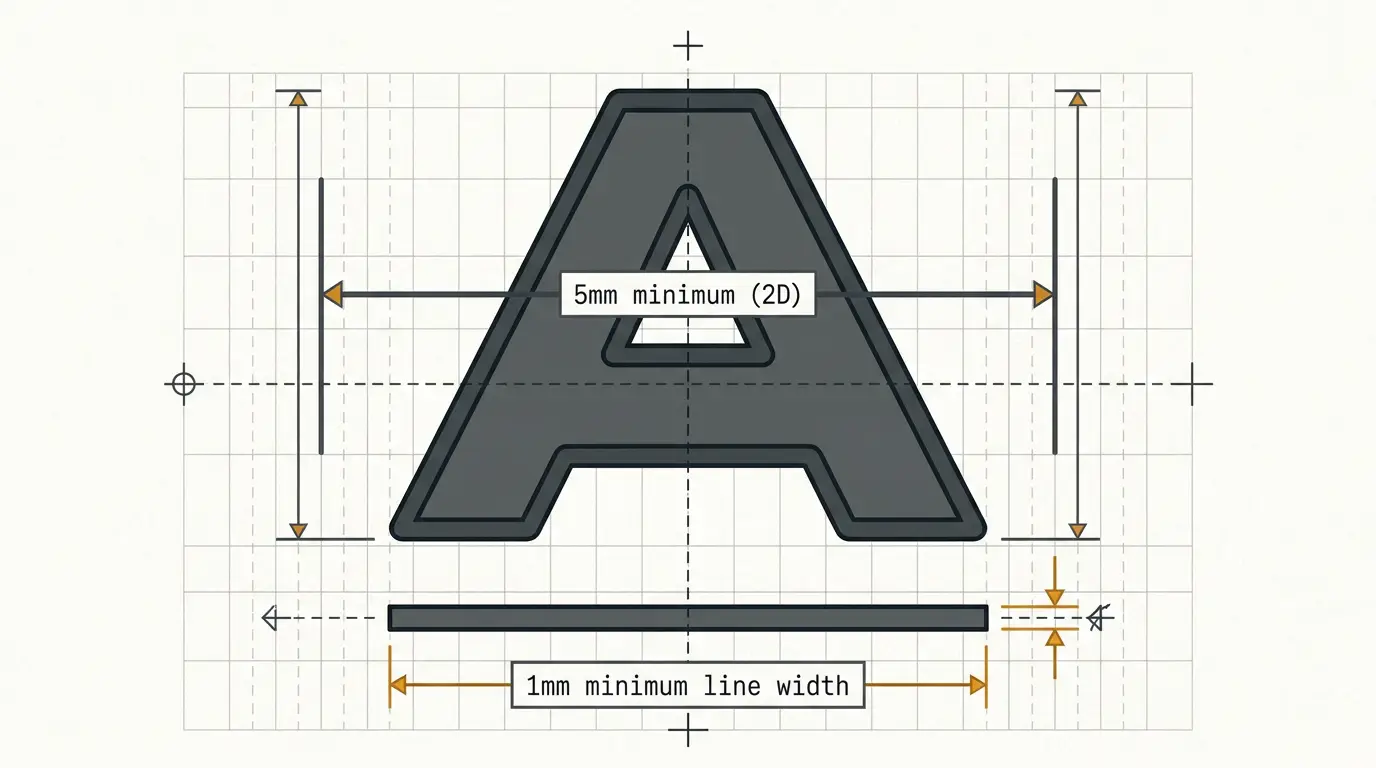
The minimum text height is 5mm on 2D patches and 6mm on 3D patches. The minimum line width is approximately 1mm. Mould engraving has a physical resolution limit, so text and lines below these figures close up and lose legibility after moulding.
Legibility depends on relief as well as size. A 3D patch needs slightly larger text than a 2D patch, because sculpted relief rounds the edges of each letterform. Keep fine print and thin strokes above tolerance, and simplify any element that falls below it. See the minimum text size guide for worked examples. Scale governs text and lines; it also governs the overall size and outline of the patch.
Design specification
Sizes, Shapes and Die-Cut Outlines
Custom PVC patches are produced between 25mm and 200mm across the longest edge. Size is measured as the average of width and height, which is the convention UK suppliers quote against. Standard shapes include round, square, rectangular, oval and shield.
Custom die-cut shapes follow the outline of your artwork at no additional tooling cost. The mould is cut to your design regardless of profile, so an irregular badge shape costs the same to tool as a circle. A die-cut edge seals during moulding, so the border never frays.
Design the outline as part of the artwork, not as an afterthought. A clean silhouette reproduces sharply, while a fiddly outline with tiny spurs moulds poorly. Explore the range on the sizes and shapes and custom die-cut shapes pages. With size and shape defined, the artwork is ready to assemble.

Design specification
How to Prepare Your Artwork (Step by Step)
Artwork preparation follows seven steps. Each step removes a common cause of proof revision, so the design reaches the mould correctly the first time.
- Choose the relief — decide between 2D flat-topped and 3D sculpted construction.
- Build in vector at final size — draw the design as scalable outlines at the finished patch dimensions.
- Flatten to bold shapes — convert gradients and photographic detail into solid colour zones.
- Assign Pantone references — tag every colour with a PMS solid coated reference.
- Check the minimums — confirm text is at least 5mm and lines are at least 1mm.
- Define the die-cut outline — set the silhouette the mould will follow.
- Submit for a digital proof — send the file for a proof before any tooling begins.
Following the sequence keeps the file production-ready. The final step, the proof, is where the design is confirmed before it is cut into metal.

Design specification
Common PVC Patch Artwork Mistakes to Avoid
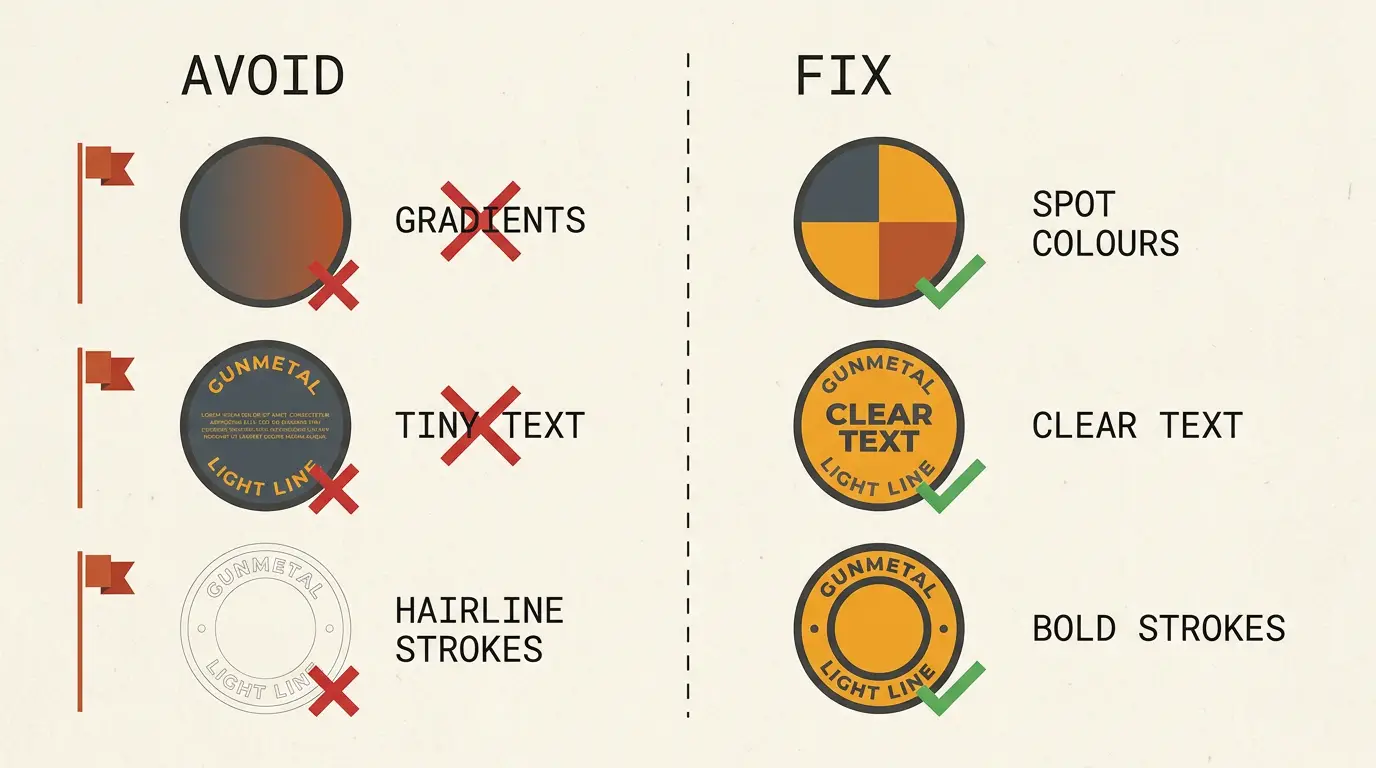
Five artwork mistakes cause most proof revisions. Each one has a straightforward fix that keeps the design mould-ready.
- Photographic or gradient-heavy art — flatten it into bold spot colours.
- Text below tolerance — enlarge text to at least 5mm, or 6mm on 3D relief.
- Hairline strokes — thicken lines to at least 1mm.
- Unspecified colours — assign a Pantone reference to every colour.
- Low-resolution raster as final art — supply vector, or raster at 300 DPI at final size.
Avoiding these mistakes shortens the proof cycle, because the first proof already reflects a clean, mouldable design. A correct file then moves smoothly into the approval stage.
Design specification
The Digital Proof and Approval Process
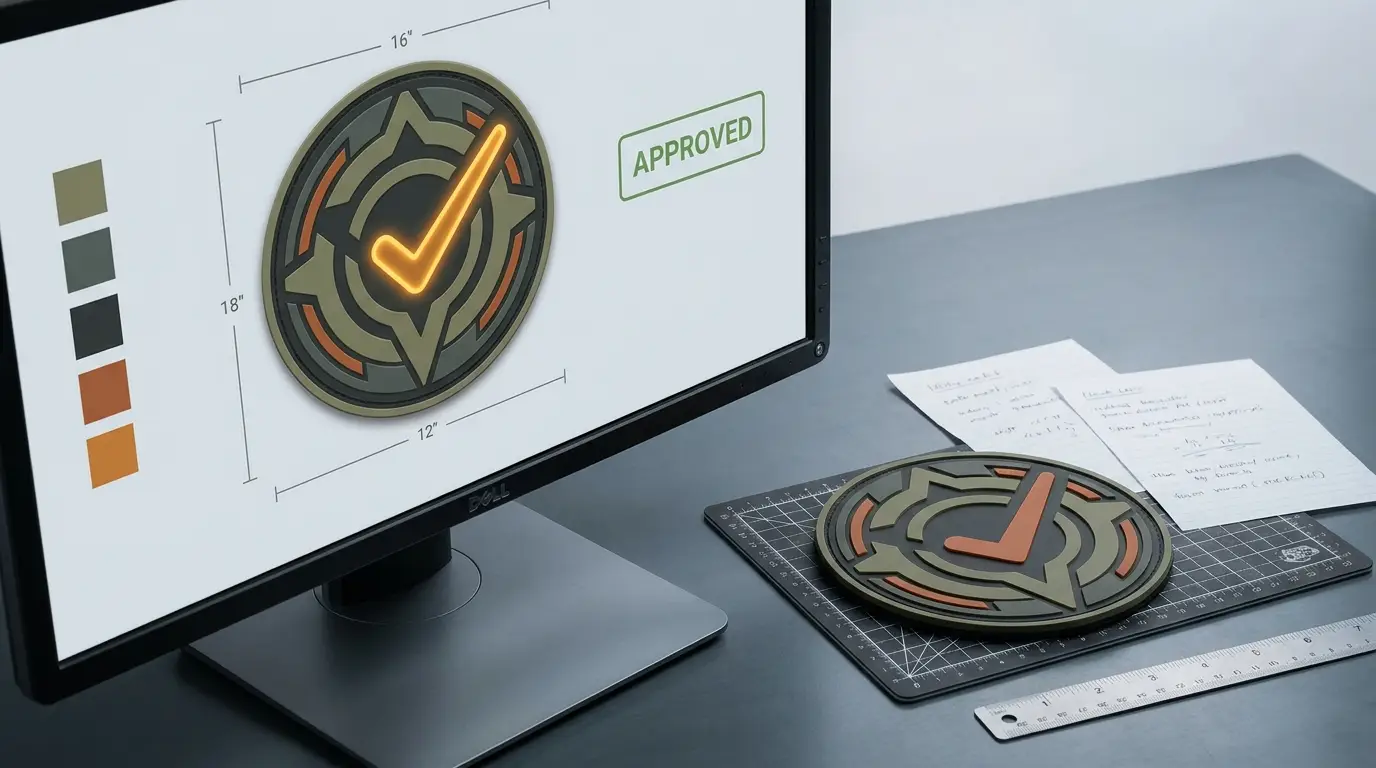
Every custom PVC patch order includes a digital proof before production. The proof shows the final layout with Pantone references marked, and you approve it before any mould is engraved. Approval locks the design, because the next stage cuts that design into metal and cannot be changed afterwards.
The mould is retained after production. A retained mould means a reorder of the same design needs no re-engraving, so identical patches match the original on every run. There is no minimum order quantity, so you can approve a proof for a small batch or a large production run.
Check three things on the proof before you approve it:
- Colours — verify each colour against its Pantone reference.
- Dimensions — confirm the size and the die-cut outline.
- Text — read every word at final size for legibility.
Careful proof-checking protects the whole order, since the approved file becomes the mould. Learn how the mould is produced on the proof and approval and PVC patch mould engraving pages.
Production-ready reference
PVC Patch Design Specifications at a Glance
| Attribute | Value |
|---|---|
| Preferred artwork | Vector (AI, EPS, PDF, SVG) |
| Raster minimum | 300 DPI at final size |
| Colour system | Pantone (PMS), pigment through full depth |
| Relief | 2D flat-topped / 3D sculpted |
| Finished thickness | 2.5mm (2D) / 3.5mm (3D) |
| Minimum text height | 5mm (2D) / 6mm (3D) |
| Minimum line width | ~1mm |
| Size range | 25mm – 200mm |
| Shapes | Round, square, oval, shield, custom die-cut |
| Custom die-cut cost | No extra tooling charge |
| Minimum order | No minimum |
| Standard turnaround | 10–14 working days from proof approval |
| Express turnaround | 5–7 working days from proof approval |
| UK mainland delivery | Add 1–2 working days |
In their words
Stories About Us and Our Customers
PVC patches end up on kit that works for a living. These are the orders behind them, the brief, the mould, and what the patch had to survive.
Tactical · Hook-and-loop
“The patches arrived clean, sharp and ready to go straight onto our kit bags.”
The hook-and-loop backing made it easy for the team to swap patches between packs, jackets and plate carriers without losing the raised detail in the badge.
Sarah Mitchell · Manchester
Workwear · Sew-on
“The PVC badges made our workwear look much more professional than printed logos.”
The sew-on finish gave the uniforms a permanent patch that could handle daily wear, wet weather and repeated cleaning.
James Carter · Birmingham
Streetwear · 3D relief
“The 3D finish gave our caps the premium detail we wanted.”
The raised rubber face helped the logo stand out on the front panel while keeping the colours consistent across the run.
Amelia Thompson · London
Outdoor · Waterproof
“The patches held up well on wet kit and still looked fresh after a muddy weekend.”
Waterproof PVC was chosen for bags and jackets where stitched thread would have absorbed moisture and frayed at the edge.
Oliver Hughes · Bristol
Club · Custom shape
“Our badge shape was unusual, but the final patch followed it neatly.”
The custom die-cut outline kept the club crest recognisable while the moulded edge avoided the bulky border of an embroidered patch.
Priya Shah · Leeds
Security · Velcro
“Being able to remove and replace patches between shifts has been really useful.”
Hook-and-loop backing was selected for staff jackets so roles and identifiers could be changed quickly without replacing garments.
Daniel Evans · Cardiff
Merchandise · Colour match
“The colours matched our brand better than the woven sample we tried before.”
Pantone-matched PVC helped keep the logo consistent for merchandise, reorder stock and event giveaways.
Hannah Wilson · Nottingham
Motorcycle · Jacket patch
“The rubber patch gave the jacket a cleaner, tougher finish.”
The club needed a weather-resistant badge that could handle rain, road grime and regular outdoor use.
Mark Robinson · Newcastle
Sports · Team kit
“The patch worked well on kit bags and training jackets.”
A flexible PVC build kept the team crest visible without adding a heavy stitched border to lightweight gear.
Rebecca Green · Sheffield
Repeat order · Reorder
“Reordering was simple because the mould was already set up.”
The second run kept the same dimensions, relief and colour references as the original patch order.
Thomas Baker · Glasgow
Tactical · Hook-and-loop
“The patches arrived clean, sharp and ready to go straight onto our kit bags.”
The hook-and-loop backing made it easy for the team to swap patches between packs, jackets and plate carriers without losing the raised detail in the badge.
Sarah Mitchell · Manchester
Workwear · Sew-on
“The PVC badges made our workwear look much more professional than printed logos.”
The sew-on finish gave the uniforms a permanent patch that could handle daily wear, wet weather and repeated cleaning.
James Carter · Birmingham
Streetwear · 3D relief
“The 3D finish gave our caps the premium detail we wanted.”
The raised rubber face helped the logo stand out on the front panel while keeping the colours consistent across the run.
Amelia Thompson · London
Outdoor · Waterproof
“The patches held up well on wet kit and still looked fresh after a muddy weekend.”
Waterproof PVC was chosen for bags and jackets where stitched thread would have absorbed moisture and frayed at the edge.
Oliver Hughes · Bristol
Club · Custom shape
“Our badge shape was unusual, but the final patch followed it neatly.”
The custom die-cut outline kept the club crest recognisable while the moulded edge avoided the bulky border of an embroidered patch.
Priya Shah · Leeds
Security · Velcro
“Being able to remove and replace patches between shifts has been really useful.”
Hook-and-loop backing was selected for staff jackets so roles and identifiers could be changed quickly without replacing garments.
Daniel Evans · Cardiff
Merchandise · Colour match
“The colours matched our brand better than the woven sample we tried before.”
Pantone-matched PVC helped keep the logo consistent for merchandise, reorder stock and event giveaways.
Hannah Wilson · Nottingham
Motorcycle · Jacket patch
“The rubber patch gave the jacket a cleaner, tougher finish.”
The club needed a weather-resistant badge that could handle rain, road grime and regular outdoor use.
Mark Robinson · Newcastle
Sports · Team kit
“The patch worked well on kit bags and training jackets.”
A flexible PVC build kept the team crest visible without adding a heavy stitched border to lightweight gear.
Rebecca Green · Sheffield
Repeat order · Reorder
“Reordering was simple because the mould was already set up.”
The second run kept the same dimensions, relief and colour references as the original patch order.
Thomas Baker · Glasgow
Answers
PVC Patch Design FAQ
Can I send a JPEG or PNG for my PVC patch?
Yes, at quote stage. A vector file (AI, EPS or PDF) is preferred for production, because it scales to any patch size without loss of quality. A raster file must be supplied at 300 DPI at final size to hold detail.
What is the minimum text size on a PVC patch?
The minimum text height is 5mm on 2D patches and 6mm on 3D patches. Text below these figures closes up during moulding and loses legibility.
Do you charge extra for a custom shape?
No. Custom die-cut outlines carry no extra tooling cost, because every order requires a bespoke mould regardless of shape.
Can PVC patches reproduce gradients?
No. PVC reproduces flat spot colours best, because each colour sits in its own mould recess. Convert gradients into solid colour zones before submitting artwork.
Will I see my design before it is made?
Yes. You approve a digital proof before any mould is engraved, and approval locks the design for production.
Is there a minimum order for custom PVC patches?
No. There is no minimum order quantity, so you can order the exact quantity you need.
Ready for artwork
Design Your PVC Patch
A well-prepared design controls colour, relief and legibility from the first proof. Supply scalable vector artwork, specify Pantone references, keep text above 5mm and define a clean die-cut outline, and the mould reproduces your emblem accurately across the whole run. There is no minimum order, standard production takes 10–14 working days from proof approval, and express production takes 5–7 working days. Send your design for a quotation and receive a digital proof before anything is cut.