Peel-and-stick backing · Hard surfaces
3M Adhesive-Backed PVC Patches — Peel-and-Stick Backing for Hard Surfaces
3M adhesive-backed PVC patches are moulded rubber patches finished with a 3M pressure-sensitive adhesive film on the reverse. The peel-and-stick film bonds the patch to smooth, rigid surfaces such as helmets, laptops, toolboxes and vehicle panels without sewing, ironing or heat. This backing turns a custom PVC patch into a self-adhesive badge that a customer applies by hand in seconds. Adhesive backing suits hard surfaces; sew-on backing suits fabric, and that single distinction decides most orders.
Featured Client
Definition
What Are 3M Adhesive-Backed PVC Patches?
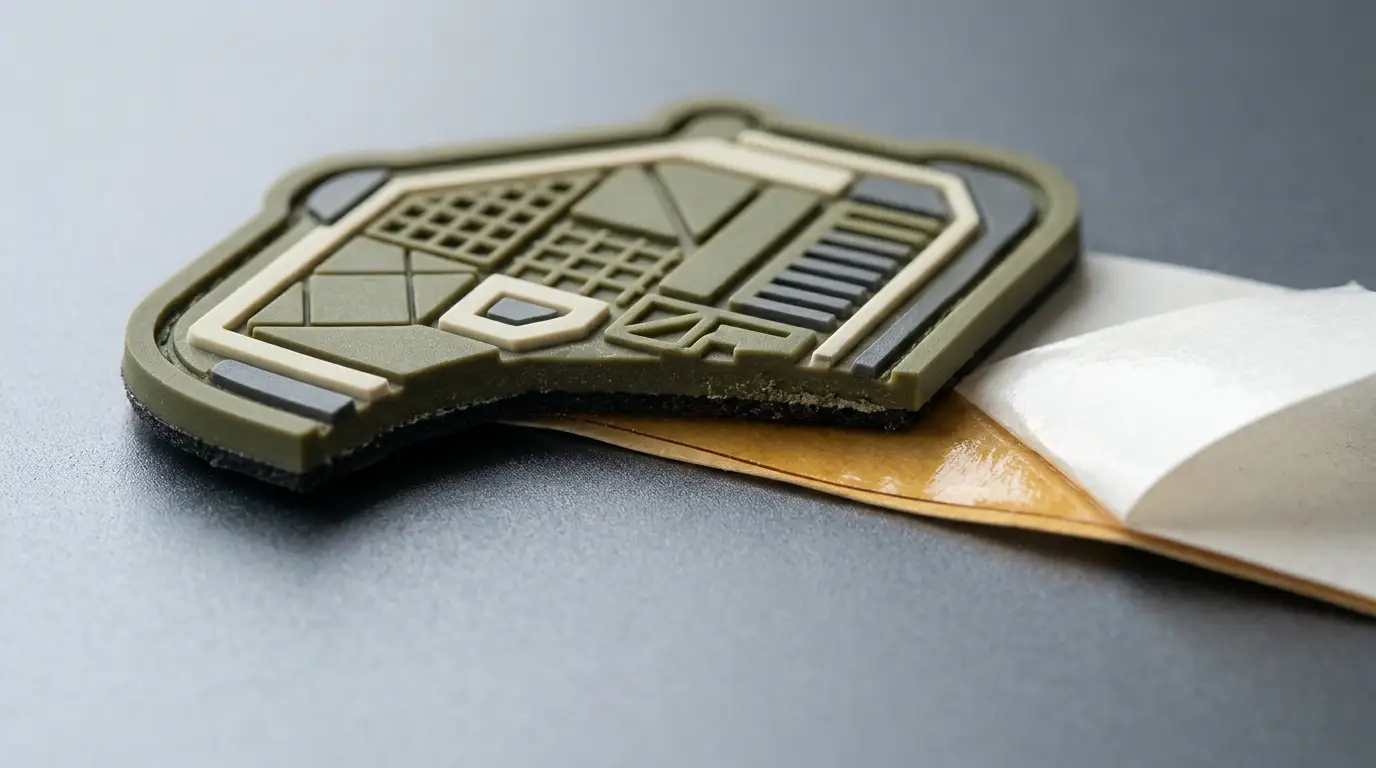
3M adhesive-backed PVC patches carry a peel-and-stick 3M film applied to the reverse of a cured PVC patch. The patch itself is moulded from plasticised polyvinyl chloride, and the adhesive layer is added afterwards, so the backing never alters the moulded relief on the face. A protective release liner covers the adhesive until the moment of application, which keeps the film clean and tacky in storage.
Custom PVC patches accept several backing types, and 3M adhesive is the option built for hard, non-fabric surfaces. Buyers also describe these as self-adhesive patches, stick-on PVC patches or peel-and-stick patches. The material and the badge stay identical across those names; only the backing changes.
| Attribute | Value |
|---|---|
| Patch material | Plasticised polyvinyl chloride (PVC) |
| Backing type | 3M pressure-sensitive adhesive film |
| Application | Peel-and-stick, tool-free |
| Best surface | Hard, smooth, rigid (non-fabric) |
| Removability | Single-use bond |
| Colour system | Pantone (PMS) matched, full depth |
| Size range | 25mm – 200mm |
| Minimum order | No minimum |
Pressure-sensitive film
What Is the 3M Adhesive on a PVC Patch?
The 3M adhesive is a pressure-sensitive adhesive, which means the bond forms under finger or roller pressure rather than under heat. Pressure-sensitive adhesive tacks on contact and reaches full strength as it cures against the surface. Domestic heat is never involved, which matters because polyvinyl chloride softens above 120°C and cannot take an iron.
How the 3M Film Bonds to a Surface
The 3M film bonds best to high-energy surfaces that are smooth, clean and dry. Surface energy governs adhesion: metals, glass, powder-coated panels and hard plastics hold the film strongly, while porous or oily surfaces resist it. A clean surface therefore produces a stronger, longer-lasting bond than a dusty or greasy one. Full bond strength develops over the first [[CURE WINDOW]] after application, so the patch stays undisturbed during that period.
The Adhesive Layer and the Moulded Face
The adhesive layer sits only on the reverse of the patch. Backing is applied after curing, so the choice of 3M adhesive leaves the Pantone-matched colour and the raised relief untouched. The face of an adhesive PVC patch looks identical to the same design supplied with velcro or sew-on backing.
Surface compatibility
Which Surfaces 3M Adhesive PVC Patches Bond To
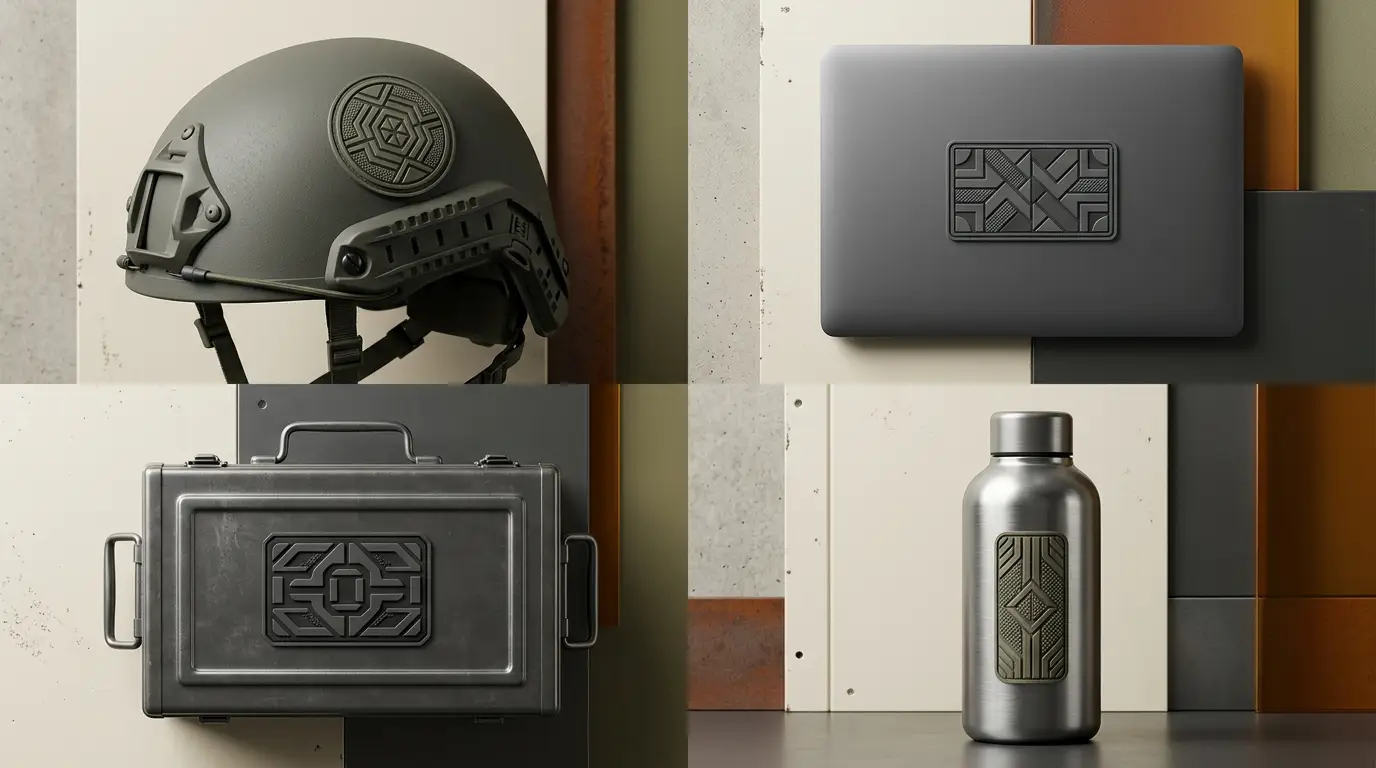
3M adhesive-backed PVC patches bond to hard surfaces, and they resist fabric. The film needs continuous, flat contact with a rigid material to hold, which rules out flexible textiles. Choosing the right substrate is the single most important decision on an adhesive order.
Best Surfaces — Hard and Smooth
Adhesive backing performs on rigid, low-porosity surfaces where the film makes full contact:
- Helmets and hard shells — motorcycle, cycling, climbing and safety helmets
- Laptop lids and tablet cases — smooth polycarbonate and aluminium
- Toolboxes and flight cases — metal and hard plastic panels
- Water bottles and flasks — stainless steel and coated finishes
- Vehicle panels and dashboards — painted metal and rigid trim
Each surface shares one property: it is hard, smooth and non-absorbent. The 3M film grips those materials and keeps the patch flush against them.
Why Adhesive Backing Is Not for Fabric
Adhesive backing does not suit fabric, because textile fibres reduce the contact area the film depends on. Fabric flexes, breathes and lifts at the edges, so the bond weakens over time and through washing. A garment therefore calls for a stitched attachment instead. For clothing, choose sew-on backing for a permanent bond, or hook-and-loop velcro backing for a removable one. Adhesive is for kit you stick to; thread and velcro are for kit you wear.
Application · Five steps
How to Apply a 3M Adhesive PVC Patch
Applying an adhesive PVC patch follows five steps, and the bond is single-use, so positioning matters before contact.
- Clean the surface. Wipe the area with isopropyl alcohol and let it dry, so no dust or oil weakens the bond.
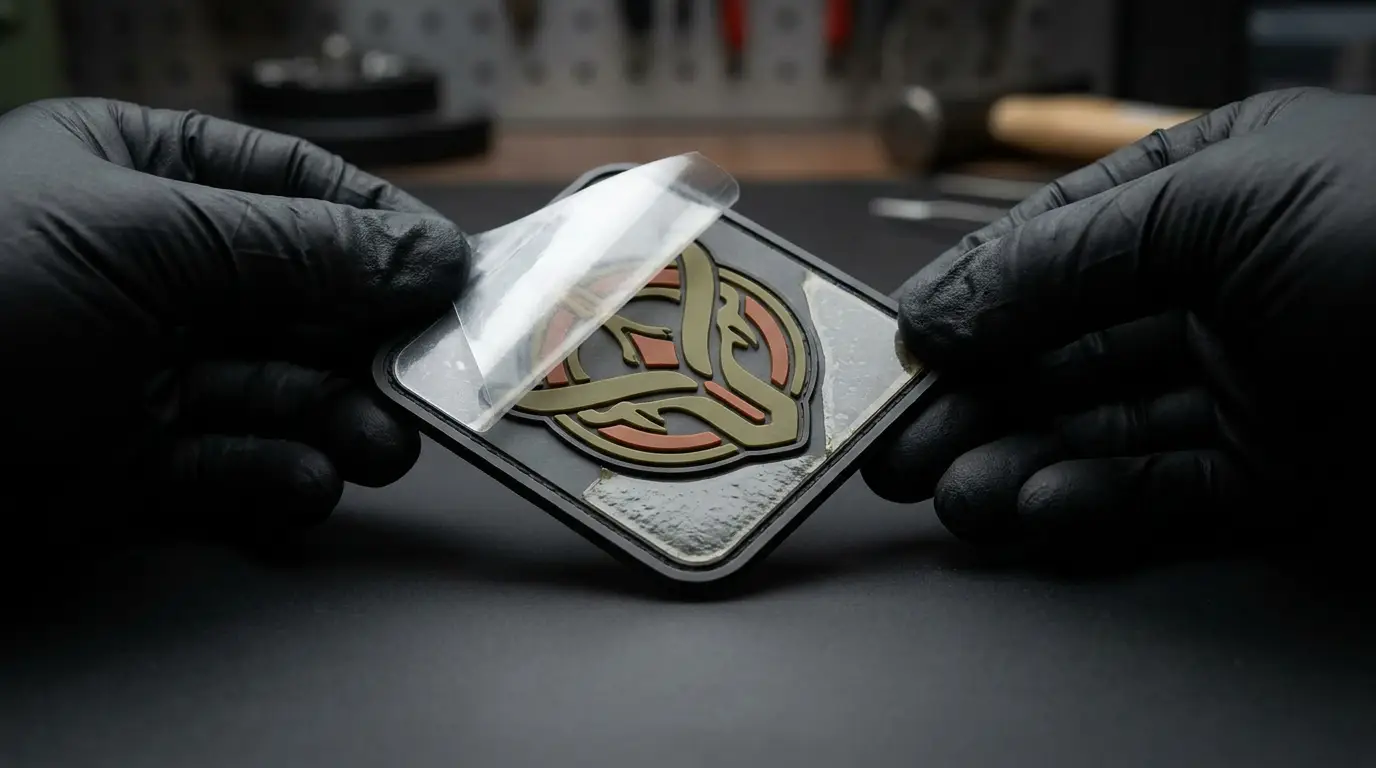
- Peel the release liner. Lift the liner from the reverse of the patch to expose the 3M film.
- Position before contact. Line up the patch precisely, because the adhesive grips on first touch and does not reposition cleanly.
- Press firmly. Apply even pressure across the whole patch, edge to edge, to remove air and maximise contact.
- Leave undisturbed. Allow the bond to cure for [[CURE WINDOW]] before handling the surface heavily.
Cleaning the surface first raises the strength of the bond; the next question is usually how adhesive compares with the other backings we offer.
Six practical advantages
Benefits of 3M Adhesive Backing
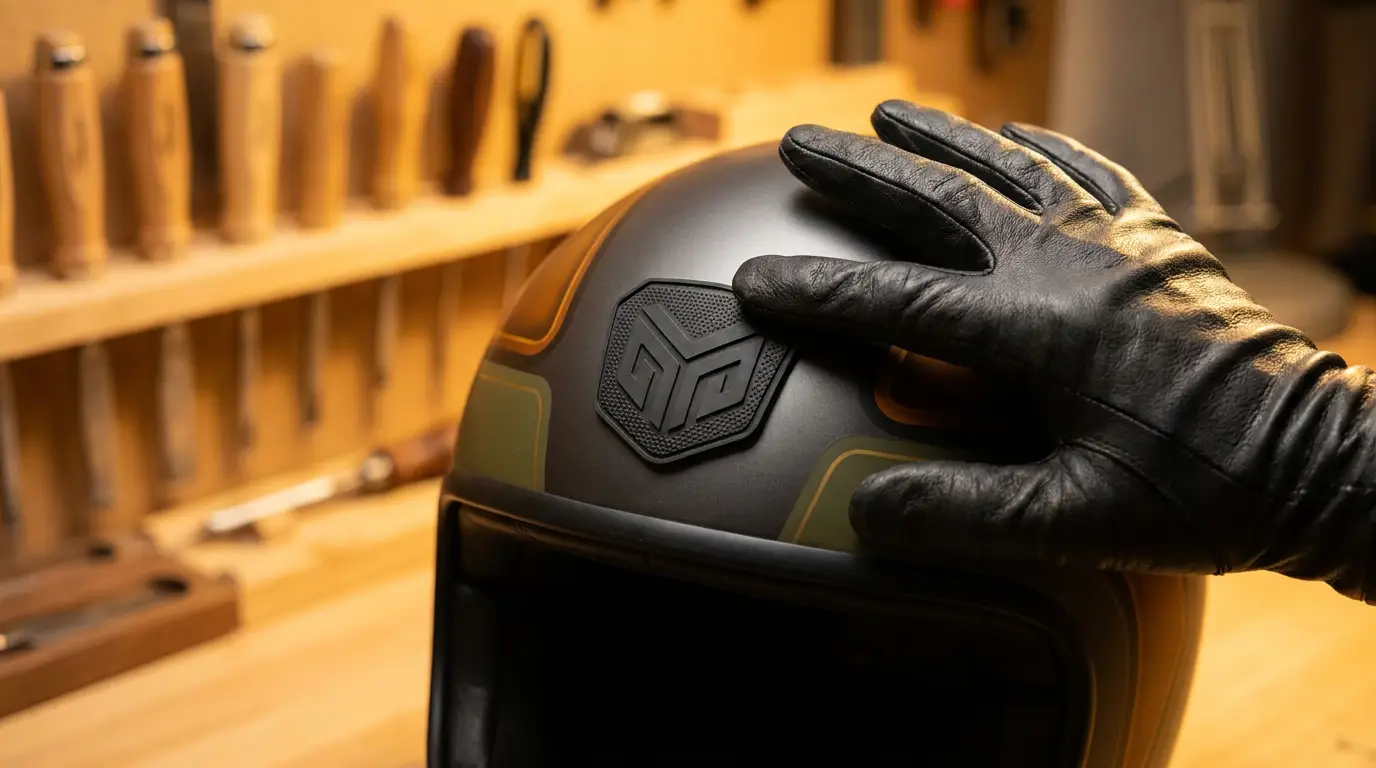
3M adhesive backing gives a custom PVC patch a fast, clean, tool-free finish on hard surfaces:
Tool-free application — the patch sticks by hand, with no sewing machine, press or iron
No heat required — the film is pressure-activated, so the moulded PVC relief stays intact
Flush, clean finish — the patch sits flat against the surface with no border or stitching
Waterproof face — the solid PVC patch absorbs no moisture, so rain leaves the badge unchanged
Pantone-matched colour — pigment runs through the full depth of the patch, not printed on top
Strong hold on the right surface — the 3M film grips hard, smooth materials reliably
Durability starts with the surface. On the right rigid substrate, a moulded rubber patch outlasts the item it decorates, which is why hard-case branding and helmet identification favour this backing.
Backing comparison
3M Adhesive vs Other PVC Patch Backings
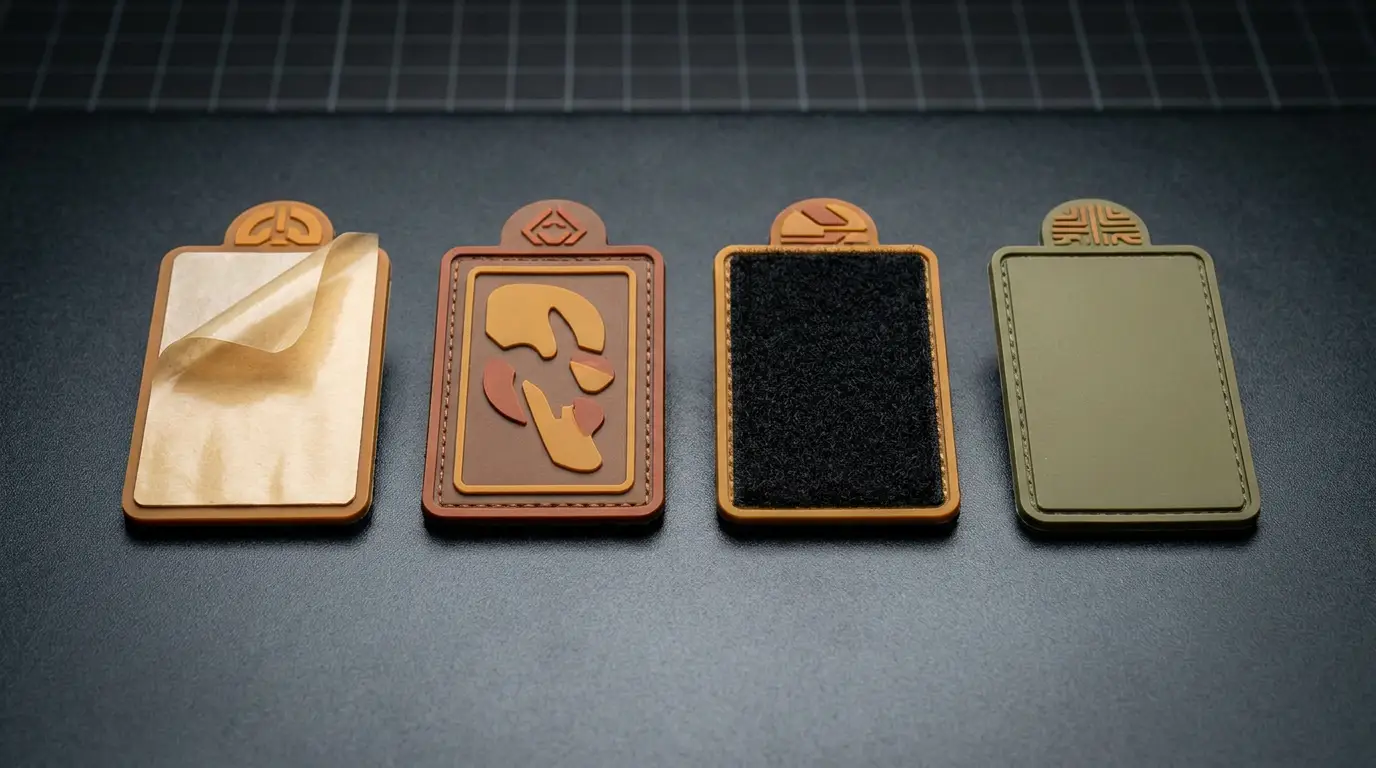
PVC patches ship with four backing types, and each one suits a different attachment. The table below sets 3M adhesive against sew-on, hook-and-loop and plain backing so the right choice is clear at a glance.
| Backing | Attachment | Removable | Best surface |
|---|---|---|---|
| 3M adhesive | Peel-and-stick film | Once (single-use) | Helmets, cases, hard surfaces |
| Sew-on | Thread | No | Workwear, jackets, fabric |
| Hook-and-loop (velcro) | Velcro field | Yes | Tactical gear, uniforms |
| Plain | None supplied | – | Custom / heat-press applications |
3M adhesive wins where the target is a hard surface and the buyer wants a fast, stitch-free bond. Sew-on backing wins on fabric where the attachment must survive industrial laundering. Velcro backing wins where the patch moves between garments. Every backing attaches the same moulded PVC face; only the reverse differs. Compare the full range on the PVC patch backing options pillar.
Artwork to delivery
How to Order Adhesive-Backed PVC Patches
Ordering adhesive-backed PVC patches follows the same route as every custom order, and there is no minimum order quantity. You send artwork, approve a digital proof, and receive a bespoke patch with 3M adhesive backing applied to the reverse.
- No minimum order — order the exact quantity you need
- Standard production — 10 to 14 working days from proof approval
- Express production — 5 to 7 working days from proof approval
- UK mainland delivery — add 1 to 2 working days
- BFPO delivery — accepted for serving personnel
- Pricing — quoted in pounds sterling, VAT at 20%
Prices depend on size, relief, colour count and backing, and reorders of an approved design cost less because the mould already exists. Read how to attach a PVC patch for step-by-step guidance across every backing.
In their words
Stories About Us and Our Customers
PVC patches end up on kit that works for a living. These are the orders behind them, the brief, the mould, and what the patch had to survive.
Tactical · Hook-and-loop
“The patches arrived clean, sharp and ready to go straight onto our kit bags.”
The hook-and-loop backing made it easy for the team to swap patches between packs, jackets and plate carriers without losing the raised detail in the badge.
Sarah Mitchell · Manchester
Workwear · Sew-on
“The PVC badges made our workwear look much more professional than printed logos.”
The sew-on finish gave the uniforms a permanent patch that could handle daily wear, wet weather and repeated cleaning.
James Carter · Birmingham
Streetwear · 3D relief
“The 3D finish gave our caps the premium detail we wanted.”
The raised rubber face helped the logo stand out on the front panel while keeping the colours consistent across the run.
Amelia Thompson · London
Outdoor · Waterproof
“The patches held up well on wet kit and still looked fresh after a muddy weekend.”
Waterproof PVC was chosen for bags and jackets where stitched thread would have absorbed moisture and frayed at the edge.
Oliver Hughes · Bristol
Club · Custom shape
“Our badge shape was unusual, but the final patch followed it neatly.”
The custom die-cut outline kept the club crest recognisable while the moulded edge avoided the bulky border of an embroidered patch.
Priya Shah · Leeds
Security · Velcro
“Being able to remove and replace patches between shifts has been really useful.”
Hook-and-loop backing was selected for staff jackets so roles and identifiers could be changed quickly without replacing garments.
Daniel Evans · Cardiff
Merchandise · Colour match
“The colours matched our brand better than the woven sample we tried before.”
Pantone-matched PVC helped keep the logo consistent for merchandise, reorder stock and event giveaways.
Hannah Wilson · Nottingham
Motorcycle · Jacket patch
“The rubber patch gave the jacket a cleaner, tougher finish.”
The club needed a weather-resistant badge that could handle rain, road grime and regular outdoor use.
Mark Robinson · Newcastle
Sports · Team kit
“The patch worked well on kit bags and training jackets.”
A flexible PVC build kept the team crest visible without adding a heavy stitched border to lightweight gear.
Rebecca Green · Sheffield
Repeat order · Reorder
“Reordering was simple because the mould was already set up.”
The second run kept the same dimensions, relief and colour references as the original patch order.
Thomas Baker · Glasgow
Tactical · Hook-and-loop
“The patches arrived clean, sharp and ready to go straight onto our kit bags.”
The hook-and-loop backing made it easy for the team to swap patches between packs, jackets and plate carriers without losing the raised detail in the badge.
Sarah Mitchell · Manchester
Workwear · Sew-on
“The PVC badges made our workwear look much more professional than printed logos.”
The sew-on finish gave the uniforms a permanent patch that could handle daily wear, wet weather and repeated cleaning.
James Carter · Birmingham
Streetwear · 3D relief
“The 3D finish gave our caps the premium detail we wanted.”
The raised rubber face helped the logo stand out on the front panel while keeping the colours consistent across the run.
Amelia Thompson · London
Outdoor · Waterproof
“The patches held up well on wet kit and still looked fresh after a muddy weekend.”
Waterproof PVC was chosen for bags and jackets where stitched thread would have absorbed moisture and frayed at the edge.
Oliver Hughes · Bristol
Club · Custom shape
“Our badge shape was unusual, but the final patch followed it neatly.”
The custom die-cut outline kept the club crest recognisable while the moulded edge avoided the bulky border of an embroidered patch.
Priya Shah · Leeds
Security · Velcro
“Being able to remove and replace patches between shifts has been really useful.”
Hook-and-loop backing was selected for staff jackets so roles and identifiers could be changed quickly without replacing garments.
Daniel Evans · Cardiff
Merchandise · Colour match
“The colours matched our brand better than the woven sample we tried before.”
Pantone-matched PVC helped keep the logo consistent for merchandise, reorder stock and event giveaways.
Hannah Wilson · Nottingham
Motorcycle · Jacket patch
“The rubber patch gave the jacket a cleaner, tougher finish.”
The club needed a weather-resistant badge that could handle rain, road grime and regular outdoor use.
Mark Robinson · Newcastle
Sports · Team kit
“The patch worked well on kit bags and training jackets.”
A flexible PVC build kept the team crest visible without adding a heavy stitched border to lightweight gear.
Rebecca Green · Sheffield
Repeat order · Reorder
“Reordering was simple because the mould was already set up.”
The second run kept the same dimensions, relief and colour references as the original patch order.
Thomas Baker · Glasgow
Frequently asked questions
3M Adhesive-Backed PVC Patches — FAQ
Do 3M adhesive-backed PVC patches stick to fabric?
NO
No. Adhesive backing is designed for hard, smooth surfaces, and textile fibres reduce the contact the film needs. Choose sew-on backing for a permanent bond on fabric.
Are 3M adhesive PVC patches permanent?
NO
No. The bond is strong but single-use, and the film does not re-stick once the patch is removed. For a bond you can reposition, choose velcro backing.
Can adhesive-backed PVC patches be ironed on?
NO
No. Polyvinyl chloride softens above 120°C, and the 3M film is peel-and-stick rather than heat-activated. Read why PVC patches cannot be ironed on for the full reason.
Is there a minimum order for adhesive-backed PVC patches?
NO
No. There is no minimum order, so you can order a single patch or a full production run.
Are 3M adhesive PVC patches waterproof?
YES
Yes. The PVC patch absorbs no water, though prolonged water and heat can weaken the adhesive bond on some surfaces over time.
Summary
Summary
A 3M adhesive-backed PVC patch is the version of a moulded rubber patch built to stick, not to be sewn. The pressure-sensitive film turns a bespoke badge into a peel-and-stick emblem for helmets, cases, bottles and vehicle panels, applied by hand and cured without heat. Hard, clean surfaces hold the bond; fabric does not, and that boundary points fabric orders towards sew-on or velcro instead. With no minimum order, Pantone-matched colour and UK production, adhesive backing gives brands and units a fast route from artwork to a finished patch on hard kit. Send your design for a free quotation and approve a digital proof before anything is moulded.