Design & Artwork · Text & Shape Limits
Minimum Text Size and Die-Cut Shapes for Custom PVC Patches
Custom PVC patches hold a minimum text height of 5mm on 2D relief and 6mm on 3D relief, and a die-cut outline that reproduces the supplied artwork exactly. Both limits are fixed when the metal mould is engraved, which is why text height and patch shape are decided before the design is finalised. This guide sets out the smallest text a PVC patch holds, the standard and custom shapes available, and how the two constraints work together on a single badge.

Featured Client
Mould logic
What Sets Text Size and Shape on a PVC Patch
A PVC patch is moulded inside an engraved metal die. The die controls two things at once: the finest text the surface can carry and the outline the finished patch takes. Engineers cut one mould per design, and that mould produces the full run and every reorder of the same badge.
The engraving stage explains both limits on this page. A cutting tool cannot engrave detail smaller than its own tip, so text below a working minimum loses definition. The same tool traces the artwork silhouette, so the patch edge follows the outline the tool was given. Text height and patch shape therefore share a single cause, and both lock the moment the digital proof is approved.
Relief determines the limit
Minimum Text Size for PVC Patches
PVC patches have a minimum text size, and the figure depends on relief. Relief is the height of the raised surface, and a taller relief needs more room to form clean edges. The two build types carry different minimums as a result.
Minimum Text Height on 2D PVC Patches
A 2D PVC patch holds text down to 5mm in height. 2D construction stacks flat-topped layers on a single plane, so lettering sits as a clean raised or recessed shape. Flat logos, line text and geometric marks reproduce well at this scale, because a flat top needs no taper and the mould can hold a tight edge.
Minimum Text Height on 3D PVC Patches
A 3D PVC patch holds text down to 6mm in height. 3D construction sculpts the surface into rounded, contoured relief, and each raised element tapers towards its top. The taper consumes width as it rises, so 3D lettering needs slightly more height than 2D lettering to stay legible. Crests, emblems and contoured type suit 3D relief once text sits at or above 6mm.
Why PVC Patches Have a Minimum Text Size
Moulded relief loses definition below the minimum, because liquid PVC fills the finest recesses before it sets. A thin stroke closes up during pouring and reads as a solid blob rather than a letter. The engraving tool sets the hard limit: it cannot cut a cavity narrower than its own tip, so detail below that width never reaches the mould in the first place. Minimum text size is a property of the tooling, not a preference.
Line Thickness and Font Choice at Small Sizes
Stroke width matters as much as letter height on a small patch. A bold sans-serif holds its shape where a thin serif closes up, so heavier weights survive reduction better than fine ones. As a guide, keep strokes clearly visible rather than hairline, and simplify dense wordmarks instead of shrinking them. Condensed spacing, tight kerning and fine detail all reduce legibility at the minimum, so open letterforms are the safer choice.
| Relief | Minimum text height | Stroke width guidance | Holds detail best |
|---|---|---|---|
| 2D PVC | 5mm | Avoid hairlines; keep strokes solid | Flat logos, line text, geometric marks |
| 3D PVC | 6mm | Slightly heavier than 2D to survive the taper | Sculpted emblems, crests, contoured lettering |


Five stock outlines
Standard PVC Patch Shapes
PVC patches come in five standard shapes: round, square, rectangular, oval and shield. Each stock shape is die-cut rather than stamped from a sheet, so the edge seals during moulding and never frays. Standard shapes suit badges where the artwork already fits a simple outline, and they carry the same clean edge as any custom profile.

Artwork-led profile
Custom Die-Cut Shapes for PVC Patches
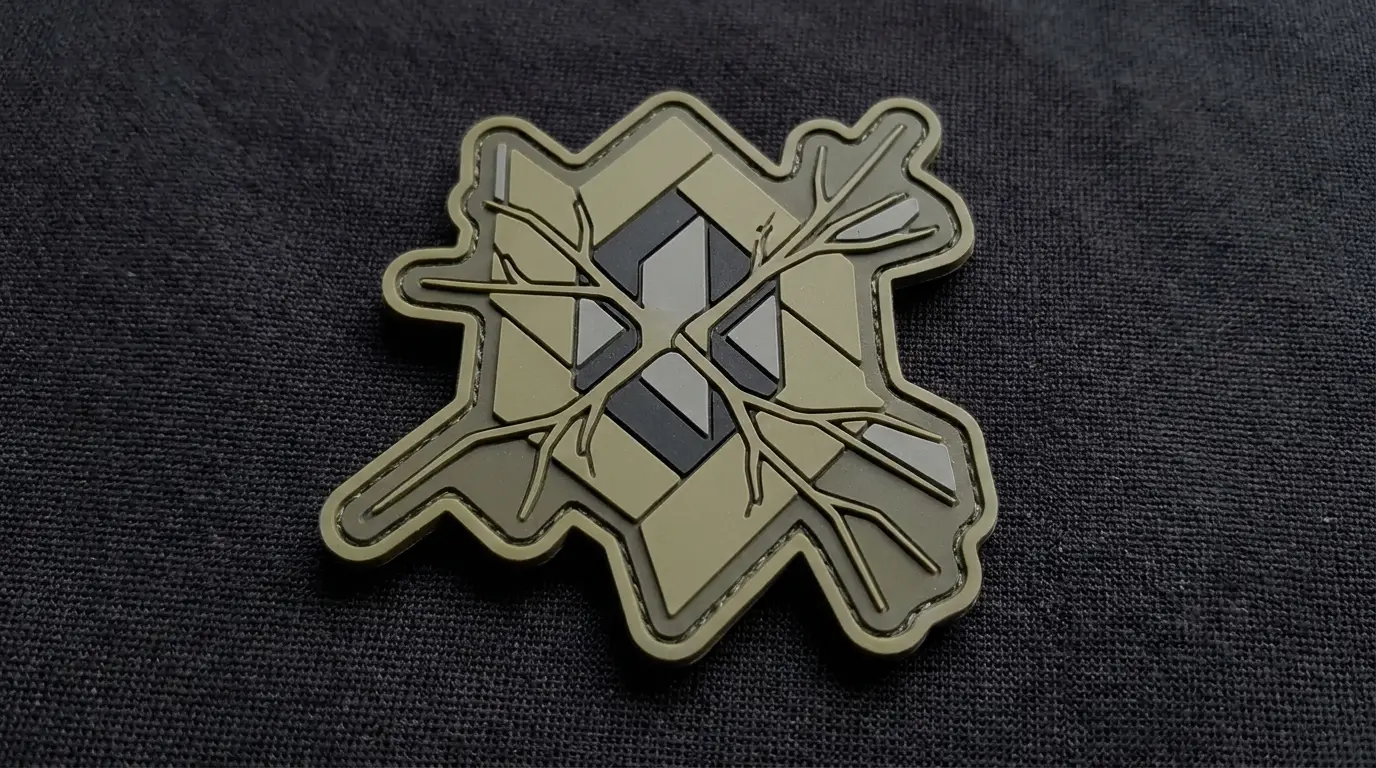
Custom die-cut PVC patches follow the outline of the artwork rather than a stock template. The mould is cut to the silhouette of the design, so the finished patch takes the shape of the logo, crest or emblem itself.
How Die-Cutting Follows Your Artwork
Die-cutting traces the artwork edge into the metal mould. The moulded patch then releases along that traced line, which is why a custom outline matches the design exactly. A shield crest keeps its shield edge, and an irregular mascot keeps its irregular edge, with no rectangular border added around it.
Why Custom Shapes Cost No Extra
Custom die-cut shapes carry no additional tooling cost. Every PVC patch needs a bespoke mould whatever its outline, so cutting that mould to a custom silhouette adds nothing over cutting it to a circle. The shape of the patch is set by the same engraving step that would run anyway, which is why bespoke outlines and standard shapes share one price basis.
Die-Cut Edge Finish
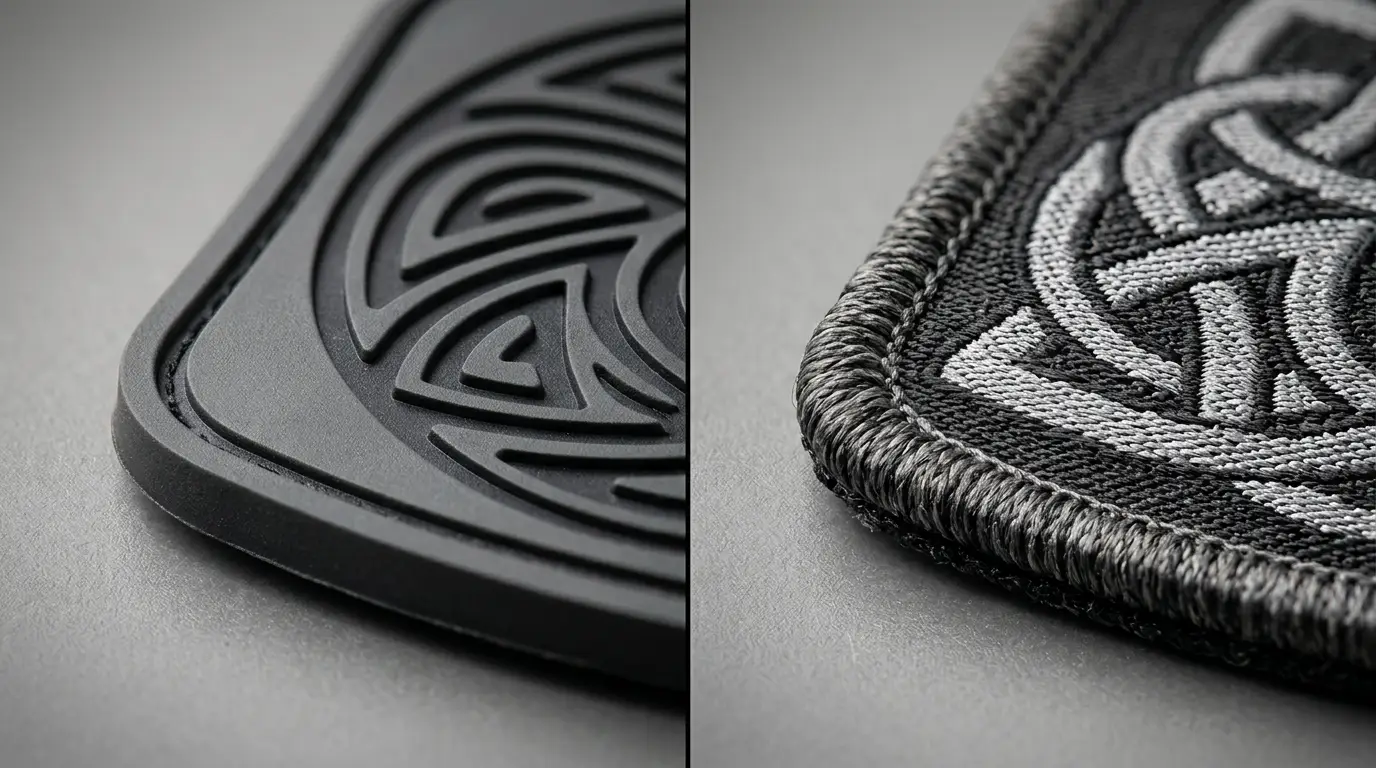
A die-cut PVC edge seals as the patch cures, so no border unravels over time. Unlike an embroidered patch, a PVC patch carries no stitched merrow border and needs no overlocked edge to stop fraying. The sealed edge stays clean through rain, laundering and abrasion, which is why moulded rubber suits outdoor and tactical gear.
Complex Outlines and Fine Protrusions
Intricate outlines, cut-outs and negative-space islands all reproduce in a PVC mould. Thin spikes and slender points remain feasible, though very narrow protrusions need a practical minimum width so they survive release from the die without tearing. Our design team flags any feature too slender to mould cleanly and adjusts it on the proof before tooling begins.
Size · wording · outline
How Text Size and Shape Work Together
Text size and patch shape are decided together, because both depend on the overall size of the patch. PVC patch size is measured as the average of width and height, across a range of 25mm to 200mm. A smaller patch leaves less room for lettering, so a compact outline forces larger, simpler text.
A cap-front patch shows the trade-off clearly. Headwear patches usually sit between 40mm and 70mm, which limits how many words fit at a 5mm or 6mm minimum. A short wordmark holds at that scale, while a long strapline needs either a larger patch or fewer words. Planning the outline, the size and the text together avoids a design that cannot mould as drawn. Shape and size are covered in full on the PVC patch sizes and shapes page, which sets out the 25mm to 200mm range and how it is measured.
Moulded edge vs stitched border
PVC Die-Cut Edges vs Embroidered Merrow Borders
PVC die-cut edges and embroidered merrow borders finish a patch in different ways, and each format holds detail to a different limit. The table below compares the two on edge, text and outline, so the right format follows the design rather than the habit.
| Attribute | PVC (die-cut) | Embroidered (merrow / laser-cut) |
|---|---|---|
| Edge finish | Sealed, moulded, non-fraying | Overlocked merrow or laser-cut |
| Smallest text | 5mm (2D) / 6mm (3D) | Thread-dependent, can blur when fine |
| Fine outline and spikes | Held cleanly by the die | Limited by stitch reach |
| Colour in fine detail | Pantone through the full depth | Matched to a thread chart |
Embroidered patches keep the traditional stitched border that club blazers and formal uniforms expect. PVC patches win on clean outlines and sealed edges wherever water, sunlight and abrasion shorten the life of thread. The full material comparison sits on the PVC vs embroidered patches page, which weighs both formats across every attribute.
Before tooling begins
Preparing Artwork for Text Size and Shape
Artwork preparation sets both limits before a mould is cut. Follow four steps to keep text legible and the outline accurate:
- Supply vector artwork. Send the design as a vector file so the outline and text stay sharp at any size.
- Mark the die-cut outline. Show the exact edge you want cut, so the mould follows the intended silhouette rather than a bounding box.
- Set text at or above the minimum. Keep lettering at 5mm on 2D relief or 6mm on 3D relief, and open up any text that sits below it.
- Approve the digital proof. Check colours against Pantone references, confirm the shape, and approve the proof, which locks both the outline and the smallest text.
Approval locks the die, so the shape and text cannot change once tooling begins. Clean vector files make this stage straightforward, and the full file specification sits on the PVC patch artwork requirements page. Both topics form part of the wider PVC patch design and artwork guide, which also covers colour matching and sizing.

In their words
Stories About Us and Our Customers
PVC patches end up on kit that works for a living. These are the orders behind them, the brief, the mould, and what the patch had to survive.
Tactical · Hook-and-loop
“The patches arrived clean, sharp and ready to go straight onto our kit bags.”
The hook-and-loop backing made it easy for the team to swap patches between packs, jackets and plate carriers without losing the raised detail in the badge.
Sarah Mitchell · Manchester
Workwear · Sew-on
“The PVC badges made our workwear look much more professional than printed logos.”
The sew-on finish gave the uniforms a permanent patch that could handle daily wear, wet weather and repeated cleaning.
James Carter · Birmingham
Streetwear · 3D relief
“The 3D finish gave our caps the premium detail we wanted.”
The raised rubber face helped the logo stand out on the front panel while keeping the colours consistent across the run.
Amelia Thompson · London
Outdoor · Waterproof
“The patches held up well on wet kit and still looked fresh after a muddy weekend.”
Waterproof PVC was chosen for bags and jackets where stitched thread would have absorbed moisture and frayed at the edge.
Oliver Hughes · Bristol
Club · Custom shape
“Our badge shape was unusual, but the final patch followed it neatly.”
The custom die-cut outline kept the club crest recognisable while the moulded edge avoided the bulky border of an embroidered patch.
Priya Shah · Leeds
Security · Velcro
“Being able to remove and replace patches between shifts has been really useful.”
Hook-and-loop backing was selected for staff jackets so roles and identifiers could be changed quickly without replacing garments.
Daniel Evans · Cardiff
Merchandise · Colour match
“The colours matched our brand better than the woven sample we tried before.”
Pantone-matched PVC helped keep the logo consistent for merchandise, reorder stock and event giveaways.
Hannah Wilson · Nottingham
Motorcycle · Jacket patch
“The rubber patch gave the jacket a cleaner, tougher finish.”
The club needed a weather-resistant badge that could handle rain, road grime and regular outdoor use.
Mark Robinson · Newcastle
Sports · Team kit
“The patch worked well on kit bags and training jackets.”
A flexible PVC build kept the team crest visible without adding a heavy stitched border to lightweight gear.
Rebecca Green · Sheffield
Repeat order · Reorder
“Reordering was simple because the mould was already set up.”
The second run kept the same dimensions, relief and colour references as the original patch order.
Thomas Baker · Glasgow
Tactical · Hook-and-loop
“The patches arrived clean, sharp and ready to go straight onto our kit bags.”
The hook-and-loop backing made it easy for the team to swap patches between packs, jackets and plate carriers without losing the raised detail in the badge.
Sarah Mitchell · Manchester
Workwear · Sew-on
“The PVC badges made our workwear look much more professional than printed logos.”
The sew-on finish gave the uniforms a permanent patch that could handle daily wear, wet weather and repeated cleaning.
James Carter · Birmingham
Streetwear · 3D relief
“The 3D finish gave our caps the premium detail we wanted.”
The raised rubber face helped the logo stand out on the front panel while keeping the colours consistent across the run.
Amelia Thompson · London
Outdoor · Waterproof
“The patches held up well on wet kit and still looked fresh after a muddy weekend.”
Waterproof PVC was chosen for bags and jackets where stitched thread would have absorbed moisture and frayed at the edge.
Oliver Hughes · Bristol
Club · Custom shape
“Our badge shape was unusual, but the final patch followed it neatly.”
The custom die-cut outline kept the club crest recognisable while the moulded edge avoided the bulky border of an embroidered patch.
Priya Shah · Leeds
Security · Velcro
“Being able to remove and replace patches between shifts has been really useful.”
Hook-and-loop backing was selected for staff jackets so roles and identifiers could be changed quickly without replacing garments.
Daniel Evans · Cardiff
Merchandise · Colour match
“The colours matched our brand better than the woven sample we tried before.”
Pantone-matched PVC helped keep the logo consistent for merchandise, reorder stock and event giveaways.
Hannah Wilson · Nottingham
Motorcycle · Jacket patch
“The rubber patch gave the jacket a cleaner, tougher finish.”
The club needed a weather-resistant badge that could handle rain, road grime and regular outdoor use.
Mark Robinson · Newcastle
Sports · Team kit
“The patch worked well on kit bags and training jackets.”
A flexible PVC build kept the team crest visible without adding a heavy stitched border to lightweight gear.
Rebecca Green · Sheffield
Repeat order · Reorder
“Reordering was simple because the mould was already set up.”
The second run kept the same dimensions, relief and colour references as the original patch order.
Thomas Baker · Glasgow
Answers
Frequently Asked Questions
Is there a minimum text size on PVC patches?YES
Yes. A 2D PVC patch holds text down to 5mm, and a 3D PVC patch holds text down to 6mm. Below those heights, moulded relief loses definition.
Can PVC patches be made in any custom shape?YES
Yes. The mould is die-cut to the artwork outline, so any silhouette is reproduced, from a simple shield to an intricate mascot.
Do custom die-cut shapes cost more than standard shapes?NO
No. Every PVC patch needs a bespoke mould whatever its outline, so a custom shape adds no tooling cost over a standard one.
Can text be smaller than 5mm on a PVC patch?NO
No. Below 5mm, fine strokes fill in during pouring and the letters close up, so text stays at or above the minimum for the chosen relief.
Do die-cut PVC edges fray like stitched patches?NO
No. The edge seals as the patch cures, so a PVC patch carries no border to unravel and needs no merrow stitching.
Summary
Summary
The metal mould decides both limits on a PVC patch: it fixes the smallest text the surface can carry and cuts the outline the patch will take. Relief drives the text minimum, at 5mm for 2D and 6mm for 3D, while the die traces any shape the artwork calls for at no extra tooling cost. Deciding text height, size and outline together, before the proof is approved, produces a badge that moulds cleanly the first time and repeats identically on every reorder. Send your design for a digital proof, and check the shape and lettering before anything is cut.