
PVC Patch Guide · Thickness & Relief
PVC Patch Thickness Explained
PVC patch thickness is the vertical depth of a moulded rubber patch, measured from the backing to the highest point of the relief. A 2D PVC patch measures 2.5mm thick, and a 3D PVC patch measures 3.5mm thick. This guide explains the standard thickness values, what sets them, and how thickness changes the flexibility, detail and durability of a custom PVC patch.
Featured Client

Definition
What Is PVC Patch Thickness?
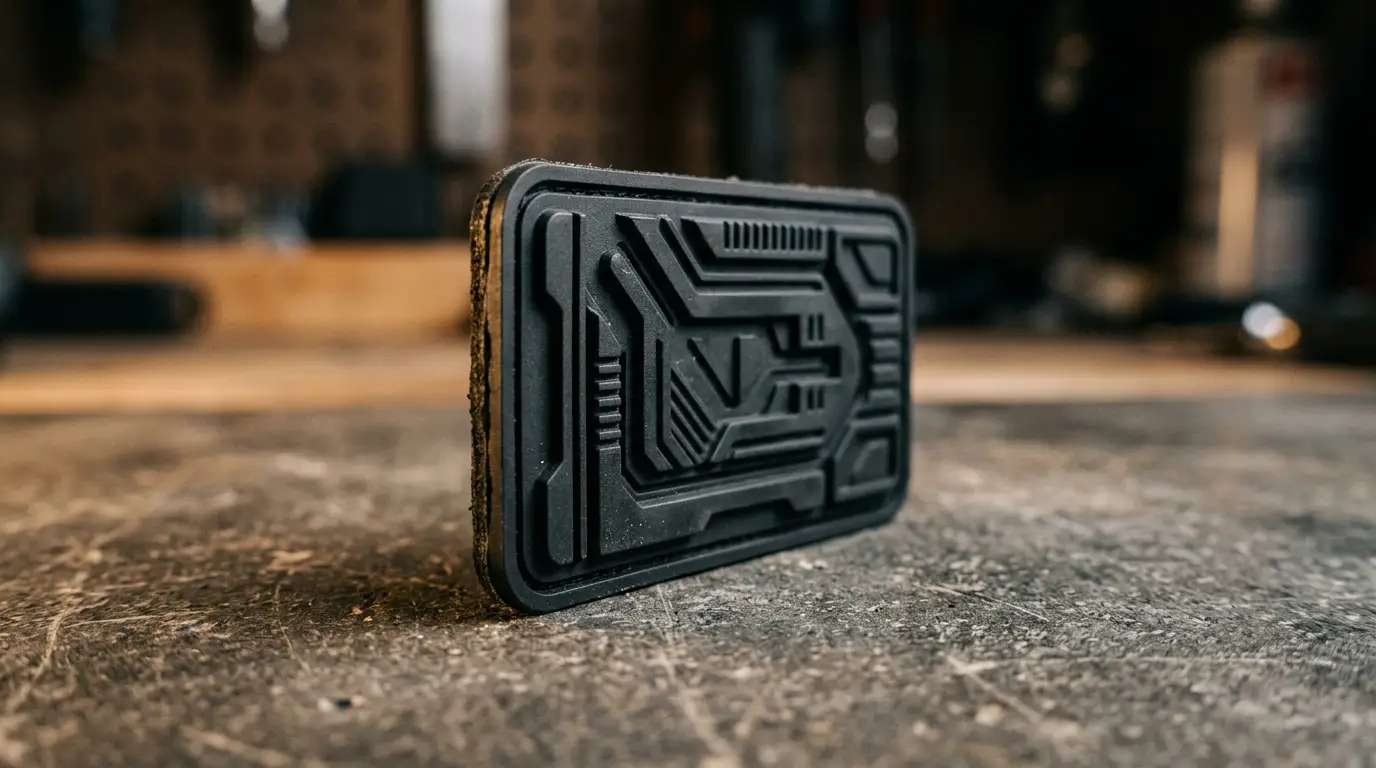
PVC patch thickness is the measurement of a patch through its vertical depth, taken from the flat backing to the top of the moulded relief. Thickness describes the profile of the patch, not its footprint. Size describes the footprint — the width and height across the face — and a PVC patch measures between 25mm and 200mm, quoted as the average of width and height. Thickness and size are separate attributes. A small patch and a large patch share the same thickness, because thickness follows the relief type rather than the outline of the design. For footprint sizing, see how patch size is measured.
PVC patch thickness runs through a narrow, predictable range. The material sets the floor and the relief sets the ceiling. Every figure on this page refers to the moulded rubber itself, measured before any backing panel is added.
Standard values
Standard PVC Patch Thickness Values
PVC patches are produced at two standard thicknesses. A 2D patch measures 2.5mm, and a 3D patch measures 3.5mm. Relief type decides which figure applies, because a deeper relief needs a deeper mould and more material.
| Attribute | 2D PVC Patch | 3D PVC Patch |
|---|---|---|
| Average thickness | 2.5mm | 3.5mm |
| Surface | Flat-topped layers | Rounded, sculpted relief |
| Mould depth | Shallow | Deep, multi-level |
| Minimum text height | 5mm | 6mm |
| Reads best at | Close range | Distance |
2D · 2.5mm
2D PVC Patch Thickness (2.5mm)
A 2D PVC patch measures 2.5mm thick. 2D construction stacks flat layers on a single plane, so every raised surface finishes flat on top. The shallow profile suits text, flat logos, geometric shapes and line artwork, and it holds the minimum text height at 5mm. Flat-topped 2D PVC patches carry the lowest profile in the range, which keeps small lettering legible down to the minimum height.
3D · 3.5mm
3D PVC Patch Thickness (3.5mm)
A 3D PVC patch measures 3.5mm thick. 3D construction pours the rubber against a sculpted mould that contours the surface into rounded relief, so elements rise to different heights and taper at the edges. The added millimetre of depth carries dimensional detail and lifts the minimum text height to 6mm. Sculpted 3D PVC patches read clearly from a distance, because the raised relief catches light at several angles.
Three factors
What Determines PVC Patch Thickness
Three factors determine the thickness of a PVC patch: relief type, mould depth and artwork detail.
Factor 01
Relief Type
Relief type sets the base thickness. 2D relief produces a 2.5mm patch, and 3D relief produces a 3.5mm patch. The choice between the two depends on the artwork rather than the size, because flat artwork gains nothing from a deeper mould.
Factor 02
Mould Depth
Mould depth follows the relief. A 2D design is engraved into a shallow cavity, and a 3D design is engraved into a deeper, multi-level cavity. One mould serves the whole production run and every reorder, so the thickness stays identical batch to batch. See how mould depth is engraved for the tooling detail.
Factor 03
Size and Artwork Detail
Artwork detail can raise thickness above the standard figures. Deep 3D relief on larger designs and oversized back patches can exceed 3.5mm where the sculpt calls for extra height. Fine, shallow artwork stays at the standard value, because the relief never needs the depth.
Performance
How Thickness Affects a PVC Patch
Thickness affects three properties of a finished patch: flexibility, detail and durability. Each property moves in a different direction, so a thicker patch is not automatically a better patch.
Property 01
Flexibility
Flexibility holds across the whole thickness range. Plasticised PVC bends with the garment at 2.5mm and at 3.5mm, and it returns to shape without cracking. A 3D patch is fractionally stiffer than a 2D patch, yet neither profile feels rigid in the hand. Hardness and flex are set by the compound, not the depth, and soft PVC and hard PVC behave differently even at the same thickness.
Property 02
Detail and Depth
Detail improves with thickness. A 3D patch holds faces, animals and sculpted crests that a flat profile cannot render. A 2D patch stays low and clean, which is the better finish for text and geometric logos. Lower profile is a strength here, not a limitation, because a flat surface keeps fine artwork sharp.
Property 03
Durability and Lifespan
Durability does not depend on thickness. A PVC patch lasts because the material is solid and the die-cut edge is sealed, not because it is thick. Pigment runs through the full depth of the PVC patch material, so the patch resists fading, peeling and fraying at 2.5mm just as it does at 3.5mm. Thickness changes the look, and the material sets how long a PVC patch lasts.
Measurement
How PVC Patch Thickness Is Measured
PVC patch thickness is measured through the vertical depth of the moulded rubber. A calliper closes on the patch from the backing to the highest point of the relief, and the reading returns the thickness in millimetres. Production holds a small tolerance around the standard figures, because moulded rubber settles slightly as it cures. The measurement covers the patch alone and excludes the garment beneath it, so a patch stitched to a thick jacket remains a 2.5mm or 3.5mm patch.
Comparison
PVC Patch Thickness vs Other Patch Types
PVC patches sit thicker than embroidered and woven patches. A PVC patch measures 2.5mm to 3.5mm, an embroidered patch measures 1.5mm to 2mm, and a woven patch measures around 1mm. The raised profile is what gives a rubber patch its dimensional, tactile face.
| Patch type | Typical thickness | Profile |
|---|---|---|
| PVC | 2.5–3.5mm | Raised, dimensional |
| Embroidered | 1.5–2mm | Lower, thread texture |
| Woven | ~1mm | Slimmest, flattest |
Woven and embroidered patches win on profile. A woven patch is the slimmest and flattest of the three, which suits fine labels and lightweight garments where a raised badge would feel bulky. An embroidered patch carries thread texture at a lower height than PVC. PVC leads wherever depth, weather resistance and moulded detail matter more than a flat finish, and the full trade-off is set out on PVC compared with embroidered patches and PVC compared with woven patches.
In their words
Stories About Us and Our Customers
PVC patches end up on kit that works for a living. These are the orders behind them, the brief, the mould, and what the patch had to survive.
Tactical · Hook-and-loop
“The patches arrived clean, sharp and ready to go straight onto our kit bags.”
The hook-and-loop backing made it easy for the team to swap patches between packs, jackets and plate carriers without losing the raised detail in the badge.
Sarah Mitchell · Manchester
Workwear · Sew-on
“The PVC badges made our workwear look much more professional than printed logos.”
The sew-on finish gave the uniforms a permanent patch that could handle daily wear, wet weather and repeated cleaning.
James Carter · Birmingham
Streetwear · 3D relief
“The 3D finish gave our caps the premium detail we wanted.”
The raised rubber face helped the logo stand out on the front panel while keeping the colours consistent across the run.
Amelia Thompson · London
Outdoor · Waterproof
“The patches held up well on wet kit and still looked fresh after a muddy weekend.”
Waterproof PVC was chosen for bags and jackets where stitched thread would have absorbed moisture and frayed at the edge.
Oliver Hughes · Bristol
Club · Custom shape
“Our badge shape was unusual, but the final patch followed it neatly.”
The custom die-cut outline kept the club crest recognisable while the moulded edge avoided the bulky border of an embroidered patch.
Priya Shah · Leeds
Tactical · Hook-and-loop
“The patches arrived clean, sharp and ready to go straight onto our kit bags.”
The hook-and-loop backing made it easy for the team to swap patches between packs, jackets and plate carriers without losing the raised detail in the badge.
Sarah Mitchell · Manchester
Workwear · Sew-on
“The PVC badges made our workwear look much more professional than printed logos.”
The sew-on finish gave the uniforms a permanent patch that could handle daily wear, wet weather and repeated cleaning.
James Carter · Birmingham
Streetwear · 3D relief
“The 3D finish gave our caps the premium detail we wanted.”
The raised rubber face helped the logo stand out on the front panel while keeping the colours consistent across the run.
Amelia Thompson · London
Outdoor · Waterproof
“The patches held up well on wet kit and still looked fresh after a muddy weekend.”
Waterproof PVC was chosen for bags and jackets where stitched thread would have absorbed moisture and frayed at the edge.
Oliver Hughes · Bristol
Club · Custom shape
“Our badge shape was unusual, but the final patch followed it neatly.”
The custom die-cut outline kept the club crest recognisable while the moulded edge avoided the bulky border of an embroidered patch.
Priya Shah · Leeds
Answers
PVC Patch Thickness — Frequently Asked Questions
How thick is a PVC patch?2.5–3.5MM
A PVC patch is 2.5mm thick in 2D relief and 3.5mm thick in 3D relief. Relief type decides which figure applies to a given design.
Are 3D PVC patches thicker than 2D PVC patches?YES
Yes. 3D patches measure 3.5mm and 2D patches measure 2.5mm. The extra depth carries the sculpted, rounded relief that flat 2D construction cannot hold.
Can PVC patches be made thicker than 3.5mm?YES
Yes. Deep 3D relief on larger and oversized back patches can exceed 3.5mm where the sculpt requires the added height.
Does a thicker PVC patch last longer?NO
No. Lifespan comes from the solid PVC material and the sealed die-cut edge, not from added thickness. A 2.5mm patch and a 3.5mm patch share the same durability.
Is a thicker PVC patch stiff or hard to bend?NO
No. Plasticised PVC stays flexible at 2.5mm and at 3.5mm, and it returns to shape without cracking after bending.
Choosing the profile
Choosing the Right PVC Patch Thickness
The right thickness follows the artwork and the viewing distance, not the instinct that thicker means better. Flat logos, lettering and line work belong on a 2.5mm 2D patch, where a low profile keeps the design crisp and legible. Sculpted emblems, faces and crests belong on a 3.5mm 3D patch, where the extra depth models the detail and carries across a room. Flexibility and lifespan stay strong across both profiles, because the plasticised rubber and the sealed edge do that work regardless of depth. Match the profile to the job, and the patch performs whether it measures 2.5mm or 3.5mm.