Permanent backing · UK uniforms & workwear
Sew-On PVC Patches — Permanent Stitched Backing for UK Uniforms and Workwear
Sew-on PVC patches are moulded rubber badges finished with a stitch channel around the border, which produces the strongest and most permanent attachment of any PVC backing. Sew-on backing suits fabric because PVC patches cannot be ironed on, and a stitched bond replaces heat as the permanent method. UK workwear firms, cadet detachments and sports clubs specify sew-on backing when a custom badge has to survive the working life of the garment.

Featured Client

Definition
What Are Sew-On PVC Patches?
Sew-on PVC patches are custom rubber patches supplied with a stitch channel or pre-punched holes around the perimeter, so a needle passes through the border without splitting the rubber. The moulded face stays identical to any other PVC patch; sew-on describes the backing and the attachment method, not the material. Sew-on backing sits at the strong end of the range, and it forms a permanent bond that a wearer does not remove between uses.
Sew-on backing is applied after the patch cures, so the choice never affects the moulded relief on the front. The polyvinyl chloride is still poured, coloured and cured first; the border is then prepared for stitching. This sequence keeps the raised detail sharp while adding a sewable edge that a tailor can work by machine or by hand.
See all backing options for PVC patches, or return to our PVC patches homepage.

Attachment mechanics
How Sew-On Backing Works on PVC Patches
Sew-on backing works through a border that a needle can penetrate cleanly. Solid PVC resists a needle, so the patch carries a thinner sewing edge rather than a full-thickness rim.
The Stitch Channel and Pre-Punched Border
The stitch channel is a recessed lip moulded around the outline of the patch. The channel thins the rubber at the very edge, and the needle drives through that thinned band instead of the solid centre. Some designs use pre-punched holes at set intervals instead, which guide the stitches and space them evenly. Both methods keep the thread on the border and away from the moulded artwork.
Machine Sewing and Hand Sewing
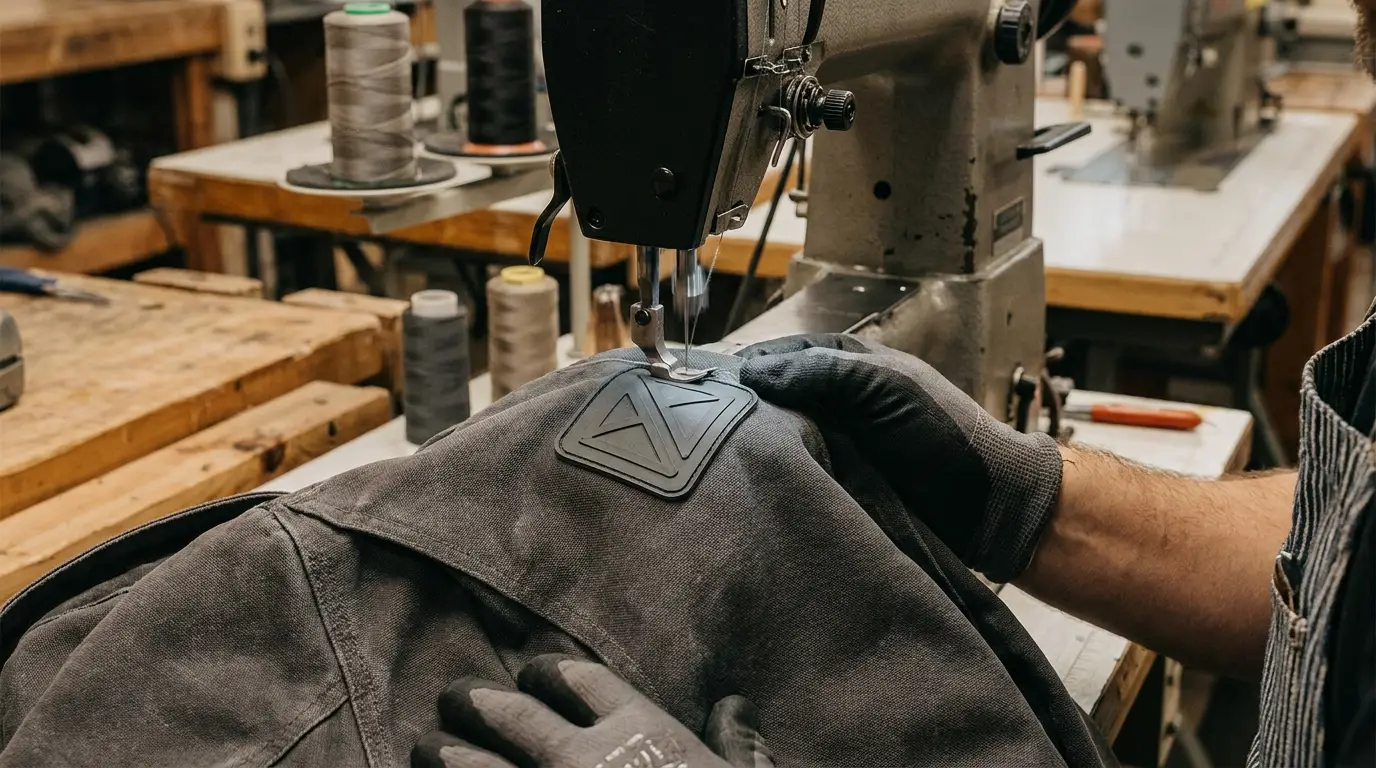
Tailors attach sew-on PVC patches by machine or by hand. Machine sewing is standard for fleet workwear, because an industrial sewing machine runs a consistent seam around every garment in a batch. Hand sewing suits single items and awkward positions, such as a curved cap panel or a jacket back. The stitched bond survives industrial laundering, which is the point of failure for printed transfers and adhesive films.

Five measurable advantages
Why Choose Sew-On Backing for PVC Patches
Sew-on backing delivers the most durable attachment of the four PVC options, and it earns its place through five measurable advantages:
- Strongest bond — stitched thread holds the patch through daily wear, tension and abrasion that lift adhesive over time.
- Permanent — sew-on backing fixes the badge to the garment, unlike hook-and-loop backing that stays removable.
- Laundry-proof — the seam withstands repeated washing at 40°C, including the industrial cycles used on uniforms.
- No heat required — sewing protects the moulded relief, because PVC softens above 120°C and heat deforms the design.
- Regulation-ready — a permanent, tamper-resistant badge meets uniform and cadet standards where a removable patch would not.
Unlike iron-on backing, sew-on backing needs no heat at all. PVC softens above 120°C, and a domestic iron reaches 180°C on a cotton setting, so ironing destroys the relief. Sew-on backing therefore replaces iron-on as the permanent method for attaching a PVC patch to fabric. Durability at the seam translates into cost per wear, which is why safety-critical and uniformed sectors adopt stitched patches first.
Backing comparison
Sew-On vs Other PVC Patch Backings
Sew-on backing differs from hook-and-loop, adhesive and plain backing in permanence, removability and best surface. The table sets the four options side by side so the right backing matches the job.
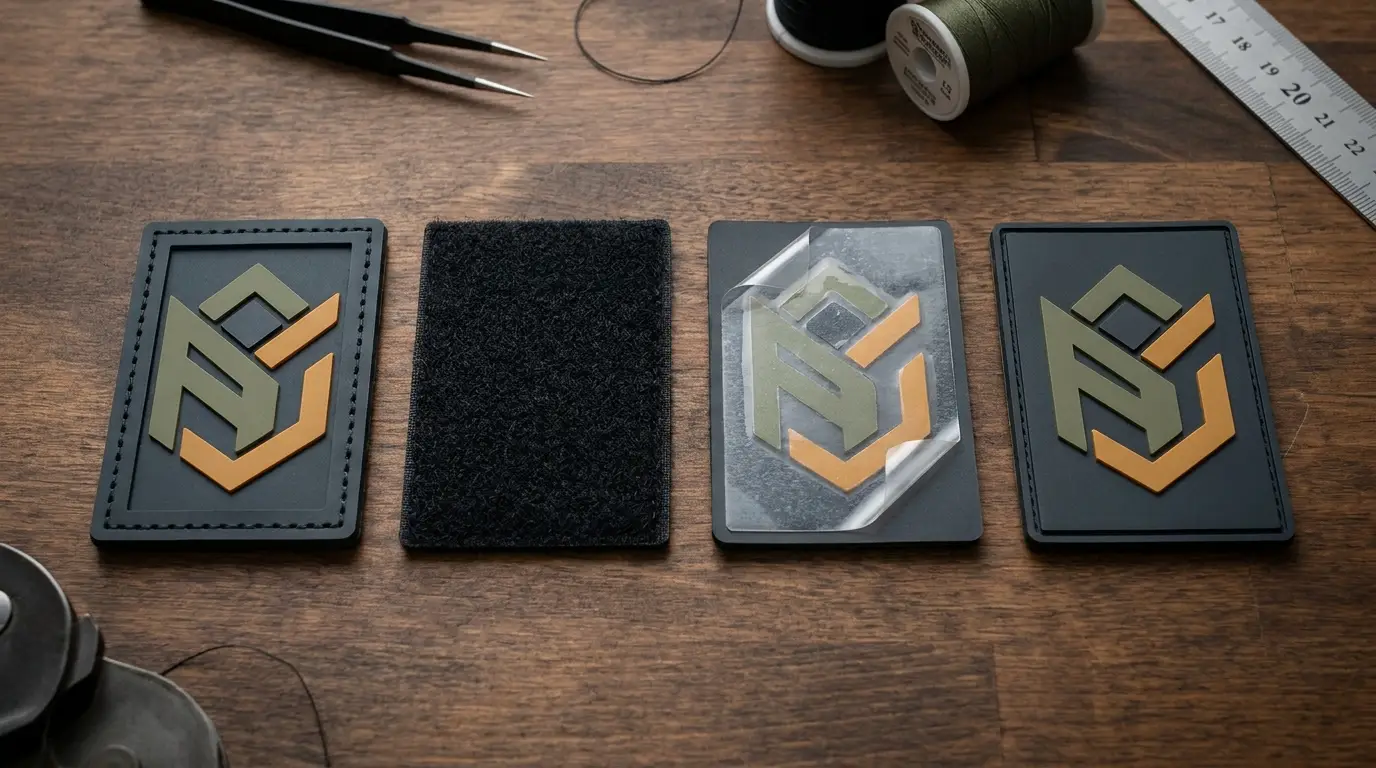
| Backing | Attachment | Removable | Best surface | Permanence |
|---|---|---|---|---|
| Sew-on | Thread through a stitch channel | No | Workwear, jackets, uniforms | Permanent |
| Hook-and-loop (velcro) | Velcro field | Yes | Tactical gear, changeable roles | Repositionable |
| 3M adhesive | Peel-and-stick film | Once | Helmets, cases, hard surfaces | Semi-permanent |
| Plain | None supplied | – | Heat-press, moulded-in, loose stock | Depends on method |
Iron-on backing does not appear in this table, because PVC patches are never supplied iron-on. Sew-on backing is the correct choice wherever a printed transfer or adhesive would peel, and it holds the badge in place for the full life of the garment. Hook-and-loop backing suits the opposite need, where a wearer swaps emblems between packs and jackets rather than fixing one in place.
For smooth rigid surfaces, compare 3M adhesive backing.
Applications
Where Sew-On PVC Patches Are Used
Sew-on PVC patches appear wherever a badge has to stay put and survive washing. Application drives the specification, because the environment sets the size, the placement and the seam.
Workwear and Corporate Uniforms
Facilities firms, engineering contractors and hospitality groups sew PVC patches onto polo shirts, softshells and hi-vis jackets. Sew-on backing withstands the industrial laundry cycles that strip printed logos within weeks. Pantone matching holds the brand colour across every garment in a fleet, which keeps identity consistent on site.
Military and Cadet Uniforms
British forces personnel and cadet detachments fit sew-on PVC patches to smocks, shirts and rank slides where regulation demands a permanent, tamper-resistant badge. A stitched insignia meets that standard, and BFPO delivery reaches serving personnel at posted addresses.
Military and cadet patches covers the wider specification.
Sports Clubs and Club Colours
Rugby clubs, sailing teams and cycling collectives stitch PVC crests onto kit bags, training tops and club jackets. A sewn badge keeps the crest fixed through match-day wear and repeated washing, and the moulded rubber resists the rain and grime that fray a stitched thread border.
Four-step attachment
How to Sew On a PVC Patch
Sewing a PVC patch onto a garment follows four steps, and each step keeps the thread on the border and off the artwork.
- Position the patch. Place the patch on the garment and pin or tack it so it cannot shift while you stitch.
- Thread the needle. Load a machine needle or a hand needle with thread that matches the border colour.
- Stitch the perimeter. Sew through the stitch channel around the full outline, keeping an even seam close to the edge.
- Lock the seam. Backstitch at the finish to secure the thread, then trim the loose ends flush.
A sewing machine produces the cleanest, most repeatable seam for batches. A hand-sewn seam works well for a single garment or a position a machine cannot reach.
For the wider attachment decision, see how to attach a PVC patch.
Artwork to delivery
Ordering Sew-On PVC Patches in the UK
Sew-on PVC patches are made to your artwork with no minimum order, so you order the exact quantity you need. Patches are produced between 25mm and 200mm across the longest edge, in 2D relief at 2.5mm or 3D relief at 3.5mm, with colour Pantone-matched through the full depth of the material. Sew-on backing is added after curing, and it carries no separate tooling cost.
Standard production takes 10 to 14 working days from proof approval, and express production takes 5 to 7 working days from proof approval. UK mainland delivery adds 1 to 2 working days, and BFPO delivery is available for serving personnel. Prices are quoted in pounds sterling and exclude VAT at 20%. Send your design for a quotation and approve a digital proof before any mould is cut.
In their words
Stories About Us and Our Customers
PVC patches end up on kit that works for a living. These are the orders behind them, the brief, the mould, and what the patch had to survive.
Tactical · Hook-and-loop
“The patches arrived clean, sharp and ready to go straight onto our kit bags.”
The hook-and-loop backing made it easy for the team to swap patches between packs, jackets and plate carriers without losing the raised detail in the badge.
Sarah Mitchell · Manchester
Workwear · Sew-on
“The PVC badges made our workwear look much more professional than printed logos.”
The sew-on finish gave the uniforms a permanent patch that could handle daily wear, wet weather and repeated cleaning.
James Carter · Birmingham
Streetwear · 3D relief
“The 3D finish gave our caps the premium detail we wanted.”
The raised rubber face helped the logo stand out on the front panel while keeping the colours consistent across the run.
Amelia Thompson · London
Outdoor · Waterproof
“The patches held up well on wet kit and still looked fresh after a muddy weekend.”
Waterproof PVC was chosen for bags and jackets where stitched thread would have absorbed moisture and frayed at the edge.
Oliver Hughes · Bristol
Club · Custom shape
“Our badge shape was unusual, but the final patch followed it neatly.”
The custom die-cut outline kept the club crest recognisable while the moulded edge avoided the bulky border of an embroidered patch.
Priya Shah · Leeds
Security · Velcro
“Being able to remove and replace patches between shifts has been really useful.”
The hook-and-loop backing keeps identifiers flexible across rotating uniforms while the PVC face stays easy to wipe clean.
Daniel Brooks · Glasgow
Questions answered
Sew-On PVC Patches — Frequently Asked Questions
Can PVC patches be sewn on?
Yes. A moulded stitch channel or pre-punched holes around the border let a needle pass through without splitting the rubber, so any PVC patch can be supplied sew-on.
Are sew-on PVC patches permanent?
Yes. Sew-on backing is the strongest of the four backings and fixes the badge to the garment, so it is not designed to be removed between uses.
Can sew-on PVC patches be machine washed?
Yes. The stitched seam survives repeated laundering at 40°C, including the industrial cycles used on workwear and uniforms.
Can you iron on a PVC patch instead of sewing it?
No. PVC softens above 120°C, so heat deforms the relief. Sew-on backing replaces iron-on for a permanent bond on fabric.
Is there a minimum order for sew-on PVC patches?
No. There is no minimum order quantity, so you can order a small batch or a full production run.
Permanent fabric attachment
Why Sew-On Backing Suits PVC Patches
Sew-on backing answers a limitation built into the material itself. A PVC patch cannot take an iron, yet many garments still need a badge that never comes off, and a stitched seam solves both at once. The moulded rubber survives rain, sunlight and washing; the thread holds it to the fabric through the same conditions. For workwear, cadet uniforms and club kit across the UK, that pairing of a weatherproof face and a permanent seam is why sew-on remains the standard PVC backing.